















KLM Fokker F VIII Sevenoaks Crash 22 August 1927
The KLM Fokker F.VIII Sevenoaks Crash was a serious aviation accident that happened on 22 August 1927 near Sevenoaks in Kent, England. A Fokker F.VIII operated by KLM Royal Dutch Airlines crashed only about ten minutes after leaving Croydon Airport. The aircraft was flying to the Netherlands with nine passengers and two crew members on board. The accident was caused by a failure of the aircraft’s tail structure, which made the airplane extremely difficult to control. One crew member died, while the other people on board survived, although several were injured.
The crash became an important event in the early history of commercial aviation. During the 1920s, passenger aircraft were becoming larger and airlines were beginning to operate regular international services. However, aircraft design, maintenance methods, and safety standards were still developing. The Sevenoaks accident showed how a small structural failure could quickly become a life-threatening emergency.
The KLM Fokker F.VIII
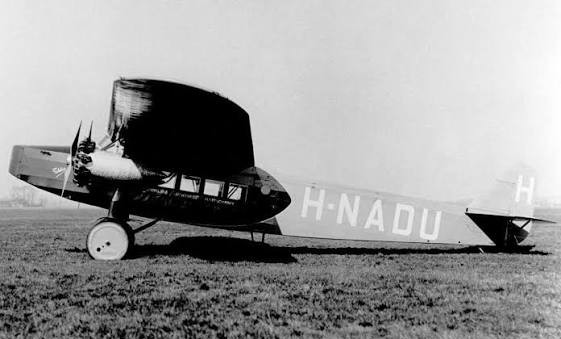
The aircraft involved in the accident was a Fokker F.VIII, with the registration H-NADU and construction number 4993. It had been built in 1926 and entered KLM service on 24 June 1927, only about two months before the accident. The aircraft was therefore relatively new when it crashed.
The Fokker F.VIII was a twin-engine passenger aircraft designed by the Dutch aircraft manufacturer Fokker. It was developed during a period when airlines were looking for aircraft that could carry more passengers and provide better performance on regular routes.
The aircraft involved in the Sevenoaks accident was powered by two Gnôme-Rhône Jupiter engines. It was being used by KLM for international passenger operations between Britain and the Netherlands.
KLM was already an important airline in European aviation at this time. Regular air services connected the Netherlands with other European countries, and London was one of the important destinations.
The Flight from Croydon
On the morning of 22 August 1927, Fokker F.VIII H-NADU prepared for a scheduled international flight from Croydon Airport in southern London toward the Netherlands. Contemporary and historical records identify the destination as Waalhaven Airport at Rotterdam, although some accident databases describe the schedule as Croydon–Amsterdam.
There were 11 people on board:
- 9 passengers
- 1 pilot
- 1 mechanic or flight engineer
The aircraft also carried mail and freight. One historical account records approximately 13 kilograms of mail and 144 kilograms of freight.
The aircraft left Croydon at about 8:07 in the morning. At first, there was nothing unusual about the flight. The aircraft climbed away from the airport and began its journey across southern England.
The passengers probably expected an ordinary international flight. At that time, air travel was still relatively new, and many passengers considered flying an exciting but somewhat risky form of transportation.
The Sudden Problem
Only about ten minutes after takeoff, the situation changed dramatically.
The pilot noticed serious vibrations in the aircraft. The airplane then made a sudden and sharp movement toward the right. The problem was connected to the aircraft’s tail. A tensioning wire associated with the tail structure broke, and the failure resulted in the separation of the rudder and vertical tailfin.
The vertical tailfin and rudder were extremely important for controlling the airplane’s direction. Without them, the pilot lost much of the aircraft’s normal directional control.
The aircraft began to descend in a wide right-hand turn. Historical descriptions explain that the pilot tried to control the aircraft by adjusting the horizontal stabilizer. However, these efforts could not fully restore control. This was an extremely difficult situation because the failure happened while the aircraft was already in the air. The pilot had very little time to find a suitable place to land.
The Pilot’s Fight to Save the Aircraft
The pilot faced a serious emergency. The aircraft was losing height and turning. If the airplane entered a steep dive or spin, there would have been almost no chance of survival.
Instead of simply allowing the aircraft to fall, the pilot tried to reduce its speed and make the descent less dangerous. Historical accounts state that the engines were eventually shut down and the aircraft’s attitude was adjusted in an attempt to reduce the steepness of the descent.
The pilot’s actions helped prevent an even more severe impact.
The aircraft could not make a normal landing because the pilot had lost important control functions. The only realistic option was to bring the aircraft down as safely as possible in the available area.
The Crash at Sevenoaks
The Fokker eventually reached the area around Sevenoaks in Kent. The aircraft came down in the grounds of a large private property known as St. Julian’s at Underriver. Instead of hitting the ground at a very steep angle, the aircraft struck the crowns of trees. The trees absorbed some of the impact and helped reduce the violence of the crash.
The aircraft was badly damaged and was ultimately considered beyond repair. Historical records describe the airplane as being destroyed in the accident.
Although the crash was serious, the outcome could have been much worse. There were eleven people aboard the aircraft, and most survived.
One Crew Member Was Killed
Sadly, the aircraft’s mechanic or flight engineer, J. Brunklaus, was killed in the crash. Sources identify him as J. L. A. M. Brunklaus, aged 25. He was fatally injured when part of the aircraft, including an engine, crushed him during the impact.
The pilot survived. Passengers also survived, although several people suffered injuries.
Different historical databases give slightly different descriptions of the number of injured survivors. One commonly cited summary records one death, eight injuries, and ten survivors. Other contemporary accounts describe injuries among the passengers and crew. The important point is that the majority of those aboard survived an accident that could easily have resulted in many more deaths.
Investigation into the Accident
After the crash, investigators examined the aircraft and the wreckage. The most important discovery was related to the aircraft’s tail.
The tailfin and rudder had separated during flight. Records indicate that the failure involved a tensioning wire. The tail components were found at a significant distance from the main wreckage, showing that they had separated before the aircraft reached the ground.
This evidence helped investigators understand why the pilot had suddenly lost control.
The accident was therefore not simply a case of pilot error. The central problem was a structural failure of an important part of the aircraft.
The accident demonstrated the importance of strong aircraft structures and careful inspection of components that could experience repeated loads and vibrations.
Why the Accident Was Important
The Sevenoaks crash happened at a time when commercial aviation was still developing rapidly. Aircraft were becoming faster and more capable, but engineers were still learning how structures behaved during long-term operation.
The Fokker F.VIII was a modern aircraft for its period, but the accident showed that even a relatively new airplane could suffer a dangerous structural problem.
The crash also demonstrated the importance of the pilot’s ability to manage an aircraft after a major mechanical failure. The pilot could not restore normal control, but his efforts to reduce the aircraft’s descent and avoid a direct dive helped improve the chances of survival.
The accident became part of the wider history of early KLM operations. The Fokker F.VIII involved in the crash had only entered KLM service in June 1927 and was written off after the accident on 22 August 1927.
The Fokker F.VIII After the Accident
The Sevenoaks accident did not end the story of the Fokker F.VIII type. KLM continued to operate other F.VIII aircraft. The type remained part of the development of European passenger aviation.
However, KLM would later lose another F.VIII in an accident in 1928. Other examples of the aircraft continued operating with different organizations and airlines for years.
The Sevenoaks crash remains particularly notable because it involved a structural failure of the tail shortly after takeoff and because most people aboard survived despite the loss of control.
Conclusion
The 22 August 1927 KLM Fokker F.VIII Sevenoaks Crash was one of the most important accidents of early European commercial aviation. The aircraft, H-NADU, had left Croydon Airport on an international flight to the Netherlands with nine passengers and two crew members. Only about ten minutes into the flight, a failure in the tail structure caused the rudder and vertical tailfin to separate.
The loss of the tailfin made the aircraft extremely difficult to control. The pilot fought to keep the aircraft from entering a dangerous dive and eventually brought it down into trees near Underriver, Sevenoaks.
The aircraft was destroyed, and one crew member lost his life, but the other ten people survived. The accident highlighted the dangers faced by early commercial aviation and the importance of structural strength, inspection, and aircraft control.
Today, the Sevenoaks crash is remembered as an example of how aviation safety developed through experience. Every accident provided engineers, airlines, and pilots with information that could help make future aircraft safer. The tragedy of H-NADU therefore became part of the long history of lessons that helped commercial aviation move toward the much higher safety standards used today.

Ajeet Yadav is an aviation enthusiast covering airline news, airports, aircraft, and industry developments through well-researched and reliable reporting.