




Thieuloy-Saint-Antoine Mid-Air Collision: The World’s First Airliner Mid-Air Disaster

Thieuloy-Saint-Antoine Mid-Air Collision: The World’s First Airliner Mid-Air Disaster
The Thieuloy-Saint-Antoine Mid-Air Collision remains one of the most significant events in early aviation history. The accident is remembered as the first recorded mid-air collision involving two commercial airliners, highlighting the challenges of civil aviation during its formative years. Occurring over the countryside of northern France, the tragedy claimed the lives of everyone aboard both aircraft and exposed the need for improved air traffic management, communication procedures, and flight safety regulations.
Although commercial aviation was still in its infancy, the disaster became a turning point that demonstrated the growing complexity of air travel as more aircraft began sharing the skies.
Background
The early 1920s marked a period of rapid expansion in commercial aviation across Europe. Following the end of World War I, military aircraft technology was increasingly adapted for civilian use. Airlines began connecting major cities with scheduled passenger services, offering a faster alternative to rail and sea transportation.
However, aviation infrastructure remained limited. There were no radar systems, no centralized air traffic control, and very few standardized flight procedures. Pilots relied largely on visual navigation, maps, landmarks, and their own judgment to avoid hazards and other aircraft.
As air routes became busier, the possibility of two aircraft occupying the same airspace increased significantly. Unfortunately, the aviation industry had not yet developed effective systems to prevent such encounters.
The Aircraft Involved
The collision involved two commercial aircraft operating regular passenger services:
de Havilland DH.18A
One aircraft was a de Havilland DH.18A, registered G-EAWO, operated by Daimler Hire Ltd. The British-built aircraft was a single-engine passenger airliner designed shortly after World War I. It typically carried a small number of passengers and was widely used on regional routes within Europe.
The DH.18A represented one of Britain’s earliest attempts to establish scheduled commercial airline services.
Farman F.60 Goliath
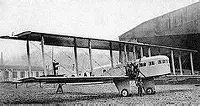
The second aircraft was a Farman F.60 Goliath, registered F-GEAD, operated by Compagnie des Grands Express Aériens (CGEA). Originally designed as a heavy bomber during World War I, the Goliath was later converted into one of Europe’s earliest passenger airliners.
The aircraft was capable of carrying more passengers than many of its contemporaries and became an important part of France’s developing commercial aviation network.
The Collision
While flying over the Thieuloy-Saint-Antoine area in the Picardy region of France, the two aircraft approached each other in the same airspace.
Without radar or radio communication to warn either crew, the pilots had only visual observation to detect conflicting traffic. At some point during the flight, the aircraft collided in mid-air above the Thieuloy-Saint-Antoine road.
The impact was devastating.
Both aircraft were destroyed, and all seven people aboard the two aircraft lost their lives. There were no survivors.
Because the collision occurred at altitude, neither crew had sufficient time or opportunity to regain control or attempt an emergency landing.
Investigation
Aviation accident investigations during the early 1920s were far less detailed than modern investigations. Flight data recorders, cockpit voice recorders, radar recordings, and digital flight tracking systems did not exist.
Investigators relied primarily on:
- Eyewitness accounts
- Examination of wreckage
- Pilot experience
- Aircraft maintenance records
- Weather observations
Although the exact sequence of events could not be reconstructed with complete certainty, investigators concluded that the collision resulted from both aircraft occupying the same airspace without any system to coordinate their movements.
The accident exposed one of the greatest weaknesses of early commercial aviation: there was no organized method for separating aircraft in flight.
Why the Accident Was Historic
The Thieuloy-Saint-Antoine Mid-Air Collision is historically significant because it became the first known mid-air collision between two commercial airliners.
Until then, aviation accidents generally involved engine failures, weather conditions, structural failures, or difficult landings. This tragedy introduced an entirely new category of aviation risk—aircraft colliding with one another while in flight.
The disaster demonstrated that as commercial aviation expanded, preventing aircraft conflicts would become just as important as improving aircraft reliability.
Impact on Aviation Safety
Although large-scale air traffic control systems would not be introduced for many years, accidents like the Thieuloy-Saint-Antoine collision encouraged governments and aviation authorities to begin developing safer operating procedures.
Over the following decades, aviation introduced major improvements, including:
- Standardized air routes.
- Assigned cruising altitudes.
- Improved pilot communication procedures.
- Air traffic control services.
- Radio navigation equipment.
- Radar surveillance.
- International flight regulations.
- Collision avoidance technologies.
Modern commercial aircraft now operate under strict separation standards, with pilots receiving continuous guidance from air traffic controllers and onboard collision avoidance systems that warn crews of nearby aircraft.
The Legacy of the Aircraft
Both aircraft involved represented important milestones in early civil aviation.
The de Havilland DH.18A helped establish Britain’s early airline industry by providing scheduled passenger services between major cities.
The Farman F.60 Goliath became one of Europe’s first successful passenger aircraft and demonstrated that larger commercial airliners were practical for regular operations.
Despite their contributions, both aircraft reflected the technological limitations of their era, when aviation safety relied heavily on pilot judgment rather than advanced technology.
Lessons Learned
The Thieuloy-Saint-Antoine Mid-Air Collision reinforced several critical lessons that continue to influence aviation today:
- Aircraft require organized separation in shared airspace.
- Standardized flight procedures reduce collision risk.
- Reliable communication between aircraft and ground services is essential.
- International cooperation improves aviation safety.
- Continuous technological innovation is necessary as air traffic grows.
These principles have become fundamental components of modern air navigation systems worldwide.
Conclusion
The Thieuloy-Saint-Antoine Mid-Air Collision stands as a landmark event in aviation history. As the world’s first recorded mid-air collision involving two commercial airliners, it revealed the dangers of increasingly crowded skies during the early years of passenger aviation.
The accident claimed the lives of all seven people aboard the two aircraft and underscored the urgent need for better airspace management. Although aviation technology and safety systems have advanced dramatically since then, the lessons learned from this tragedy helped shape many of the procedures and regulations that make modern commercial aviation one of the safest forms of transportation today.

Ajeet Yadav is an aviation enthusiast covering airline news, airports, aircraft, and industry developments through well-researched and reliable reporting.