














- Manual maintenance tracking is no longer a viable option for Indian NSOPs under the DGCA’s 2026 compliance framework.
- Maintenance records are now public documents—incomplete or inconsistent data will cost operators both audits and charter revenue.
- Operators who cannot demonstrate adequate in-house MRO capability must outsource to a DGCA-approved organisation or risk being grounded.
The DGCA‘s regulatory response to two fatal accidents within a single month in early 2026 has fundamentally altered the compliance environment for India’s Non-Scheduled Operator Permit (NSOP) sector.
Business jets, air charters, and air ambulances, operators that had historically faced less stringent oversight than scheduled carriers, are now subject to intensive audits, a mandatory safety ranking system, compulsory public disclosure of maintenance records, and a direct requirement that any operator without adequate in-house MRO capability must engage a DGCA-approved maintenance organisation.
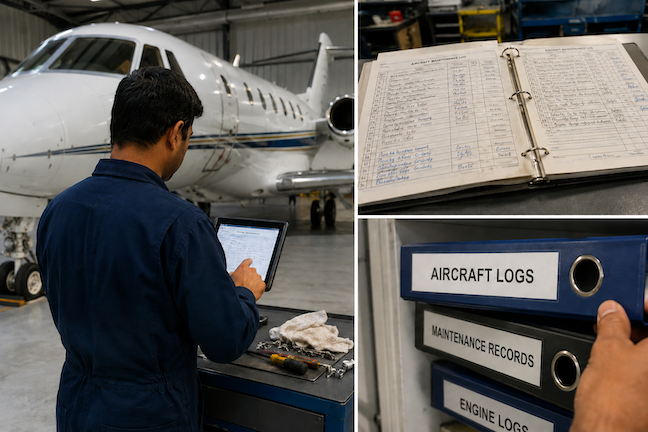
What this means in practice is a direct challenge to the maintenance management methods that many NSOPs still rely on: paper logbooks, spreadsheets, and informal scheduling. The financial case against these tools is measurable.
Accounting for personnel time, compliance exposure, and the effect on aircraft resale value, operators running paper-based or Excel-based systems spend approximately 60 to 85% more than those using digital platforms. The more consequential issue, though, is not expenditure but the ability to demonstrate compliance, not just claim it.
Digital logs carry timestamps that cannot be retroactively altered, whereas paper logbooks do not and cannot withstand a structured cross-verification of entries when an audit team requests one. With 73% of Indian NSOP operators running fleets of just one to three aircraft, a grounding order carries consequences that extend well beyond schedule disruption.
Four Compliance Obligations, One Integrated Platform
The DGCA mandates issued in February 2026 are not one compliance requirement. There are four, each with distinct documentation obligations and audit exposure. A digital MRO management platform addresses all four in an integrated framework.
Operators who build their compliance systems around it will clear DGCA inspections, rank well on the public safety index, and establish a maintenance culture that does not have to be reconstructed each time an audit is scheduled.
1. Technical Log Verification
In a large number of NSOP operations, technical logs are maintained in paper logbooks or across disconnected spreadsheets, with no automatic reconciliation between what was scheduled, what was carried out, and what received a certified sign-off.
The result, when an audit team requests documentation, is a time-consuming retrieval process that may still surface apparent gaps even where the maintenance itself was properly conducted.

A digital MRO system eliminates this problem at the source.
Every maintenance event, from a scheduled A-check to an unplanned component replacement, enters a single timestamped record with a certified sign-off that cannot be modified after the fact.
An operator with this system in place can produce a complete airworthiness trail within minutes of a request, rather than spending hours assembling physical documents.
- Automatic generation of Aircraft Maintenance Logs (AMLs) tied to each flight
- Digital sign-off workflows for certifying engineers, creating non-repudiable records
- Reconciliation of actual flight hours against maintenance intervals without manual calculation
- Exportable audit packs that align with DGCA inspection checklists
2. Continued Airworthiness
The new directives place airworthiness management under direct scrutiny, specifically covering component-level life tracking, Airworthiness Directive (AD) compliance monitoring, and proactive management of life-limited parts (LLPs).
For an aircraft flying multiple missions across India within a single week, keeping accurate component hour records through manual processes is neither reliable nor sustainable.
An aviation MRO management system maintains a live airworthiness dashboard against each tail number in the fleet, with continuous tracking of every component’s installed hours, cycles, and calendar days relative to applicable limits. Threshold alerts are generated well before a limit is reached, giving operators time to act rather than discovering an exceedance after the aircraft has already flown.
- Real-time airworthiness dashboard per tail number with component-level tracking
- Automated SB/AD compliance monitoring against OEM and DGCA, EASA, and FAA directives
- Proactive LLP management with threshold alerts ahead of calendar or cycle limits
- Tracking of repeat defects and resolutions
3. Public Disclosure of Maintenance Records
Of the February 2026 mandates, the public disclosure requirement carries the broadest commercial consequences. NSOP operators are now obligated to publish aircraft age, maintenance history, and pilot experience data on their websites. The DGCA has indicated it will produce a safety ranking of all operators based on this compliance data.
Maintenance records, previously managed as internal documents, are now subject to public scrutiny, and an operator’s position on the regulator’s ranking will be visible to any charter client before a booking decision is made. Operators with incomplete or inconsistent records face not only audit failure but a visible ranking disadvantage with direct revenue implications
When maintenance data is managed through a digital system, the following disclosure-relevant records remain current and accessible at all times:
- Aircraft age and total airframe hours: always current, always accessible
- Maintenance programme status: what was done, when, and by whom with AME licence details
- Outstanding defects and deferred maintenance items with approved deferral basis (MEL/CDL)
- Direct read-only regulatory access for ad hoc audits
4. MRO Capability and Outsourcing Compliance
Operators with in-house MRO facilities will be assessed against DGCA’s adequacy standard, which requires documented maintenance programmes, systematic maintenance processes, a functioning quality management system, calibrated tooling records, and verifiable adherence to SOPs and the Maintenance Organisation Exposition. Those who do not meet the standard will be required to outsource to a DGCA-approved maintenance organisation.
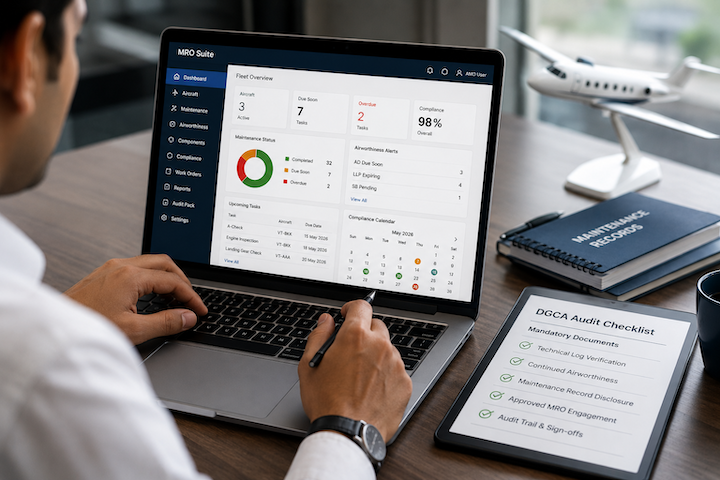
Operators with in-house MRO facilities will be assessed against DGCA’s adequacy standard, which requires documented maintenance programmes, systematic maintenance processes, a functioning quality management system, calibrated tooling records, and verifiable evidence of adherence to SOPs/MOE (Maintenance Organisation Exposition).
Those who do not meet the standard will be required to outsource to a DGCA-approved maintenance organisation. When maintenance is outsourced, the operator’s digital system takes on a governance function, ensuring that work orders are raised with a defined scope, assigned to the approved vendor, and tracked through to completion within the operator’s own records.
In either case, the following capabilities give the accountable manager the visibility needed to exercise oversight meaningfully:
- Digital work order trail with AME sign-off and regulatory reference with dirty fingerprints, the difference between “adequate” and “non-compliant” in DGCA’s assessment framework
- Certificates of Release to Service (CRS) stored against work orders for complete traceability
- Quality management system documentation and calibrated tooling records accessible on demand
- Real-time visibility for the accountable manager across in-house and outsourced maintenance activity
For NSOPs operating in India, the four requirements now in force, namely audit-ready technical records, continued airworthiness of ageing fleets, public maintenance disclosures, and demonstrable MRO adequacy, map directly onto what a modern digital maintenance management system is designed to deliver.
For Indian business aviation operators today, investing in a capable digital maintenance platform is not discretionary overhead. It is the operational and regulatory foundation on which continued flying depends.
* Saravanan Rajarajan is Associate Vice President – India and South Asia Business at Ramco Systems, with over 16 years of experience in aviation MRO software, ERP implementations and aviation technology consulting across global markets.
Also Read: Aircraft Management in India: The Opportunity Is Real, the Readiness Is Not