










Air traffic controller training continues to face challenges around early knowledge integration, instructor capacity, and the time required to progress from ab initio training to licensing. This interview explores how immersive, low-footprint 3D tools can complement traditional classroom instruction, high-fidelity simulators, and on-the-job training by strengthening mental model formation, supporting competency-based training and assessment, and improving the effectiveness of briefing and debriefing. These issues are discussed with Sandra Rouphael, Director of Business Performance & ATS Training Operations—Civil Aviation at CAE, in the context of how CAE Ridge fits within modern ATS training frameworks.
Could you briefly explain what CAE Ridge is and what problem it solves in air traffic controller training?
CAE Ridge™ is an advanced 3D tabletop tool originally proven within our Defense & Security business unit. While advanced three-dimensional visualisation and mission-simulation technologies are well established in pilot and mission-crew training, similar tools have historically been limited for air traffic controllers.
CAE Ridge™ is not a full simulator and is not intended to replace one. It is used as an interactive learning tool for instructors and students, for briefing and debriefing simulation sessions, reviewing specific challenges in On-Job-Training (OJT) and presenting 3D data to students in a natural, easy to understand way.
Instead of relying on traditional side or top views, CAE Ridge presents the environment in a fully immersive 3D map. Airspace blocks are shown transparently, allowing users to easily understand their structure and relationships. The view can be rotated, panned, and zoomed, and CAE Ridge™ also adds a unique dimension: the map and airspace remain fixed in space, letting the user walk around the environment to change perspective. Powered by CAE’s extensive global airport database, the 3D environment is fully adaptable and can be modelled to accurately represent any location.
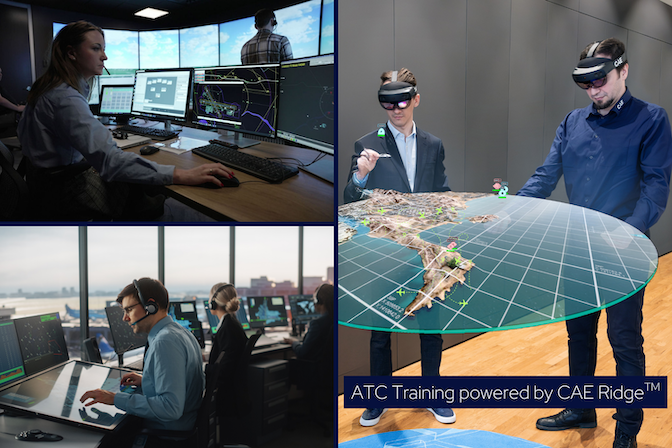
Integration of knowledge in the early stages of air traffic control training is key to establishing a stable learning progression toward licensing. ANSPs have expressed that, in cases where students struggle, they often find out, and sometimes too late, that the understanding of foundational concepts was not fully acquired.
CAE Ridge™ supports instructors and students during the on-the-job training phase by offering the ability to review specific situations and work through challenges in a safe and engaging environment.

CAE Ridge™ closes an existing gap in ATC training by transforming traditional tabletop or basic computer‑based instruction into interactive 3D environments suited for today’s learners.
This enables instructors, new trainees, and experienced controllers to visualise operations, explore scenarios, and rehearse procedures collaboratively and remotely with multiple students sharing the same situation simultaneously online.
At a time when the air navigation services industry is focused on improving success rates in ATC training and reducing time from start of training to licensing, CAE Ridge’s™ objectives are to accelerate integration of knowledge, boost confidence, increase operational readiness and enhance operational decision‑making.
Initial use cases were around learning airport layouts, practicing standard phraseology for taxi instructions, reviewing SIDs & STARs and discussing conflict detection & resolution.
Customers who received a demonstration of CAE Ridge™ also shared their interest in other potential uses, such as testing for airspace or ATC procedures re-design, evaluating the impact of noise-abatement procedures, or modelling in support of safety investigations.
What led CAE to broaden its focus into air traffic services training and develop a dedicated solution like CAE Ridge?
While researching our 2023 Aviation Talent Forecast, we became aware of the need for more air traffic controllers and of the training capacity issues for air navigation services providers. We started internal discussions on how CAE could help Air Navigation Service Providers (ANSPs) recruit people into critical air traffic services (ATS) jobs and train them to meet all safety standards efficiently by supplementing the ANSPs’ internal training capabilities.
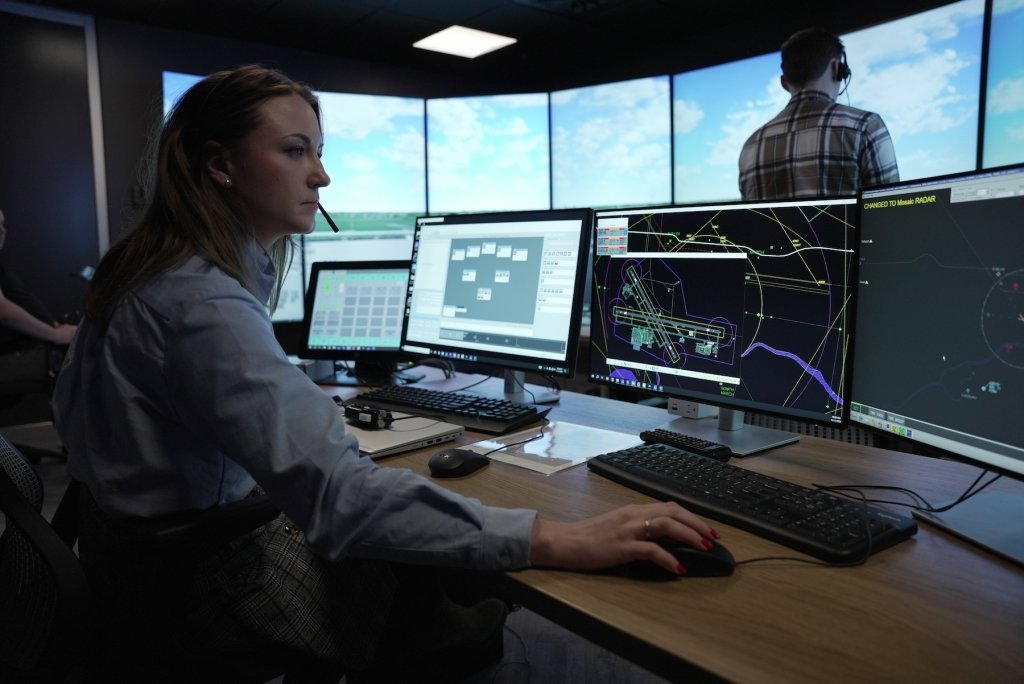
With CAE’s extensive background in advanced training delivery and modern learning sciences, adding air traffic control training to our portfolio made sense as a natural extension of our business and core mission to make the world safer.
In fact, many of the training solutions and expertise developed by CAE, and currently used in other aviation fields, are fully transferable to air traffic control training. A great example of that is CAE Ridge™, an immersive 3D tabletop training tool originally proven within our Defence & Security business unit for military applications. We already know it works well, accelerates learning, and improves operational decision-making, so we are now looking to bring it into the ATS training space.
With CAE’s footprint and added capabilities, CAE is a partner of choice for a real solution to ANSP’s staffing gaps, training effectiveness and capacity issues.
How do you see CAE Ridge changing the way air navigation service providers (ANSPs) design and deliver controller training?
We believe that CAE Ridge™ is poised to fundamentally reshape how ANSPs design and deliver controller training in the coming decade. By replacing traditional 2D or tabletop methods with immersive 3D environments, CAE Ridge™ enables trainees to build stronger mental models much earlier in their learning journey. This will accelerate competency development by allowing training organisations to create and rehearse Competency-Based Training and Assessment (CBTA) aligned scenarios that strengthen core competencies such as situational awareness, communication, and teamwork.
CAE Ridge™ also supports a shift toward more modern training design to meet the needs of today’s and tomorrow’s learners, contributing to improving the attraction and retention of new employees.
Beyond initial training, CAE Ridge™ opens new possibilities for operational integration and recurrent training–helping strengthen continuous improvement in a competency‑focused training ecosystem.
Based on your early experience, what specific elements of the Ridge environment have the greatest impact on shortening the path from ab‑initio training to controller licensing?
Four elements stand out:
- Immersive 3D airspace visualisation lets trainees build robust mental models much earlier, so they arrive at tower and radar simulators better prepared.
- CAE Ridge™ enables pre-simulator procedure rehearsal and CBTA‑aligned scenario development, which strengthens competencies like situational awareness, communication, and teamwork before high‑fidelity practice.
- Collaborative multi-user training and 3D briefing/debriefing accelerate learning loops—whether in the classroom or remotely-reducing remedial cycles and helping trainees progress to licensing faster.
- Integration of an additional support tool for OJT in towers, identified by ANSPs as a training phase where supplemental training and extensions are frequent.
How is CAE Ridge integrated into the ATS training pipeline alongside simulators and on-the-job training?
CAE Ridge™ can be integrated into the ATS training pipeline to enhance the effectiveness of classroom learning and help unlock OJT challenges.
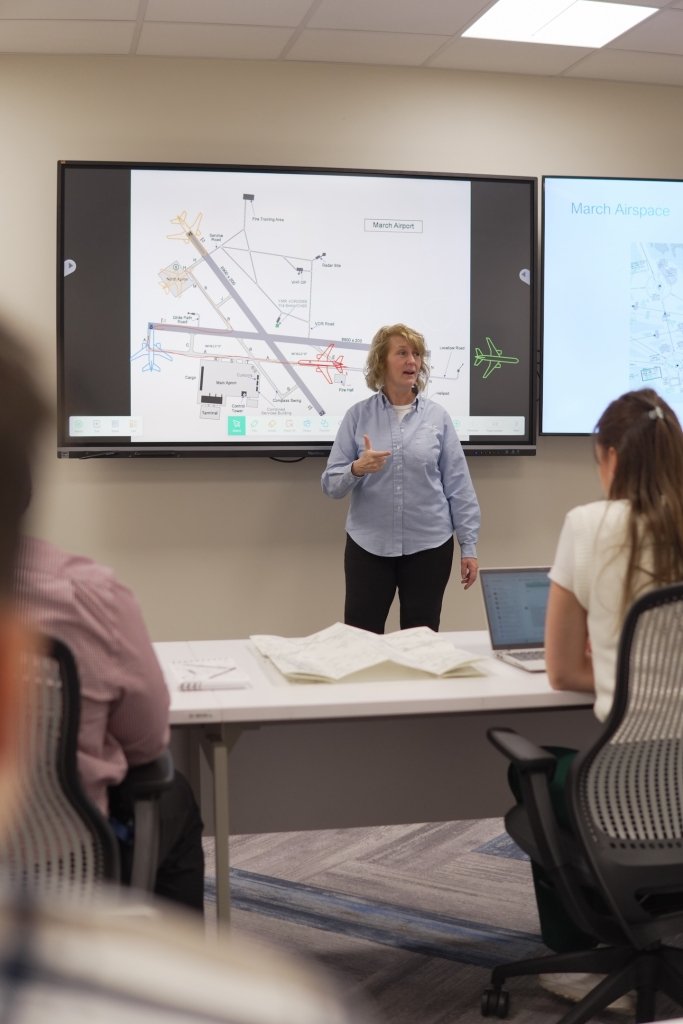
In support to theoretical lessons, trainees use CAE Ridge™ to build strong mental models of airport layouts, standard phraseology, airspace and procedures, rehearse tasks, and run CBTA‑aligned scenarios before entering high fidelity radar or tower simulators. This boosts preparedness and reduces remedial simulator time.
During simulator phases, CAE Ridge™ supports briefings, debriefings, and targeted competency reinforcement using 3D visualisations.
As trainees progress into OJT, instructors use CAE Ridge™ for procedure refreshers and operational or incident reviews, giving trainees a safe environment to revisit complex scenarios and work through challenges.
Because CAE Ridge™ can be used in classrooms, remote sessions, operational briefings and as autonomous practice by students, it stays connected across the full training continuum—strengthening readiness at every stage and improving flow through limited simulator and OJT capacity.
How is CAE Ridge being used to design and assess CBTA scenarios, and what feedback have you received so far?
CAE Ridge™ scenarios are designed and run with the goal of isolating targeted competencies or skills, in alignment with a CBTA structure to strengthen competencies like situational awareness, communication, and teamwork.
Instructors who experienced Ridge expressed enthusiasm for briefing, debriefing, and teaching targeted competencies within a collaborative practice environment for multiple students and the ability to discuss, observe, and confirm the acquisition of the competencies. The ability to manually move aircraft in real-time throughout a lesson was also highlighted as a key instructor tool to adapt to student needs and individual learning curves.
Students liked the engaging environment and the opportunity for autonomous practice to strengthen their skills.
What human‑factors research or evidence has guided the way Ridge presents 3D information, and how are you measuring improvements in situational awareness?
While CAE Ridge™ is not yet backed by formal human‑factors research specific to ATS, its design draws on CAE’s long experience delivering immersive simulation that strengthens early mental‑model formation and spatial understanding. In practice, instructors can use CAE Ridge™ to let trainees walk through airspace structures, traffic flows, and procedures visually, which has already shown clear benefits for situational awareness.
As we continue promoting the tool with ANSPs, we will work with instructors to align CAE Ridge™ use with CBTA‑based behavioural indicators—giving us a structured way to track improvements in situational awareness and competency development over time.
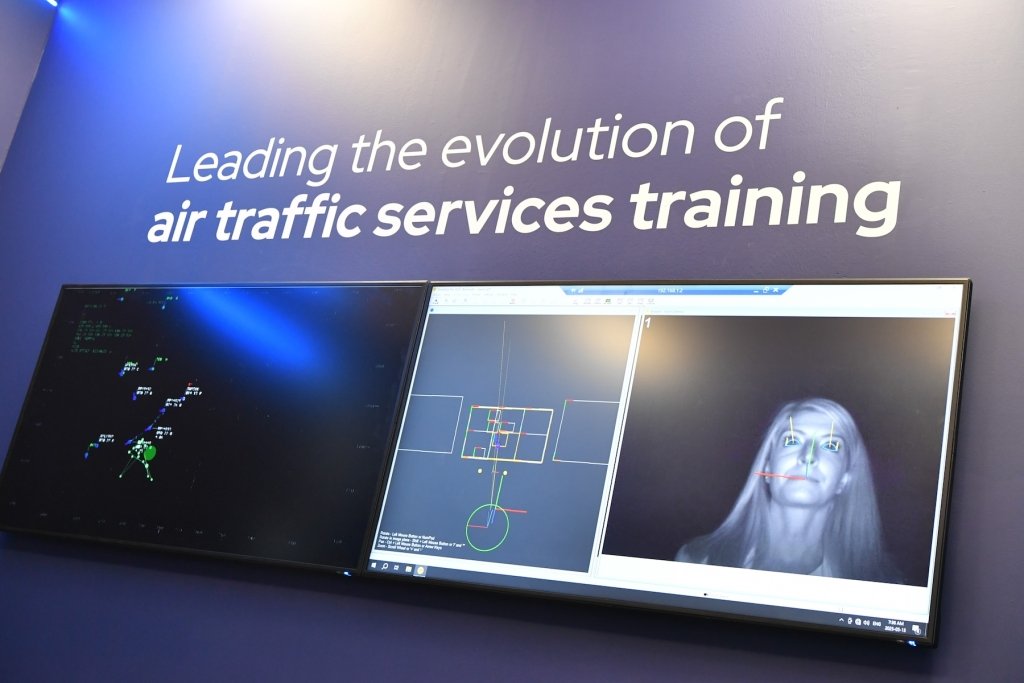
How is CAE Ridge integrated into the Air Traffic Services Training Centre curriculum in Montreal, and which ANSPs or regions does the centre serve?
The introduction and use of CAE Ridge™ within the ATS training domain was announced at Airspace Asia‑Pacific in December 2025, where CAE shared that CAE Ridge™—already proven in military applications—can now be applied to Air Traffic Services training.
Over the coming months, we will integrate it into ATS programs with customers for whom it will add value.
What types of operational problems or training gaps are Asia‑Pacific ANSPs asking you to address with CAE Ridge, and how does their demand differ from more mature markets?
From what we heard at the Airspace Asia-Pacific conference, ANSPs will likely be turning to CAE Ridge™ to accelerate early mental‑model formation, help address OJT challenges, increase autonomous practice, and provide a teaching tool to adapt training to students’ needs.
They’re asking for tools that let trainees visualise airspace structures, airport layouts and enable procedural rehearsals and operational reviews in a low-footprint, collaborative 3D environment.
How are ANSPs using Ridge for distributed or remote training, and what does this mean for countries facing instructor shortages or geographically dispersed operations?
ANSPs will have the ability to use CAE Ridge™ to extend training beyond centralised facilities by running collaborative, instructor-led sessions remotely on low-footprint devices. Because CAE Ridge™ is platform‑agnostic and works on laptops, tablets, touchscreens, and AR headsets, instructors can conduct scenario walk-throughs, pre-sim preparation, and CBTA-aligned exercises even when trainees are spread across multiple sites.
This allows teams to share the same 3D operational picture in real time—visualising airspace, procedures, traffic flows, and changes together without needing to co-locate. For countries with limited instructor availability or geographically dispersed units, CAE Ridge™ acts as a force multiplier:
- It lets a single instructor reach many trainees across regions.
- It standardises the delivery of common scenarios and procedures across multiple facilities.
- It supports consistent CBTA-aligned training without requiring full simulator access.
- It reduces reliance on travel and on-site infrastructure.
This is especially valuable in APAC, where many ANSPs operate across islands or large territories and face uneven access to skilled instructional staff.
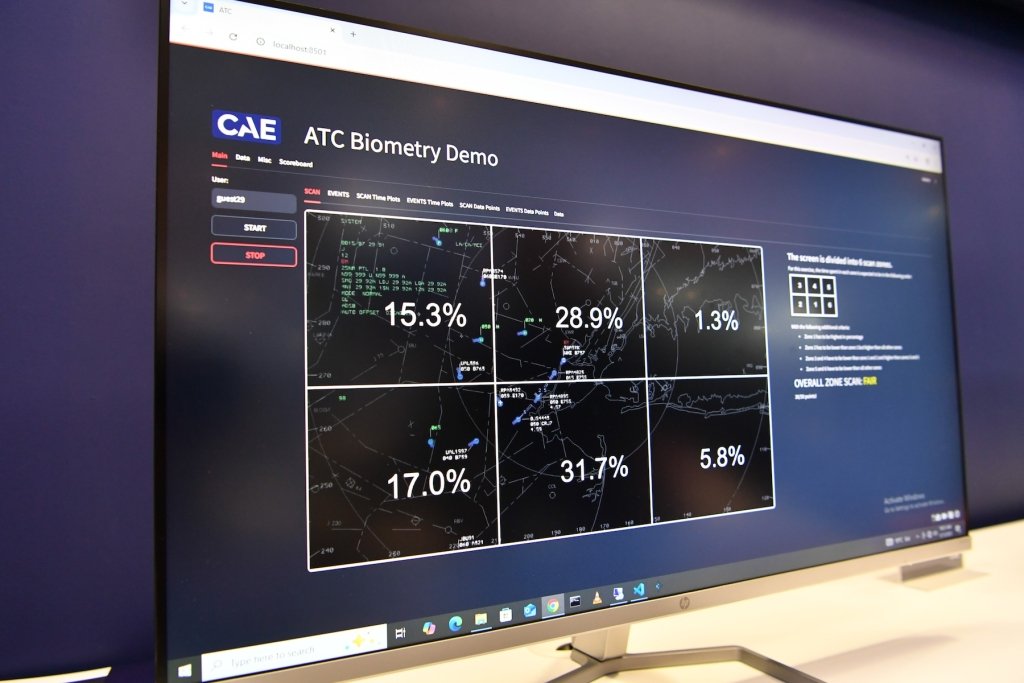
What data or performance analytics can be drawn from CAE Ridge sessions, and how can they be used to improve training and support evidence-based discussions with regulators?
When we talk about “digitally powered training tools,” we’re referring to CAE Ridge’s™ role within a digitally powered, CBTA-aligned training flow—one that enables instructors to design scenarios, observe behaviours, and debrief using a shared 3D operational picture. In practice, this ecosystem supports the collection of several types of meaningful training data:
Instructor observations and CBTA mapping
- Structured notes tied to observable behaviours, for example, communication, teamwork, workload management, and situational awareness, are captured during scenario walkthroughs and debriefs.
Performance artifacts for evidence‑based discussion
- 3D replays and visualisations that show how trainees interpreted a situation, executed a procedure, or responded to complexity. These artifacts support evidence-based conversations with trainees, training managers, and regulators.
Together, these elements create a traceable digital record of training activities and behaviors. This data supports continuous refinement of training programs, helps standardise instruction across locations, and provides a foundation for evidence‑based dialogue with regulators about competency development, scenario effectiveness, and training outcomes.
How do you see CAE Ridge supporting countries building up their controller training capacity, including emerging markets like India?
CAE Ridge™ allows ANSPs to:
- Build core competencies earlier and faster:
- By giving trainees immersive 3D exposure to airspace structures, flows, and procedures before they enter expensive tower or radar simulators, CAE Ridge™ helps countries accelerate the development of situational awareness, communication, teamwork and procedural understanding.
- Expand capacity:
- Because CAE Ridge™ runs on laptops, tablets, touchscreens, and AR headsets, it enables affordable, distributed training where full simulator infrastructure is not necessary. Support for the delivery of standardised training sessions across geographically dispersed regions.
- For countries with multiple Flight Information Regions (FIRs) or remote airports, CAE Ridge™ provides a common CBTA‑aligned training environment, helping maintain consistent quality even when trainees are trained at different sites.
- Optimise instructor resources:
- A single instructor can run multi‑user, collaborative sessions across sites, increasing reach without needing more local instructors or travel from students.