










SITA says Aviation’s Record Tech Investment depends on Data Coordination

- Aviation IT spend reached $50.8 billion in 2025, but fragmented data is limiting how effectively that investment delivers.
- Airlines are upgrading operations systems and using AI for disruption management, yet data integration remains the main barrier.
- Progress in digital identity, cybersecurity and emissions tracking is strongest where data is controlled, and weakest where coordination is required.

SITA’s 2025 Air Transport IT Insights report finds that, while the air transport industry invested a record $50.8 billion in technology in 2025, a common obstacle keeps emerging: where data does not flow freely between systems and partners, that investment cannot fully deliver what it was designed to unlock.
The cost of this data coordination gap is higher than ever now that the conflict in the Middle East continues to disrupt the industry at a global scale. Operators investing in closing that gap are building foundations that will outlast the current disruption.
“We are publishing this research at a moment when the industry is under significant pressure. Across every area we measured, the same constraint emerges: where data does not flow freely across systems and partners, investment cannot fully deliver what it was designed to unlock. That constraint carries a higher cost today, but also a clear opportunity to emerge stronger.” said David Lavorel, CEO of SITA.
Airlines and airports are increasing their investment in IT. In 2025, airlines committed $36 billion, or 3.6% of revenue, while airports raised their spend to $14.8 billion, representing 7.3% of revenue, up from 6.4% the previous year.
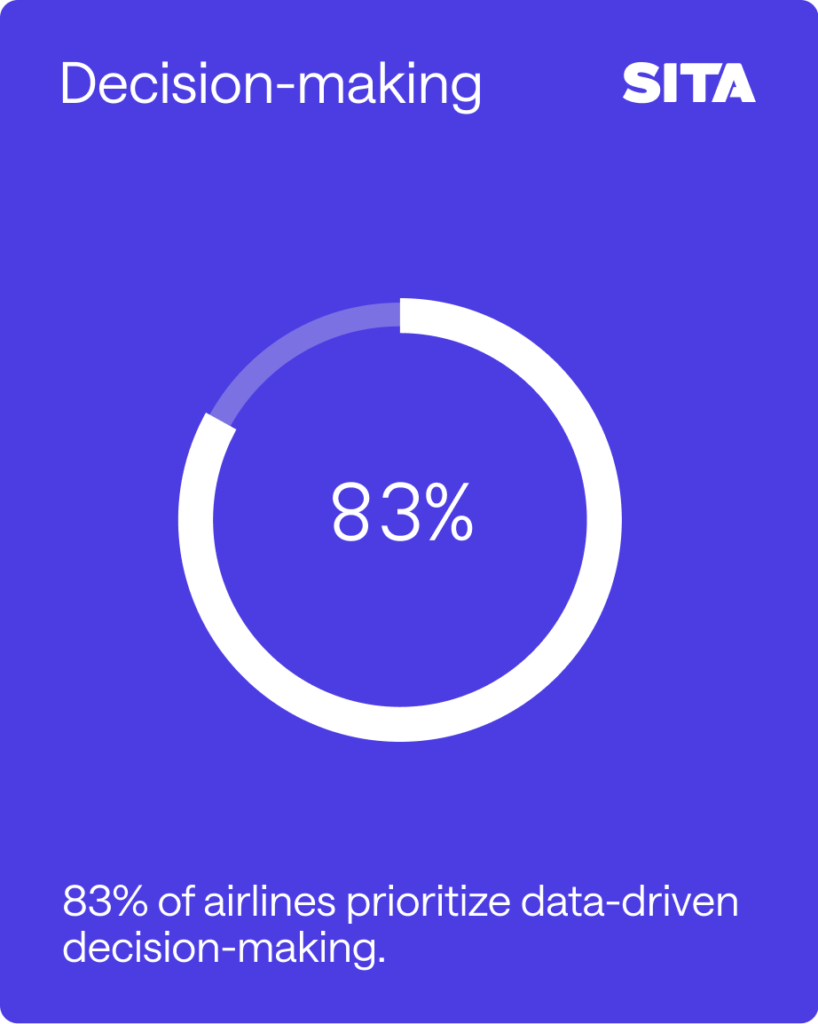
The reason is consistent across both: eighty-three per cent of airlines and 89% of airports say data-driven decision-making is a strategic priority, a clear signal that the industry is actively building the operational foundations it believes resilience depends on.
Operational reliability now drives financial performance
When operations run close to capacity, disruption carries a direct financial cost. Flight delays alone account for $30 billion of the industry’s total revenue, according to IATA.
Improving the predictions and response to disruption is key, which is why data integration is starting to be actively addressed: 46 per cent of airlines are upgrading their flight operations systems to make information consistent and accessible across flight, crew, aircraft and passenger systems in real time.
The goal is to give operational teams the shared picture they need to intervene earlier, before a single delay becomes a network problem.
Yet 49% of airlines identify data integration and consistency as the primary barrier to achieving this. When information is fragmented across systems, the window for early intervention closes before it can be used.
AI delivers most value when coordinating decisions across systems
Early AI deployments in aviation focused on individual systems: predictive alerts, route optimisation, and maintenance forecasting. The shift now underway is more significant. Sixty-three per cent of airlines use AI in operations control to manage disruption, aircraft assignment and crew availability simultaneously, evaluating recovery options across multiple constraints at once before recommending actions.
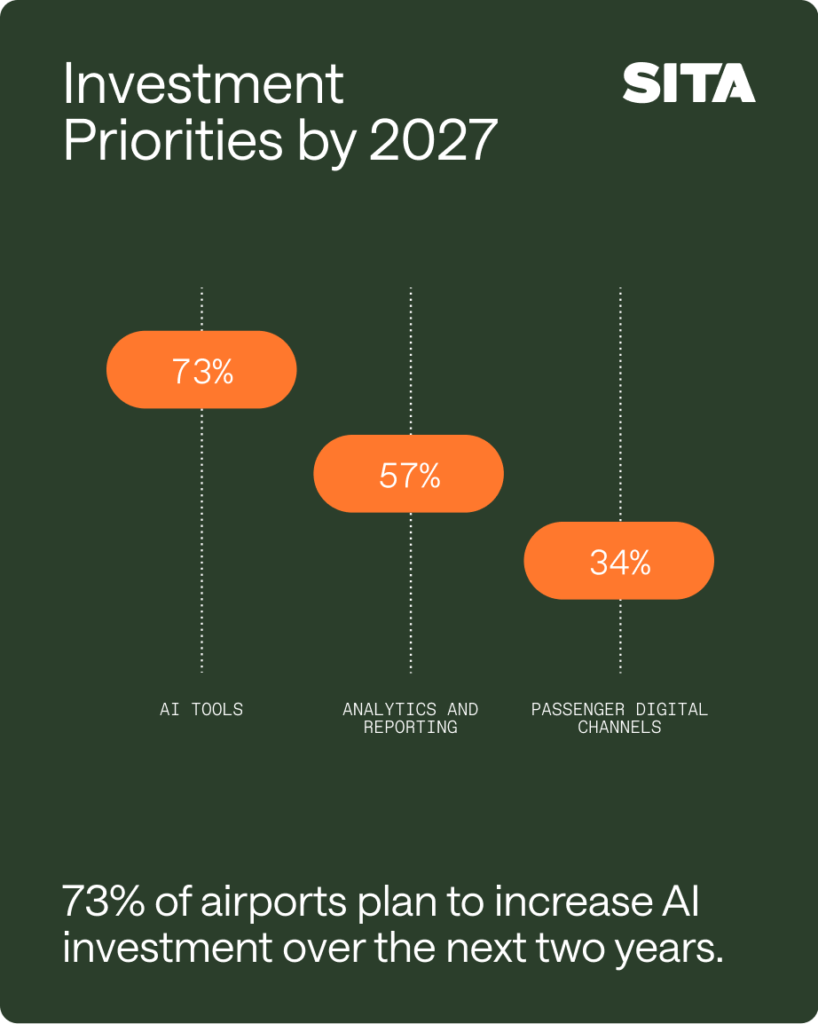
Seventy-nine per cent name generative AI and large language models as their top investment priority for the next 12 months, a signal that ambition is running well ahead of current deployment.
AI is used most confidently when using it within a single system. It is used least where decisions require consistent data from multiple partners: only 17% of airlines use AI to monitor turnaround activity in real time. Airports are moving to close that gap, with 53% now applying AI to aircraft turnaround, up from 36% in 2024. But the ceiling on AI’s impact is not capability. It is data alignment.
“Aviation is deploying AI with real ambition. But the survey is clear: the primary barrier to maximizing that investment is the lack of data integration across the operation. The technology is there. The data infrastructure to connect it often is not,” added Lavorel.
Cybersecurity now protects shared operational data
As airlines and airports connect more systems across operations, passengers and partners, the exposure from a cyber incident has changed.
A breach would no longer affect a single platform. It risks affecting the accuracy and availability of the shared data that operations depend on: gate changes, turnaround status, passenger information.
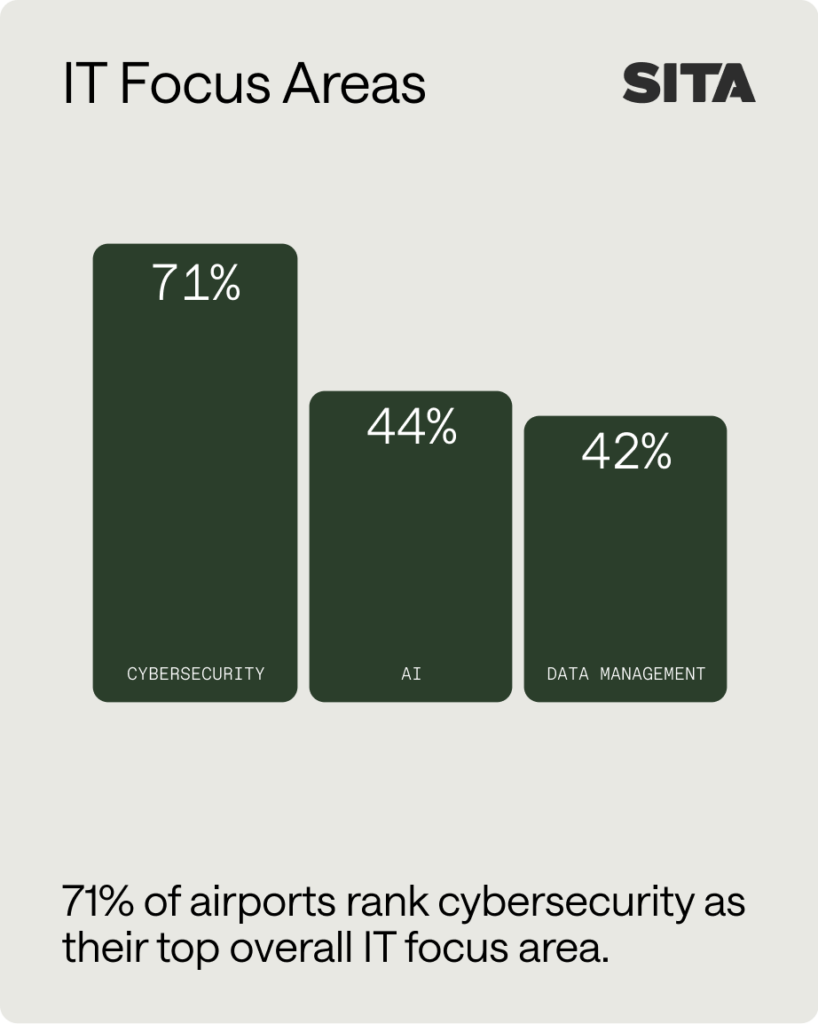
Seventy-one per cent of airports now rank cybersecurity as their top overall IT focus area, and 68% name it as the primary driver of infrastructure upgrades.
The industry is responding: 64% of airports are already applying AI in cybersecurity to detect anomalies earlier and reduce response times, up from 51% in 2024.
Digital identity is scaling fast, but coordination remains the key constraint
The move toward airline and airport-issued digital identity credentials is accelerating sharply. Sixty-four per cent of airlines plan to use their own issued credentials, up from 32% in 2024, and biometric border control, already live at 54% of airports, is expected to reach 83% by 2028.
The technology is ready and the investment is committed. The key to delivering value is coordination: 57% of airlines cite airport cooperation as the primary requirement for scaling digital identities, up from 40% the previous year.
An identity program only works when every touchpoint in the passenger journey recognises the same record consistently. Without that alignment, the infrastructure exists, but the benefit does not.
Sustainability advances most where operators control data
The sustainability data in this year’s report tells the same story.
The focus is strongest where a single operator owns the data and the decision: 83% of airlines are implementing fleet renewal programs, 67% are sourcing Sustainable Aviation Fuel in selected locations and 75% of airports use building management systems to monitor terminal energy.
However, adoption of total emissions tracking and airside carbon measurement – capabilities that require consistent data sharing across airlines, ground handlers and infrastructure – remains below 20%.
The pattern is not a coincidence. Across AI, cybersecurity, digital identities and sustainability, the report finds the same ceiling: progress is most advanced where data is coordinated across systems and partners.
“Across AI, cybersecurity, digital identities and sustainability, operators name the same constraint: data that does not flow freely across systems and partners. It is consistent across every area we measured. Data coordination is not a future priority. It is what is limiting outcomes today,” concluded Lavorel.
Also Read: The Frictionless Airport: Everything Is Ready Except the System