



















History of Air Navigation – Part IV: International Civil Aviation Organization (ICAO) Annex 10, Volume I

- ICAO Annex 10 Volume I was developed from the Chicago Convention to create globally uniform standards for aeronautical telecommunications and radio navigation aids, improving safety and consistency across international airspace.
- The Annex defines Standards and Recommended Practices (SARPs) and outlines key navigation systems such as ILS, VOR, DME, GNSS and others, ensuring harmonised performance and interoperability worldwide.
- Its global adoption has enabled seamless navigation between different countries’ airspaces, reducing pilot workload and supporting the safe expansion of international aviation operations.

HF/VHF Direction Finders described in earlier Parts were classified as Communication-based aids (rather than primary self-contained navigation systems), where communication systems were used to get navigational information, also by ground-based Air Traffic Control.
Also, there were other limitations, like pilots were required to make a voice call to the ground station to generate bearing information, and that only one aircraft at a time could get its bearing information. Also, it took some time for the process of calculating the bearing and passing it on to the concerned aircraft.
The post-World War II years saw tremendous development in aircraft capabilities, including range and endurance, which led to a massive increase in international flight operations. To support the enhancement of air safety and the uniformity of development of the aviation environment over the whole globe, the United States took an initiative by inviting States to a Convention on International Civil Aviation at Chicago in December 1944.
The Convention, attended by 54 States (including India), adopted several Articles of Association. Article 37 of proceedings (adopted on 7 December 1944) required that “International Civil Aviation Organisation shall adopt and amend from time to time, as may be necessary, international standards and recommended practices and procedures dealing with: Communication systems and air navigation aids, including ground markings.“
To meet this requirement, Standards and Recommended Practices (SARPs) for Aeronautical Telecommunications were first adopted by the ICAO Council on 30 May 1949 and were designated as Annex 10 to the Convention. These SARPs became effective from 1 March 1950. Similar Articles and Annexes were adopted for other disciplines to support every aspect of international civil aviation.
Annexes
An ICAO Annex is made up of the following parts, not all of which, however, are necessarily found in every Annex. These parts have the status as indicated below:
Material Comprising of the Annex proper
A. Standards and Recommended Practices (SARPs)adopted by the ICAO Council under the provisions of the Convention.
- Standard: Any specification for physical characteristics, configuration, material, performance, personnel or procedures, the uniform application of which is recognised as necessary for the safety and regularity of international air navigation and to which contracting States will conform in accordance with the Convention; in the event of impossibility of compliance, notification to the Council is compulsory under Article 38.
- Recommended Practices: Any specification for physical characteristics, configuration, material, performance, personnel or procedure, the uniform application of which is recognised as desirable in the interest of safety, regularity or efficiency of international air navigation.
B. Appendices: They comprise of material grouped separately for convenience but forming part of the Standards and Recommended Practices adopted by the Council.
C. Definitions: Explanation of the terms used in Standards and Recommended Practices (SARPs) which are not self-explanatory in that they do not have accepted dictionary meanings. A definition does not have independent status but is an essential part of each SARP in which the term is used, since a change in the meaning of the term would affect the specification.
D. Attachments: They comprise of material supplementary to the SARPs or is included as guide to their applications.
Annex 10 Volume I
Up to and including its Seventh Edition, Annex 10 was published in one volume containing four parts, wherein Part I was for Equipment and Systems, Part II was for Radio Frequencies, Part III was for procedures, and Part IV was for Codes and Abbreviations. Part IV was subsequently removed and transferred to Doc 8400.

On 31 May 1965, the seventh edition was replaced by two volumes, Volume I containing two parts, Part I containing Equipment and Systems and Part II containing Radio Frequencies, and Volume II containing Communication Procedures.
Finally, through Amendment 70 on 20 March 1995, Annex 10 was restructured to include five volumes:
- Volume I Radio Navigation Aids
- Volume II Communication Procedures
- Volume III Communication Systems
- Volume IV Surveillance Radar and Collision Avoidance Systems and
- Volume V Aeronautical Frequence Spectrum Utilisation.
As has been described, ICAO Annex 10 Volume I (Aeronautical Telecommunications: Radio Navigation Aids) began with its first adoption in 1949. Standards and Recommended Practices (SARPs) for Aeronautical Telecommunication were adopted by the Council on 30 May 1949 pursuant to the provision of Article 37 of the Chicago Convention, 1944.
Article 38 of the Chicago Convention and provisions made in Annex 15 makes it obligatory for all the Contracting States of ICAO to notify any differences between their national regulations/practices and the International Standards contained in the Annex.
Compulsory compliance to Annex 10 Volume 1 SARPs, has resulted in a uniform navigation environment over the whole world. The same level of navigation performance is now available over global airspace, and this seamless performance reduces stress on pilots when their aircraft crosses from airspace controlled by one State to airspace controlled by the other State.
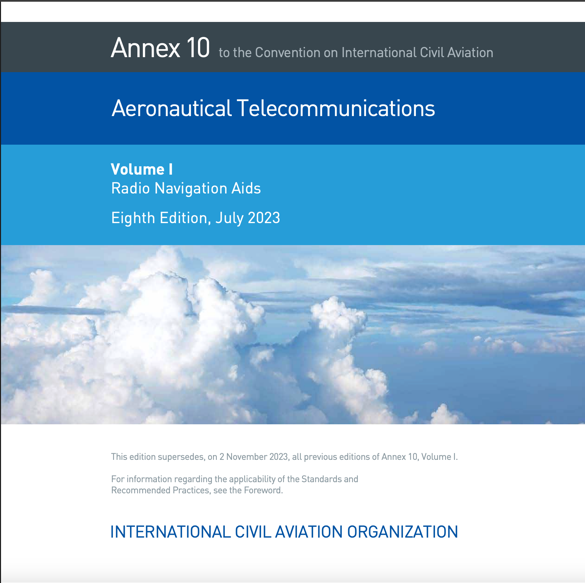
Annex 10, Volume 1, provides detailed information for all the Radio Navigation Aids (including Global Navigation Satellite Systems, GNSS). The Eighth Edition, published in July 2023, is the latest edition of the volume.
The document has been divided into three chapters, two Appendices and eight Attachments in addition to a Forward providing historical background, Action by Contracting States, Status of Annex Components, Selection of Language and Editorial Practices.
The following is the list of radio navigation aids which have been included in the Eighth edition. States are not obliged to provide any other navigation aid in their airspace (like Tactical Air Navigation, TACAN or Transponder Landing System, TLS). This Annex has been adopted in four languages – English, French, Russian and Spanish. Each State can choose one of these four languages for the implementation of the Annex.
Radio Navigation Aids adopted;
- Instrument Landing System (ILS)
- Precision Approach Radar (PAR)
- VHF Omnidirectional Radio Range (VOR) (including DVOR)
- Non-Directional Beacon (NDB)
- UHF Distance Measuring Equipment (DME)
- En-route VHF Marker Beacons (75 MHz)
- Global Navigation Satellite System (GNSS)
- Airborne Automatic Direction Finder (ADF)
- Microwave Landing System (MLS)
It may be mentioned that ICAO recommends aircraft equipage (selection from the above-mentioned airborne complement). For example, Tactical Air Navigation (TACAN) is not included in the ICAO-recommended list of navigation systems, but some States permit its use for obtaining slant distance information. An ICAO-recommended DME airborne Interrogator can use TACN transmission to derive the slant distance.

To make sure that the performance of the systems installed for radio navigation meets the requirements of the Standards included in Annex 10, Volume I, and to ensure continued compliance, navigation systems are checked periodically on the ground and through flight calibration.
Detailed information on the testing of navigation aids has been provided in ICAO Doc 8071, Volume I.
Conclusion
To support the uniform development of international civil aviation, the Chicago Convention was held in December 1946. India, represented by Sir Girija Shankar Bajpai (Chairman of Delegation), Sir Gurunath Bewoor, Sir Fredrick Tymms and Sirdar G. D. Singh, also participated.
As recommended by the Convention, Standards and Recommended Practices were adopted to provide the same level of services (for every phase of flight) by all the UN member States. This has helped in providing a uniform operating environment for civil aviation over the whole world, thus supporting the enhancement of safety and reducing pilots’ stress.
Also Read: History of Air Navigation – Part III: Ground-Based Direction Finding
Dr. SK Saraswati – He joined Civil Aviation Department in 1972 through Engineering Services Examination and has an extensive experience in planning, procurement, installation, commissioning, maintenance, calibration, as instructor of Communication, Navigation, Surveillance and ATM Automation. He also served as Airport Director (Bangalore, Hyderabad) and Regional Executive Director. He served ICAO and after retirement was Consultant to Tata Advanced Systems Ltd.