














- Commercial aviation MRO is facing capacity strain as older aircraft remain in service longer, while complex maintenance planning, records, approvals and parts coordination still depend heavily on manual processes.
- Basic digitisation is no longer enough in maintenance environments where technical data, non-routine findings, labour planning and supply-chain decisions have to move quickly across engineering, procurement, production and finance.
- Agentic AI helps address these challenges by analysing technical documents, compiling work packages, anticipating non-routine findings, recalculating schedules and keeping every technical action subject to human approval before execution.

The global commercial aviation Maintenance, Repair, and Overhaul (MRO) sector is facing an unprecedented capacity challenge. Driven by an expanding global fleet and sustained travel demand, with older aircraft remaining in service longer than anticipated, the commercial MRO market has surpassed $136 billion. While modern aircraft and engines are built with advanced digital systems, the maintenance infrastructure around them still relies on manual, disconnected processes.
Across the industry, highly complex work scopes are still routinely managed offline using an inefficient mix of spreadsheets, legacy emails, paper records, and isolated software systems. This widening gap between demand and operational capability creates friction at every stage. The result is an operational bottleneck that limits asset utilisation, extends turnaround times (TAT), and erodes profit margins across the aviation maintenance sector.To manage an acute shortage of skilled technicians and sustained supply chain pressure, the industry needs to move beyond past basic digitisation. The industry requires a decisive transition toward autonomous, goal-oriented Agentic AI systems to eliminate the delays that keep aircraft grounded.
Technical Data and Non-Routine Delays
The initial administrative hurdle in traditional MRO occurs before technical teams can begin working on the aircraft.
When a commercial engine or airframe arrives at a facility for a major check, it is accompanied by massive volumes of unstructured data. Technical planners must meticulously read, interpret, and cross-reference Aircraft Maintenance Manuals (AMMs), Maintenance Planning Documents (MPDs), Illustrated Parts Catalogues (IPCs), Service Bulletins (SBs), and operator history files.
For a complex engine work scope, a human planner typically spends up to 20 days performing this manual data extraction. They must identify individual tasks, map out exact operational workflows, estimate labour hours, and calculate costs just to generate an initial customer quote. This three-week administrative delay keeps multi-million-dollar aviation assets grounded and non-revenue-generating.
This rigid pre-maintenance schedule is immediately disrupted once physical maintenance begins. Industry data reveals that roughly 40% of the final scope of work during heavy maintenance emerges as “non-routines”—unforeseen defects like corrosion, structural wear, or hairline cracks discovered only after teardown and inspection.
Under traditional operating models, a significant non-routine finding completely derails the baseline timeline. Planners must spend hours or days manually rebuilding the entire critical path, re-allocating labour, sourcing long-lead parts, and negotiating back-and-forth customer approvals while technicians await instructions.
Managing thousands of these interconnected, unpredictable events simultaneously remains a primary driver of costly schedule overruns.
Goal-Driven AI Frameworks
To resolve these recurring operational delays, the aerospace industry is transitioning from passive software tools to goal-driven AI frameworks.
Unlike traditional artificial intelligence or standard generative models—which are strictly reactive and rely on single-turn, human-prompted questions and answers—agentic systems are goal-driven. An AI agent can independently plan an entire workflow, execute a sequence of complex tasks, query internal databases, read unstructured technical manuals, call external system APIs, route files for approval, and adapt based on operational outcomes.
In a highly regulated, safety-critical sector like aviation MRO, this technology acts as an integrated digital layer across the entire maintenance lifecycle.
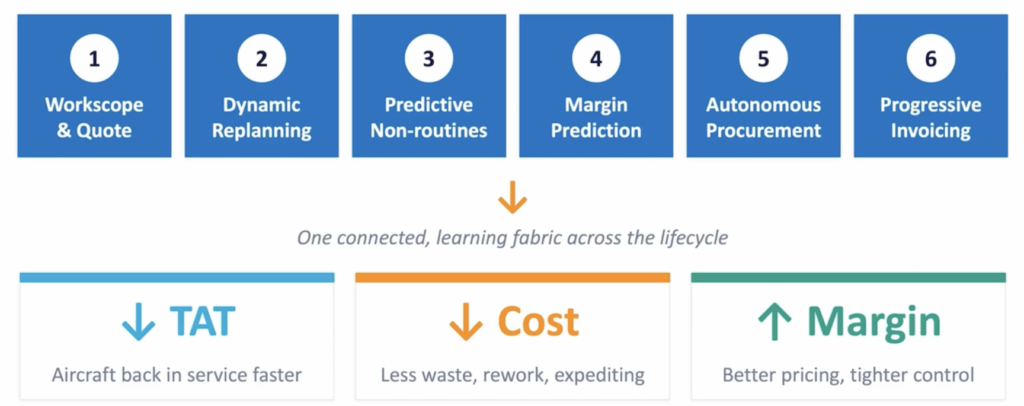
Source: Ramco Systems
Rather than treating engineering, procurement, production, and finance as isolated departments, Agentic AI coordinates actions across them simultaneously. It systematically applies four key operational levers:
- Automation: Strips repetitive data entry from human administrative tasks.
- Intelligence Infusion: Embeds predictive data patterns directly into the active workflow.
- Optimisation: Evaluates hundreds of parts, schedules, and vendor permutations simultaneously.
- Productivity Enhancement: Ensures that certified engineers can stop reviewing paperwork manually and focus entirely on technical judgment.
Enterprise Use Cases
The practical application of agentic workflows fundamentally alters the economics of the maintenance shop through several core enterprise use cases:
- Work Package Compilation: Instead of a planner spending weeks to build a proposal, the agents read technical documents, extract tasks, and sequences them in minutes. By extracting tasks, automatically sequencing them based on airworthiness dependency rules, and drawing on historical job data, the agent compresses the 20-day planning cycle into less than an hour. The human planner simply reviews, adjusts, and approves the generated draft.
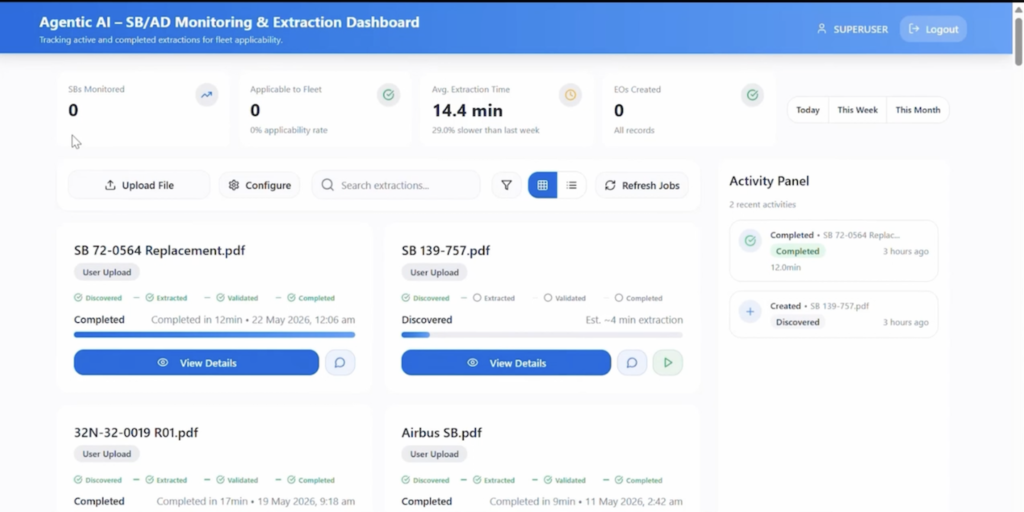
- Technical Document Processing: Extraction agents continuously monitor OEM and regulatory portals for new Service Bulletins (SBs) or Airworthiness Directives (ADs). The agent filters out irrelevant updates, structurally maps relevant data, and drafts an Engineering Order (EO) in a unified engineering dashboard for the team. Engineers can query the document in natural language to instantly clarify complex applicability criteria, such as specific aircraft serial number ranges or manufacturing batches.
- Predictive Maintenance and Schedule Optimisation: By analysing historical inspection data across thousands of identical components, predictive AI forecasts likely non-routine findings before an aircraft enters the hangar, allowing parts to be pre-allocated to the specific hangar bay. When unexpected defects do occur on the floor, the agent recalculates the entire facility schedule in seconds, instantly generating a costed customer approval request to minimise asset downtime.
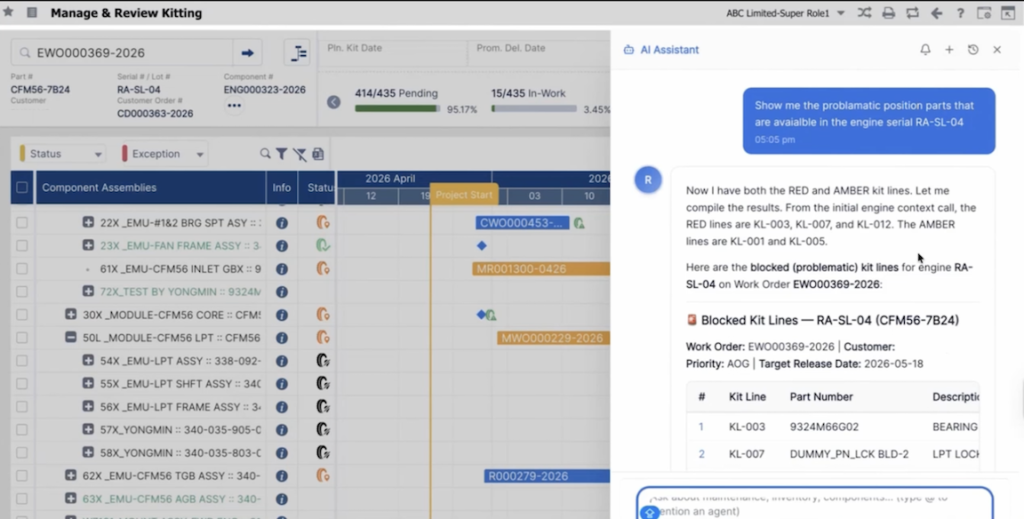
- Material Sourcing and Allocation: An engine cannot be completed if a facility has only 1,999 of the 2,000 required parts. When a critical part shortage occurs, a context-aware system automatically checks network-wide inventory, evaluates interchangeable alternate parts, reviews open repair orders, and presents a ranked list of sourcing recommendations optimised for timeline, compliance, and cost.
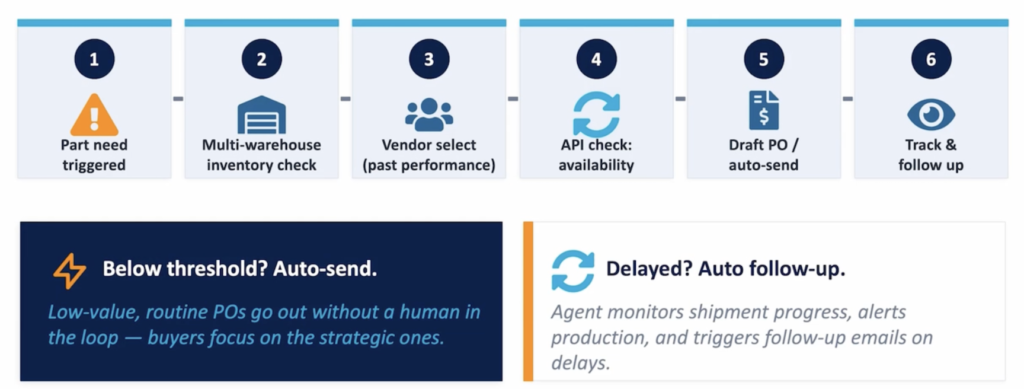
- Cost Tracking and Invoicing: For low-value consumables, agents can execute purchase orders autonomously based on pre-set corporate thresholds, tracking shipment status and automated vendor follow-ups. On the back end, the agent continuously compiles a running ledger of labour hours and parts consumption as the work happens. Customer approvals are verified progressively, transforming a month-long post-delivery invoice dispute cycle into a single hour upon asset release.
Compliance and Human Oversight
Deploying Agentic AI does not mean removing human expertise from the hangar floor; rather, it is about amplifying it. In a safety-first industry like aviation, autonomy must always be bound to strict human oversight. The underlying architecture of these AI agents ensures that they function strictly as highly advanced operational assistants.
Every single technical recommendation, draft engineering order, purchase order, and altered work package generated by the system remains in a locked “draft status”. No action is executed autonomously within the core operating system without the explicit review and digital sign-off of a licensed human professional. By eliminating the friction of manual data collection and administrative follow-ups, the technology allows certified engineers to maximise their technical capacity.
The most competitive MRO facilities of tomorrow will not simply be the largest, but the most digitally connected.
Also Read: GE Aerospace Expands Pune’s Role in Global Engine Component Production