








Swiss Solar-Powered Plane Crashes
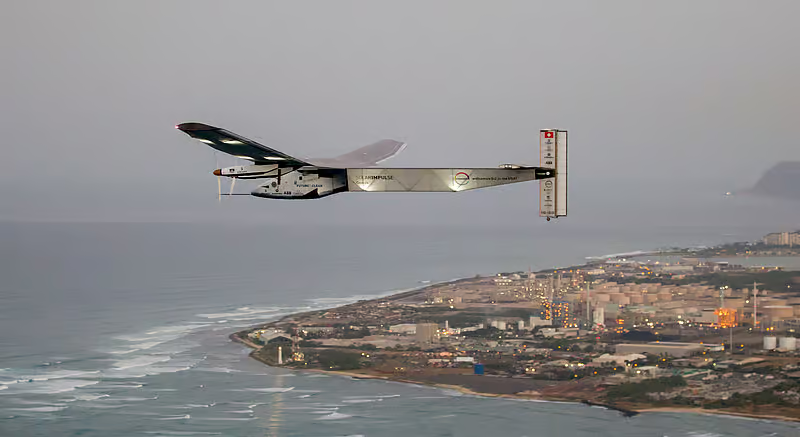
The famous solar-powered aircraft Solar Impulse 2, which made history in 2016 by flying around the world without using fuel, has crashed into the Gulf of Mexico during a recent mission. The aircraft’s current owner, Skydweller Aero, confirmed the incident in an official statement.
Solar Impulse 2 became globally famous after completing a groundbreaking round-the-world journey powered entirely by solar energy. The aircraft was flown by Swiss pilots Bertrand Piccard and Andre Borschberg.
The historic mission was completed in 2016 and demonstrated that long-distance air travel could be possible without traditional jet fuel. During the journey, the aircraft covered around 26,700 miles, or nearly 43,000 kilometers, across four continents, two oceans, and three seas.
The flight was completed in 17 stages over a total of 23 flying days. The aircraft relied completely on solar power collected through thousands of solar cells attached to its wings. This achievement was considered a major milestone in clean energy aviation and sustainable technology.
After its historic mission, Solar Impulse 2 was sold in 2019 to Skydweller Aero, a company focused on developing solar-powered autonomous aircraft. The company later modified the aircraft into a drone capable of operating without pilots onboard.
According to the company, the aircraft took off from Stennis, Mississippi, on April 26, 2026, as part of a military-related exercise connected to the United States Navy. The flight was intended to test the aircraft’s long-endurance capabilities in a mission environment.
Skydweller Aero stated that the aircraft remained airborne for an impressive eight days and 14 minutes before the incident occurred. The company described the mission as a record-breaking achievement that proved the possibility of “perpetual solar-powered flight.”
However, the aircraft eventually crashed into the Gulf of Mexico on May 4. The company described the incident as a “controlled ditching,” which generally refers to a planned emergency landing on water.
Despite the crash, the company highlighted that the mission successfully demonstrated the aircraft’s ability to stay in the air for extremely long periods using only solar energy. Such technology could potentially be used in the future for surveillance, communication, environmental monitoring, and military operations.
The aircraft itself was unique because of its lightweight structure and extremely wide wingspan, which allowed it to capture enough solar energy to continue flying day and night. During daytime, solar panels charged onboard batteries that powered the aircraft after sunset.
The crash has attracted attention worldwide because Solar Impulse 2 was considered one of the most important symbols of clean aviation innovation. Aviation experts and environmental supporters had praised the aircraft for showing that renewable energy could play a major role in future transportation technology.
The National Transportation Safety Board (NTSB) has now started an investigation into the accident to determine the exact cause of the crash.
Although the aircraft has been damaged, the mission still marks another important step in the development of long-duration solar-powered aviation technology. Experts believe such aircraft could become increasingly valuable in the future as the world looks for cleaner and more sustainable forms of air travel.

Ajeet Yadav is an aviation enthusiast covering airline news, airports, aircraft, and industry developments through well-researched and reliable reporting.