



















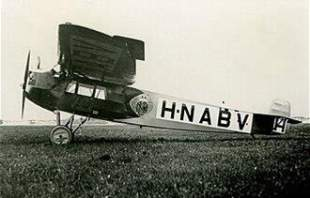
KLM Fokker F.III Disappearance
The disappearance of KLM Fokker F.III H-NABS on 24 April 1924 was one of the earliest major accidents involving the Dutch airline KLM. The aircraft was operating a scheduled passenger flight from Croydon Airport in England to Waalhaven Airport in Rotterdam when it disappeared over the English Channel. There were three people on board: one pilot and two passengers. None survived, and the aircraft was never recovered.
KLM and the Fokker F.III
KLM, formally Koninklijke Luchtvaart Maatschappij, began operations in October 1919 and was among the world’s early commercial airlines. During the 1920s, the airline operated international routes between the Netherlands, Britain, France and other European destinations.
The Fokker F.III was one of the aircraft used by KLM during this period. Developed by Dutch aircraft manufacturer Fokker, the F.III was designed for passenger transport and became an important aircraft in the early development of European commercial aviation. KLM operated several Fokker F.III aircraft on its scheduled services.
The aircraft involved in the 1924 disappearance was Fokker F.III H-NABS, construction number 1535. It was registered to KLM on 12 May 1922 and was fitted with a 240-horsepower Siddeley Puma engine. The aircraft remained in KLM service until the accident in April 1924. Its registration was cancelled on 12 May 1924.
The Flight on 24 April 1924
On 24 April 1924, H-NABS was scheduled to fly from Croydon Airport, near London, to Waalhaven Airport in Rotterdam.
The aircraft departed Croydon at approximately 10:43 a.m. There were three people aboard. The pilot was Adriaan Pieter Johannes Pijl, while the two passengers were W. J. van Hien and C. J. M. Modderman.
Weather conditions became an important factor during the journey. Fog affected the flight, and the aircraft made an intermediate stop at Lympne Airport in Kent. After landing at Lympne, the aircraft later departed again for the Netherlands.
H-NABS left Lympne at approximately 1:34 p.m. Its planned destination was Waalhaven Airport in Rotterdam. The aircraft then headed across the English Channel.
It never arrived at Rotterdam.
The Aircraft Was Not Equipped With Radio
One significant feature of the flight was that H-NABS did not have a radio communication system.
In 1924, aircraft radio equipment was not yet universally installed on commercial aircraft. This meant that the crew of H-NABS could not maintain continuous radio communication with the ground while crossing the English Channel.
At Waalhaven, officials initially expected the aircraft to arrive normally. When it failed to appear, the absence of radio communication meant there was no immediate message from the pilot explaining the aircraft’s position or circumstances. H. Nieuwenhuis, the official responsible at Waalhaven, was alerted after the aircraft failed to arrive.
The lack of communication made determining the aircraft’s location considerably more difficult.
Search Operation
After H-NABS failed to arrive, a large search operation was organized.
Telephone and telegraph services were used to collect information about the aircraft. Officials contacted ships, lightships, coastguards and other personnel in the English Channel area and asked them to look for the missing aircraft.
The search expanded after sunrise.
Three Dutch naval seaplanes based at De Kooy Airfield participated in the search. A Dutch torpedo boat was also involved. Three Royal Air Force seaplanes joined the operation, along with KLM aircraft H-NABJ and H-NABX.
Additional searches were conducted along the Dutch coast and over areas of the English Channel. Aircraft normally used for photographic work were also employed in the search.
French aircraft later joined the operation and searched along the French coast. Several aircraft operating scheduled services also examined parts of the suspected route.
Despite the number of aircraft and vessels involved, no confirmed wreckage of H-NABS was found.
Reports of Possible Wreckage
During the search, there were reports suggesting that the aircraft might have been found near the Goodwin Sands.
On 26 April, a telegram reported that a Dutch aircraft had supposedly been located on a sandbank in the Goodwin area. Another report stated that a British aircraft had observed oil in the same general area.
The information was subsequently determined to be incorrect. No confirmed wreckage of H-NABS was identified.
The search continued, but the aircraft and the three people aboard were never located.
The Investigation
An investigation was conducted into the disappearance.
The official investigation considered the weather and visibility conditions during the flight. According to the investigative committee, the available evidence indicated that the most likely explanation was that the aircraft had struck the water while flying at full speed beneath fog.
A witness at Sandgate reportedly observed the aircraft while visibility over land was relatively good. However, fog over the sea prevented a clear view of the horizon. This information was considered relevant to the investigation into the aircraft’s disappearance.
Because the aircraft was never recovered, there was no physical wreckage available for a detailed examination.
Consequently, the exact circumstances of the final moments of H-NABS could not be established through examination of the aircraft.
The Pilot
The aircraft was flown by Adriaan Pieter Johannes Pijl, who had considerable flying experience for the period.
Pijl was born on 22 November 1895 in Amersfoort, Netherlands. Before joining KLM, he had served as a military aviator and had accumulated approximately 750 hours of flight time.
He joined KLM on 1 April 1922 and subsequently recorded approximately 1,220 additional flight hours with the airline. He had crossed the English Channel 215 times before the disappearance of H-NABS. Historical accounts described him as an experienced and calm pilot with extensive aviation knowledge.
His experience was one of the factors considered in contemporary accounts of the accident.
KLM’s Safety Record Before the Disappearance
The disappearance occurred after KLM had already accumulated a substantial number of flights on its European routes.
Historical records state that KLM aircraft had completed approximately 2,734 flights between Rotterdam and Croydon over the North Sea before the H-NABS disappearance. The airline had also operated thousands of flights on routes between Belgium and the United Kingdom and between Croydon and Paris.
The H-NABS accident was therefore the first major accident in KLM’s history.
The event attracted considerable attention because commercial aviation was still developing and public confidence in regular air transportation was an important issue for the industry.
Introduction of Radio Communication
The disappearance resulted in changes to KLM’s aircraft communication equipment.
Contemporary accounts cited by historical aviation sources state that experts considered radio communication an important safety measure. With radio equipment, a pilot could communicate with ground stations and receive information while operating in poor weather.
Following the accident, KLM aircraft were equipped with radio communication systems. From 1 October 1924, radio communication equipment became compulsory under the regulations introduced following the international aviation conference.
The introduction of radio represented an important development in the operation of commercial aircraft over long-distance routes and over water.
The Fokker F.III After the Accident
The loss of H-NABS did not end the use of the Fokker F.III by KLM.
The type continued to operate on the airline’s European network. Other Fokker F.III aircraft remained in service with KLM during the 1920s, while examples of the aircraft were also operated by other European airlines.
The Fokker F.III became part of the early development of scheduled passenger aviation in Europe. Its operation on routes between countries demonstrated the growing use of aircraft for regular international transportation.
H-NABS was one of several Fokker F.III aircraft operated by KLM, but its disappearance became a significant event in the airline’s early history.
The Final Status of H-NABS
The aircraft was never recovered.
No confirmed wreckage was found during the extensive search conducted in the days following the disappearance. The three people aboard were also never recovered.
The aircraft is therefore recorded as having disappeared over the English Channel on 24 April 1924, with the presumed accident location being the Channel. The registration H-NABS was cancelled on 12 May 1924.
The official explanation identified impact with the sea while flying beneath fog as the possible cause. However, because the aircraft itself was not recovered, no physical examination could conclusively establish the exact sequence of events.
Conclusion
The KLM Fokker F.III disappearance occurred on 24 April 1924 during a scheduled flight from Croydon to Rotterdam. The aircraft, registration H-NABS, stopped at Lympne because of fog before departing for the Netherlands at approximately 1:34 p.m.
The aircraft was carrying pilot Adriaan Pijl and passengers W. J. van Hien and C. J. M. Modderman. It disappeared while crossing the English Channel.
A major search involving Dutch, British and French aircraft, ships and coastal personnel failed to locate the aircraft. Reports of possible wreckage near the Goodwin Sands were later found to be incorrect.
The investigation identified impact with the sea while flying beneath fog as the possible explanation. The aircraft had no radio communication equipment, and the accident contributed to the subsequent introduction of radio systems on KLM aircraft.
H-NABS was never recovered, and the three occupants were lost. The aircraft’s registration was cancelled in May 1924, marking the end of its recorded service with KLM.

Ajeet Yadav is an aviation enthusiast covering airline news, airports, aircraft, and industry developments through well-researched and reliable reporting.