





Imperial Airways de Havilland DH.34 Purley Crash
On 24 December 1924, a de Havilland DH.34 operated by Imperial Airways crashed shortly after taking off from Croydon Airport in Surrey, England. The aircraft, registered G-EBBX, was operating a scheduled passenger service from Croydon to Le Bourget Airport in Paris, France. The aircraft crashed at Purley, approximately 2.4 kilometres from Croydon Airport, killing all eight people on board.
The accident was the first fatal accident involving Imperial Airways and resulted in the first public inquiry into a civil aviation accident held in the United Kingdom.
The Aircraft
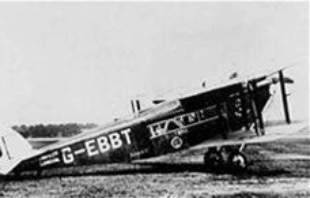
The aircraft involved was a de Havilland DH.34, construction number 35, registered G-EBBX. It had been manufactured in 1922 and entered service on 6 March that year. The aircraft was originally owned by the Air Council and had been leased to Daimler Hire Ltd. When Imperial Airways was established in April 1924, G-EBBX became part of the new airline’s fleet.
The DH.34 was an early British commercial aircraft designed for passenger and mail services. It was powered by a Napier Lion engine and was used on scheduled services during the early development of commercial aviation in Britain.
The aircraft had undergone several modifications during its operational history. In April 1924, it was fitted with a new set of wings of a type different from its standard configuration. A new certificate of airworthiness was issued on 29 April.
On 12 May 1924, the aircraft was involved in a ground collision with a searchlight at an airfield. Its wings were damaged, and the aircraft was subsequently fitted with standard wings. Another certificate of airworthiness was issued on 24 November 1924, about one month before the fatal accident.
The Flight From Croydon
On Christmas Eve, 24 December 1924, G-EBBX was scheduled to operate an international passenger flight from Croydon to Paris.
There were eight people on board, consisting of one pilot and seven passengers. The aircraft also carried mail as part of the scheduled service.
The aircraft took off from Croydon Airport at approximately midday.
Shortly after departure, witnesses observed the aircraft flying at low altitude over the Purley area. Reports described the aircraft as having difficulty gaining height. It subsequently turned and descended toward the ground. The aircraft eventually nosedived and crashed at Castle Hill in Purley, where the Kingsdown housing estate was under construction.
The crash site was approximately 1.5 miles, or 2.4 kilometres, from Croydon Airport.
The Crash at Purley
The DH.34 struck the ground and overturned. An explosion followed, and the aircraft caught fire.
The intensity of the fire prevented immediate rescue of the people inside the aircraft. Local emergency services attended the scene, but the burning wreckage made it impossible to reach the occupants until the fire had been extinguished.
The local fire brigade eventually brought the fire under control. The bodies of the eight occupants were then recovered from the wreckage. All eight people on board had died.
The accident occurred in an area that was being developed for housing. Contemporary accounts also recorded that the aircraft narrowly avoided other obstacles in the area before crashing.
Evidence From Witnesses
Several witnesses provided information about the aircraft’s final moments.
One witness reported seeing the aircraft flying low before it descended toward the ground. Another account described the aircraft as having difficulty gaining altitude after takeoff.
Evidence later presented during the investigation indicated that the aircraft had been operating at a relatively low altitude when it lost control.
A witness employed as a rigger by Imperial Airways stated that the aircraft appeared to stall from an altitude of approximately 300 feet. Another witness who had watched the aircraft take off reported that its takeoff run was unusually long, approximately 700 yards, and that it gained height slowly.
Another aircraft departing after G-EBBX was also reported to have experienced difficulty gaining height. Major Brackley, an Imperial Airways official at Croydon, reportedly noted that aircraft were not taking off easily that day.
Reports of Engine Problems
Evidence concerning the aircraft’s engine was also examined.
In the days before the accident, the engine of G-EBBX had reportedly been running roughly and had experienced fluctuating oil pressure. One witness later stated that they heard a rattling sound from the engine shortly before the aircraft nosedived.
However, another witness, an Imperial Airways rigger, said that he had not noticed anything unusual about the engine sound.
The aircraft’s Napier Lion engine had also experienced lubrication-system problems before the accident. According to evidence presented during the subsequent public inquiry, those problems had been addressed before the flight. The aircraft had also been inspected on the morning of the accident.
The investigation therefore examined whether an engine or mechanical problem had caused the aircraft to lose power or control shortly after takeoff.
The Inquest
An inquest into the deaths began at Croydon on 29 December 1924.
The proceedings included evidence concerning the identities of the victims, witnesses to the crash and pathological examinations. The inquest was later adjourned and resumed on 9 January 1925, when additional evidence concerning the aircraft’s operation and mechanical condition was heard.
Evidence about the engine’s operation before the accident became an important part of the proceedings.
The investigation also examined the aircraft’s takeoff performance and the condition of Croydon Airport.
The Public Inquiry
Following the accident, the British authorities conducted a formal investigation through the Accidents Investigation Branch.
A Public Inquiry was subsequently held under the Air Navigation legislation then in force. It opened on 23 January 1925 at the Royal Courts of Justice in London.
The inquiry was chaired by Sir Arthur Colefax, with Professor B. M. Jones and James Swinburne serving as assessors. It was the first public inquiry into a civil aviation accident in the United Kingdom.
The inquiry examined the aircraft, its certificate of airworthiness, maintenance records, engine condition, the circumstances of the flight and the conditions at Croydon Airport.
Evidence established that G-EBBX had a valid certificate of airworthiness. The aircraft had been inspected on the morning of the accident and was not overloaded. The investigation also determined that the previously reported lubrication problems with the Napier Lion engine had been rectified.
Findings of the Inquiry
The inquiry did not establish a single definite mechanical failure that could be identified as the direct cause of the crash.
The final findings stated that the aircraft had suffered an unknown mechanical defect, followed by a stall while an emergency landing was being attempted.
The pilot was not blamed for the accident, and no negligence was found on the part of Imperial Airways or the Air Ministry.
The condition of Croydon Airport was, however, identified as a contributing factor. The inquiry found that conditions at the airport made it difficult for pilots to comply with certain requirements of the Air Navigation (Consolidation) Order of 1923.
The inquiry also determined that clarification was required concerning the meaning of the term “flight” within parts of the aviation regulations.
Croydon Airport and the Inquiry
The accident brought attention to the facilities and physical conditions at Croydon Airport.
At the time, Croydon was Britain’s principal airport for international scheduled air services. The airport served routes connecting Britain with destinations across Europe.
The inquiry examined whether the airport’s layout and surrounding terrain affected aircraft operations. The findings concerning the airfield contributed to discussions about expanding the airport.
Croydon Airport was subsequently expanded, with the development incorporating most of the adjacent Beddington Aerodrome.
Imperial Airways
Imperial Airways had been established in April 1924 through the merger of several British airlines, including Daimler Airways, Instone Air Line, Handley Page Transport and the British Marine Air Navigation Company.
The newly formed airline inherited several de Havilland DH.34 aircraft. The type remained in Imperial Airways service until March 1926. The airline later moved toward the use of multi-engine aircraft for its scheduled services.
The Purley accident occurred less than nine months after Imperial Airways was established and became the company’s first fatal accident.
The DH.34 Fleet
The de Havilland DH.34 was an important aircraft in the early British commercial aviation period.
The first DH.34 entered service with Daimler Airways on the Croydon-Paris route in April 1922. Several DH.34 aircraft were subsequently operated by Daimler Airways and Instone Air Line.
When Imperial Airways was formed in 1924, it inherited six DH.34 aircraft from its constituent companies. The aircraft continued to operate passenger and mail services before being withdrawn from service in 1926.
The type had previously experienced other accidents. On 14 September 1923, Daimler Airways DH.34 G-EBBS crashed at Ivinghoe Beacon while operating a flight from Croydon to Manchester, killing all five people aboard.
Loss of G-EBBX
The aircraft involved in the Purley crash was destroyed in the accident.
The British civil aircraft register records G-EBBX as a DH.34 later modified to DH.34B configuration. Its operational history ended with the crash at Purley on 24 December 1924.
The accident resulted in the deaths of all seven passengers and the pilot.
Conclusion
The Imperial Airways de Havilland DH.34 crash occurred on 24 December 1924 shortly after G-EBBX departed Croydon Airport for a scheduled flight to Paris.
The aircraft carried seven passengers and one pilot. It crashed at Castle Hill, Purley, approximately 2.4 kilometres from Croydon Airport, after losing control at low altitude. The aircraft struck the ground, overturned and caught fire, killing everyone on board.
Evidence from the subsequent investigation included reports of slow climb performance, engine irregularities and the aircraft’s low altitude before the crash. A formal public inquiry examined the aircraft’s mechanical condition, the pilot’s actions, the operating conditions and Croydon Airport.
The inquiry concluded that an unknown mechanical defect had resulted in a stall during an attempted emergency landing. It did not find negligence by the pilot, Imperial Airways or the Air Ministry. The condition of Croydon Airport was identified as a contributing factor.
The Purley crash became the first fatal accident involving Imperial Airways and resulted in the first public inquiry into a civil aviation accident in the United Kingdom.

Ajeet Yadav is an aviation enthusiast covering airline news, airports, aircraft, and industry developments through well-researched and reliable reporting.