









Pan American Flight 1 Samoan Clipper Disaster
The Samoan Clipper disaster was a tragic aviation accident that happened on 11 January 1938 near Pago Pago, American Samoa. The aircraft was a Sikorsky S-42B flying boat operated by Pan American Airways, one of the most important airlines of the early international aviation era.
The aircraft was flying from Pago Pago to Auckland, New Zealand, as part of Pan American’s developing trans-Pacific service. It was carrying mail and express cargo, but there were no passengers on board. Seven crew members were aboard, including the famous Pan American pilot Captain Edwin C. Musick. All seven people died when the aircraft caught fire and exploded over the Pacific Ocean.
The accident was especially important because Captain Musick was one of the best-known pilots of his time. He had played a major role in developing long-distance commercial flying across the Pacific. His death shocked the aviation world and became one of the most remembered tragedies in the early history of trans-Pacific air travel.
Pan American Airways and Trans-Pacific Aviation
During the 1930s, Pan American Airways, commonly known as Pan Am, was one of the world’s leading international airlines.
The company was developing routes across the Pacific Ocean at a time when long-distance commercial flying was still new. Flying across thousands of miles of ocean required aircraft that could carry large quantities of fuel, mail, equipment, and crew.
There were no modern airports across much of the Pacific. Instead, Pan Am used carefully selected stopping points and flying-boat bases.
The route connecting the United States with New Zealand was particularly ambitious.
The Samoan Clipper was an important part of this new service.
The Sikorsky S-42B
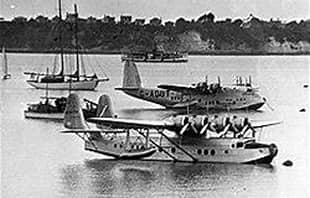
The aircraft involved in the accident was a Sikorsky S-42B, registration NC16734.
It was a large four-engine flying boat designed for long-distance passenger and mail operations.
Flying boats were different from modern airliners because they could take off from and land on water.
Instead of using a normal runway, the aircraft operated from harbors, bays, and specially prepared water areas.
This was extremely useful during the 1930s because suitable airports were not yet available in many remote parts of the world.
The S-42 was one of Pan Am’s important long-distance flying boats.
The Samoan Clipper
The aircraft had originally been known as the Pan American Clipper II.
It was later renamed the Samoan Clipper.
The aircraft had already played an important role in Pan Am’s Pacific operations.
In 1937, Pan American began developing a route connecting the United States with New Zealand.
The route used Honolulu, Kingman Reef, and Pago Pago as important points along the journey.
The Samoan Clipper was therefore part of an important experiment in international air transportation.
Captain Edwin Musick
The captain of the Samoan Clipper was Edwin C. Musick.
Musick was one of the most famous pilots of the 1930s.
He had enormous experience in long-distance aviation.
According to the official investigation, Musick had approximately 13,200 hours of flying experience, including about 2,320 hours in trans-Pacific operations.He was not an inexperienced pilot.
He was known for his careful and professional approach to flying.
His death therefore had a major impact on Pan Am and the wider aviation community.
The Trans-Pacific Route
The Samoan Clipper was operating on the route between Hawaii and New Zealand.
The route was extremely challenging.
Large sections of the journey crossed open ocean.
There were limited places where an aircraft could land safely.
Weather could change quickly.
Communication was also much more difficult than it is today.
The aircraft had to carry enough fuel to travel long distances between stopping points.
This made fuel management extremely important.
The Flight of 11 January 1938
On 11 January 1938, the Samoan Clipper departed Pago Pago, American Samoa, for Auckland, New Zealand.
The aircraft was carrying mail and express cargo.
There were seven crew members aboard.
No passengers were being carried on this service. The official accident report specifically stated that no authority had been requested or granted to carry passengers on this route. The flight initially appeared to be normal.
The aircraft took off from Pago Pago and headed toward New Zealand.
But after approximately an hour, a serious mechanical problem developed.
The Oil Leak
The crew discovered an oil leak involving the Number 4 engine.
An engine oil leak was a serious problem.
The crew could not simply continue a long ocean flight with an engine in questionable condition.
Captain Musick decided to shut down the affected engine.
The aircraft was then operating with fewer engines than normal.
The crew also decided to return to Pago Pago.
This decision was reasonable because Pago Pago was the nearest suitable location for a landing.
However, there was another problem.
The aircraft was still carrying a large amount of fuel.
The Problem With Landing
The Samoan Clipper was a very large aircraft.
It was heavily loaded with fuel for the long journey to Auckland.
The waters of Pago Pago Harbor were not large enough to make a fully loaded landing easy or safe.
The aircraft therefore needed to become lighter before attempting to land.
The crew decided to dump fuel.
Fuel dumping was intended to reduce the aircraft’s weight.
This would make the aircraft easier to land safely.
However, the fuel-dumping operation created an unexpected and catastrophic danger.
Fuel Dumping
The crew began releasing fuel from the aircraft.
At this point, something went wrong.
A fire developed.
The aircraft suddenly became engulfed in flames.
The fire rapidly intensified.
The Samoan Clipper exploded in the air and plunged into the Pacific Ocean.
The entire event happened very quickly.
There was no opportunity for the crew to escape.
The Explosion
The aircraft was approximately 12.5 nautical miles northwest of Pago Pago when the accident occurred, according to the official investigation.
The burning aircraft fell into the ocean.
All seven crew members were killed.
The aircraft was completely destroyed.
There were no survivors.
The tragedy was particularly shocking because the crew had been attempting to return safely after discovering the engine problem.
Search and Rescue
After the aircraft failed to return to Pago Pago, a search operation began.
Ships and aircraft searched the surrounding waters.
The U.S. Navy played an important role in the recovery effort.
Wreckage and an oil slick were eventually found in the ocean.
The aircraft had broken apart and scattered across the water.
The search confirmed that the Samoan Clipper had been destroyed.
The Seven Crew Members
The aircraft had a crew of seven:
- Captain Edwin C. Musick
- First Officer Charles Sellers
- Junior Flight Officer
- Navigating Officer
- Radio Officer
- Flight Engineer
- Assistant Flight Engineer
The official investigation records the seven positions and confirms that all seven crew members died.
They represented the different specialists required to operate a long-distance flying boat during the 1930s.
A trans-Pacific flight required more crew members than a modern commercial flight.
Navigation, radio communication, engineering, and aircraft handling all required specialized personnel.
The Investigation
The United States Bureau of Air Commerce investigated the accident.
The investigation examined the aircraft, the flight, the engine problem, the fuel-dumping procedure, and possible causes of the fire.
The investigation was especially difficult because most of the aircraft had disappeared beneath the ocean.
There was no modern flight-data recorder.
There was no cockpit voice recorder.
Investigators therefore had to depend heavily on radio communications, witness observations, recovered wreckage, and technical analysis.
Possible Cause of the Fire
The exact ignition source could not be established with complete certainty.
However, investigators considered the possibility that fuel vapors became trapped in parts of the aircraft.
Fuel vapors can be highly dangerous when they mix with air.
If the mixture reaches an ignition source, it can catch fire or explode.
The aircraft’s structure and fuel-dumping system were therefore carefully examined.
The official investigation could not identify one definite ignition source.
Electrical Equipment
One possibility involved electrical equipment in the aircraft.
The Pan Am Historical Foundation notes that fuel vapors may have accumulated in the wing structure and possibly been ignited by electrical components associated with the aircraft’s flaps.
This explanation remains one of the important theories concerning the disaster.
It is important to distinguish between a possible explanation and a proven fact.
The precise ignition mechanism was never established with complete certainty.
Why the Accident Was So Difficult
The accident demonstrates the difficulties of operating large aircraft in the 1930s.
Modern aircraft have sophisticated systems for detecting engine problems.
They also have carefully designed fuel systems and advanced fire protection.
Modern pilots have many ways to communicate with ground controllers and emergency services.
The Samoan Clipper had much less technology available.
The crew had to make difficult decisions using the information available at the time.
The Importance of Fuel Management
Fuel was one of the biggest challenges for long-distance flying boats.
The aircraft needed enough fuel to cross large sections of ocean.
However, carrying too much fuel made the aircraft heavier.
A heavily loaded aircraft was harder to land.
This created a difficult balance.
The crew had to carry enough fuel for the planned journey while also considering the possibility of returning to the departure point.
The Samoan Clipper accident showed how fuel management could become a serious safety issue during an emergency.
The Importance of Engine Reliability
The Number 4 engine’s oil leak began the chain of events that led to the disaster.
The crew had to shut down the engine.
The aircraft was then forced to return.
This demonstrated the importance of engine reliability on long-distance ocean flights.
A four-engine aircraft had an important advantage because it could continue flying after losing one engine.
However, continuing a long flight over the Pacific with a mechanical problem was not necessarily safe.
Returning to the nearest suitable base was the logical choice.
Captain Musick’s Decision
Captain Musick’s decision to return to Pago Pago showed his concern for safety.
He did not continue toward Auckland with a serious engine problem.
Instead, he attempted to return to a known base.
The problem was that the aircraft was too heavy for the restricted harbor area.
The crew therefore needed to reduce weight.
The tragedy occurred during this attempt.
The Loss of a Famous Pilot
The death of Edwin Musick was particularly significant.
He was one of the best-known pilots in the world.
His career had been closely connected with the development of Pan Am’s long-distance flying operations.
He had helped demonstrate that commercial aviation could cross enormous distances.
His death therefore represented the loss of an important aviation pioneer.
Impact on Pan American Airways
The accident was a major blow to Pan American Airways.
The Samoan Clipper had been part of an important new route.
The loss of the aircraft and its experienced crew created serious concerns about the safety of the service.
Reports at the time indicated that the accident temporarily affected the newly established Pan American service between the United States and New Zealand.
The airline continued to develop its Pacific operations, but the tragedy remained an important event in its history.
Impact on New Zealand Aviation
The accident also affected New Zealand.
Pan Am’s new service had connected New Zealand to the international air-mail network.
The first official New Zealand airmail flight to the United States had been carried by the Samoan Clipper earlier in January 1938.
The aircraft therefore represented an important link between New Zealand and North America.
Its loss was not only an aviation tragedy but also a setback for the development of regular trans-Pacific air services.
A New Era of International Mail
The Samoan Clipper was carrying mail because airmail was an important part of the development of international aviation.
Before long-distance aircraft became practical, international mail traveled mainly by ship.
Airplanes could greatly reduce delivery times.
A letter could travel between distant countries much faster.
Pan Am’s Pacific service was part of this transformation.
Search Operations in the Pacific
Finding a crashed aircraft in the Pacific was extremely difficult.
The ocean covers a huge area.
There were few ships in remote locations.
The aircraft left no modern satellite emergency signal.
Search teams had to depend on radio reports and observations.
A U.S. Navy seaplane tender eventually found wreckage and an oil slick.
Historical accounts place the wreckage approximately 14 miles northwest of Pago Pago.
The Legacy of Edwin Musick
Musick’s name continued to be remembered after the accident.
In 1939, a headland in New Zealand was renamed Musick Point in his honor.
This provided a permanent reminder of his contribution to early trans-Pacific aviation.
The memorial also reflected the importance New Zealand placed on the development of international air services.
Lessons From the Disaster
The Samoan Clipper accident provided several important lessons.
Engine Problems Must Be Taken Seriously
The oil leak forced the crew to make an emergency decision.
Aircraft Weight Matters
A heavily loaded aircraft can be difficult to land safely during an emergency.
Fuel Dumping Requires Care
Fuel vapors can create serious fire risks.
Electrical Systems Must Be Protected
Electrical equipment must be carefully separated from flammable fuel vapors.
Emergency Planning Is Essential
Long-distance flights require plans for dealing with engine failures and other emergencies.
Accident Investigations Are Important
Detailed investigations help identify problems and improve future aircraft design.
Improvements in Later Aircraft
Aviation technology improved greatly after the 1930s.
Fuel systems became more sophisticated.
Electrical equipment became better protected.
Engine reliability improved.
Fire detection and suppression systems were developed.
Aircraft structures were carefully designed to prevent fuel vapor accumulation.
Long-distance navigation and communication also became much more advanced.
These improvements were partly driven by lessons from accidents like the Samoan Clipper disaster.
The End of the Flying Boat Era
Flying boats played an important role in the development of international aviation.
They allowed airlines to operate routes where airports did not exist.
However, the development of long-range land aircraft eventually reduced their importance.
After the Second World War, large airports became increasingly common.
Aircraft could operate from conventional runways.
The age of the giant flying boat gradually came to an end.
The Importance of the Samoan Clipper
The Samoan Clipper represents both the promise and the danger of early trans-Pacific aviation.
It demonstrated how far aviation had progressed.
A large aircraft could carry mail across thousands of miles of ocean.
But the accident also showed how vulnerable these aircraft could be when faced with mechanical problems.
The technology was impressive, but it was still developing.
Remembering the Seven Crew Members
The seven people aboard the Samoan Clipper were experienced aviation professionals.
They were not simply names connected with an aircraft accident.
They were pilots, engineers, navigators, and radio specialists who played an important role in operating one of the world’s most advanced long-distance aircraft.
Their deaths were a major loss to their families and to the aviation community.
Historical Importance
The Samoan Clipper disaster occurred at an important moment in aviation history.
Trans-Pacific commercial flying was only beginning.
The route between North America and New Zealand represented a major achievement.
The accident showed the risks involved in opening new international routes.
It also demonstrated the importance of developing safer aircraft and better emergency procedures.
Conclusion
The Pan American Flight 1 – Samoan Clipper disaster of 11 January 1938 was one of the most important tragedies in the early history of trans-Pacific aviation.
The Sikorsky S-42B, registered NC16734, had departed from Pago Pago, American Samoa, for Auckland, New Zealand. The aircraft was carrying mail and express cargo and had a crew of seven. There were no passengers aboard.
About an hour into the flight, the crew discovered an oil leak in the Number 4 engine. Captain Edwin Musick decided to shut down the engine and return to Pago Pago. Because the aircraft was heavily loaded with fuel, the crew began dumping fuel to reduce its weight before attempting to land.
During the fuel-dumping operation, a fire suddenly developed. The aircraft exploded and plunged into the Pacific Ocean. All seven crew members were killed.
The exact source of ignition was never established with complete certainty. Investigators considered the possibility that fuel vapors accumulated within the aircraft’s structure and were ignited by an electrical source.
The death of Captain Edwin Musick made the tragedy especially significant. Musick was one of the world’s most famous pilots and had played a major role in developing Pan Am’s Pacific services.
The accident also showed the difficulties of early long-distance aviation. Aircraft had to carry large amounts of fuel, emergency landing locations were limited, and crews had much less technology than modern pilots.
The Samoan Clipper had also played an important role in establishing the new air connection between the United States and New Zealand. Earlier in January 1938, it had carried the first official New Zealand airmail to the United States. The tragedy therefore represented both the promise and the danger of early international aviation.
Today, modern aircraft have much safer fuel systems, improved engine monitoring, advanced fire protection, better navigation, and sophisticated emergency procedures. These improvements are the result of decades of engineering and lessons learned from earlier accidents.
The Samoan Clipper disaster remains an important chapter in aviation history. It reminds us of the courage of the early pilots and crews who opened the world’s first long-distance air routes, while also showing the risks they faced. The loss of seven crew members, including Edwin Musick, remains a lasting reminder of the human cost of pioneering aviation.

Ajeet Yadav is an aviation enthusiast covering airline news, airports, aircraft, and industry developments through well-researched and reliable reporting.