











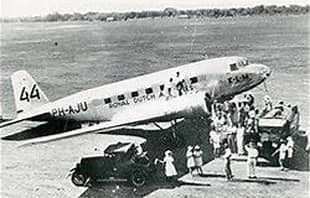
KLM Douglas DC-2 Iraqi Desert Crash 20 December 1934
The KLM Douglas DC-2 Iraqi Desert Crash was a tragic aviation accident that happened on 20 December 1934 near Rutbah Wells in Iraq. The aircraft was a Douglas DC-2-115A, registered PH-AJU and named Uiver, operated by KLM Royal Dutch Airlines. It was flying from Amsterdam, Netherlands, to Batavia in the Dutch East Indies, now known as Jakarta, Indonesia, on a special Christmas mail and passenger flight. All seven people aboard were killed.
The accident was particularly shocking because the aircraft had become famous only a few months earlier after winning the handicap division of the MacRobertson Air Race from London to Melbourne. The Uiver had become a symbol of Dutch aviation success. Its loss so soon after that achievement was therefore a major tragedy for KLM and the Netherlands.
The accident also became important in aviation history because it demonstrated the dangers of long-distance flying across remote desert areas during bad weather, especially when aircraft crews had limited navigation and weather information.
KLM in the 1930s
KLM Royal Dutch Airlines was one of the world’s oldest established airlines and had already developed an international reputation by the 1930s.
The airline operated routes connecting the Netherlands with European cities and increasingly with destinations in Asia.
One of its most important ambitions was the long-distance route from Amsterdam to Batavia, the capital of the Dutch East Indies.
This route covered thousands of miles and required numerous stops for fuel, passengers, mail, maintenance, and navigation.
The journey was much more difficult than a modern long-distance airline flight.
Aircraft had to cross mountains, deserts, and remote regions.
Weather information was limited.
Navigation was more complicated.
There were also very few places where a damaged aircraft could make an emergency landing.
The Douglas DC-2
The aircraft involved was a Douglas DC-2-115A, registration PH-AJU, named Uiver.
The DC-2 was one of the most advanced passenger aircraft of the early 1930s.
It was an all-metal, twin-engine aircraft designed by the Douglas Aircraft Company in the United States.
The aircraft was faster, stronger, and more comfortable than many earlier airliners.
The DC-2 helped establish the modern design of the commercial airliner.
The Uiver was a particularly famous example of the type.
It had entered service only a few months before the accident and had already attracted international attention.
According to accident records, the aircraft had accumulated only about 284 flight hours before the crash.
The Famous Uiver
The name Uiver is Dutch and refers to a stork.
The aircraft became famous in October 1934 when it took part in the MacRobertson International Air Race between London and Melbourne.
The race was one of the most famous aviation events of the period.
The Uiver was the only commercial passenger airliner participating in the race.
Despite this disadvantage, it performed extremely well and won the handicap section.
Its achievement made the aircraft famous throughout the Netherlands.
People followed news of the race closely.
The aircraft and its crew became national heroes.
KLM’s success in the race also strengthened the airline’s reputation for long-distance flying.
Only about two months later, however, the Uiver would be destroyed during a regular international flight.
The Special Christmas Flight
The flight involved in the accident was not an ordinary journey.
KLM organized a special Christmas mail and passenger flight from Amsterdam to Batavia.
The aircraft departed Schiphol Airport in the Netherlands on 19 December 1934.
It carried Christmas mail along with passengers.
The planned route included several stops:
Amsterdam – Marseille – Rome – Athens – Cairo – Baghdad – Karachi – Rangoon – Singapore – Batavia.
This was an extremely long journey for the period. (Bureau of Aircraft Accidents Archives)
The aircraft carried three passengers and four crew members.
The four crew members were:
- Captain Willem Beekman
- First Officer Jan van Steenbergen
- Flight Engineer Hendrik Waalewijn
- Radio Telegraphist Gysbert van Zadelhoff
The three passengers were:
- Dominique Willem Berretty
- Professor Eduard Willem Walch
- Jacobus Thym Kort
All seven would lose their lives in the crash. (uivermemorial.org.au)
Departure from Cairo
The aircraft reached Cairo during its long journey.
The next major destination was Baghdad.
The flight from Cairo to Baghdad required crossing a large and remote desert region.
The crew received weather information before departure.
Reports indicated that thunderstorms and poor weather were possible along the route.
The crew therefore knew that conditions could become difficult.
The Uiver eventually departed from Cairo-Almaza Airport late at night.
According to accident records, the departure occurred at about 11:30 p.m. local time. The aircraft then headed east toward Baghdad.
Flying Across the Iraqi Desert
The journey across the Iraqi desert was very different from flying over a populated region.
There were few towns and very few emergency landing locations.
At night, the ground was almost completely dark.
The pilot could not depend on visual landmarks in the same way that a pilot flying over a city or coastline could.
Navigation therefore depended heavily on instruments, radio communication, maps, and calculations.
The crew also had to deal with changing weather.
Thunderstorms were particularly dangerous.
Heavy rain could reduce visibility.
Strong winds could make an aircraft difficult to control.
Lightning and turbulence could also create serious problems.
The Weather Becomes Worse
During the flight, the Uiver encountered poor weather.
The crew communicated with Rutbah Wells, a desert settlement and British military post.
Rutbah was an important point on the air route because it provided a place where aircraft could obtain information and potentially land.
The weather ahead became increasingly difficult.
The crew decided to divert toward Rutbah Wells rather than continue directly toward Baghdad.
This decision was intended to provide a safer alternative.
However, the aircraft never reached the airfield.
The Final Moments
The Uiver approached the area near Rutbah Wells during the night.
The aircraft was operating in poor weather and heavy rain.
Investigators later determined that the aircraft struck the ground about 16 kilometres south of Rutbah Wells.
The aircraft hit the desert at high speed.
It was in approximately a 17-degree right bank with the nose about 12 degrees down.
The impact destroyed the aircraft.
The wreckage caught fire.
All seven people aboard were killed.
The Search for the Missing Aircraft
When the Uiver failed to arrive at Baghdad, concern quickly grew.
The aircraft had been expected to continue its scheduled journey.
Its radio communications had stopped.
Authorities began looking for the missing aircraft.
The vast desert made the search extremely difficult.
There were no modern tracking systems.
There was no satellite navigation.
There were no emergency locator transmitters capable of automatically sending the aircraft’s exact position.
Search aircraft had to look for physical evidence on the ground.
The desert was enormous, and an aircraft wreck could easily remain hidden.
Discovery of the Wreckage
The aircraft was eventually located approximately 16 kilometres south of Rutbah Wells.
The wreckage was completely destroyed and burned.
The discovery confirmed the worst fears of the airline and the families of those aboard.
There were no survivors.
The location of the aircraft helped investigators reconstruct the final part of the flight.
The remains showed that the aircraft had struck the ground rather than breaking apart in the air.
The Investigation
Investigators began examining the cause of the disaster.
One of the first questions was whether the aircraft had suffered a technical failure.
The investigation considered possibilities such as:
- Engine failure
- Fire
- Structural failure
- Lightning
- Navigation problems
- Severe turbulence
- Pilot fatigue
- Poor weather
The technical investigation concluded that the accident was not caused by an in-flight fire, structural breakup, lightning, or a major technical failure. Instead, very poor weather, the aircraft’s handling characteristics in severe turbulence, and pilot fatigue were considered important factors.
The Problem of Bad Weather
Weather was one of the most important factors.
The aircraft was flying at night through an area affected by rain and thunderstorms.
Modern aircraft have sophisticated weather radar that allows pilots to identify and avoid dangerous storm cells.
In 1934, pilots did not have this technology.
They had weather reports and radio communication, but they could not see a detailed picture of the weather ahead.
A storm that appeared manageable from a distance could become extremely dangerous once an aircraft entered it.
Pilot Fatigue
Another factor considered in the investigation was pilot fatigue.
The Uiver was operating a very long international flight.
The crew had already flown several stages from Amsterdam toward the Middle East.
Long-distance flying during the 1930s was physically demanding.
Pilots had to remain alert for long periods.
They had to navigate, communicate by radio, monitor instruments, deal with weather, and make decisions without many of the automated systems available today.
Fatigue could reduce concentration and make it harder to respond quickly to changing conditions.
Aircraft Handling in Turbulence
The Douglas DC-2 was an advanced aircraft, but it still had limitations.
Severe turbulence could make aircraft control difficult.
Sudden changes in wind direction and speed could cause an aircraft to roll, pitch, or lose altitude.
The investigation considered the DC-2’s handling characteristics in severe turbulence as another contributing factor.
The combination of poor weather, turbulence, darkness, fatigue, and limited navigation technology created a dangerous situation.
A Controversial Investigation
The official explanation was not the end of the story.
Later research suggested that there had been criticism of KLM’s operating decisions.
A report concerning responsibility was reportedly not made public at the time.
Decades later, a Dutch newspaper obtained material suggesting that investigators had placed some responsibility on KLM for taking excessive risks and for safety decisions surrounding the flight.
This later information created a controversial historical debate about the accident.
It also showed how difficult it can be to understand an aviation disaster many decades after it happened.
The Human Tragedy
The technical details of the accident cannot hide the human cost.
Seven people died.
The four crew members had dedicated their careers to aviation.
The passengers were also notable individuals.
One passenger, Dominique Willem Berretty, was a well-known Dutch journalist and newspaper businessman.
Another, Professor Eduard Walch, was a medical professor.
The third passenger was Jacobus Kort, a businessman.
Their deaths were widely reported in the Netherlands.
The loss was especially painful because the University had been celebrated only weeks earlier as a symbol of Dutch aviation success.
Shock in the Netherlands
The Uiver had become extremely popular after its success in the Melbourne air race.
People in the Netherlands had followed the aircraft’s journey with great interest.
Its victory had created national pride.
When news arrived that the same aircraft had crashed in Iraq, the reaction was one of shock.
The tragedy demonstrated how quickly aviation success could be followed by disaster.
For KLM, the crash was a major blow to its reputation and operations.
The Importance of the Univer Crash
The accident had significance beyond the loss of one aircraft.
It raised questions about the safety of long-distance airline operations.
The flight was crossing remote territory at night.
Weather conditions were difficult.
Navigation was limited.
The aircraft was carrying passengers on a very long journey.
The crash showed that international aviation required careful planning and strong safety procedures.
It also demonstrated the importance of reliable weather information and appropriate decisions when conditions deteriorated.
The Development of Long-Distance Aviation
During the 1930s, airlines were trying to establish regular routes between Europe and Asia.
These routes were technically challenging.
Aircraft had to fly long distances with multiple stops.
Fuel availability was important.
Weather could vary dramatically from one region to another.
Airfields were often basic.
Navigation facilities were limited.
The Uiver flight represented both the achievements and the risks of this period.
The aircraft had already demonstrated that a commercial airliner could travel from Europe to Australia.
But the same technology was still vulnerable when operating through difficult weather in remote areas.
Legacy of the River
The Uiver remains one of the most famous aircraft in Dutch aviation history.
Its success in the 1934 MacRobertson Air Race made it a national symbol.
Its tragic loss only two months later added a darker chapter to its story.
The accident is still remembered in connection with the development of KLM and long-distance aviation.
The four crew members and three passengers are also remembered through historical records and memorials.
The Uiver story demonstrates both the courage of early airline crews and the risks they faced.
Lessons for Modern Aviation
The accident also contains lessons that remain relevant today.
Weather must always be taken seriously.
Pilots need accurate information.
Long flights require careful crew management.
Aircraft must be designed to handle difficult conditions.
Airlines must avoid unnecessary risks.
Navigation systems must be reliable.
Emergency procedures must be effective.
Modern aviation has developed many of these protections through decades of experience.
The Uiver disaster was one of the many events that contributed to this learning process.
Conclusion
The KLM Douglas DC-2 Iraqi Desert Crash of 20 December 1934 was one of the most tragic events in the early history of Dutch commercial aviation.
The aircraft, PH-AJU Uiver, had become famous only weeks earlier after winning the handicap division of the MacRobertson Air Race from London to Melbourne. It was then assigned to a special Christmas mail and passenger flight from Amsterdam to Batavia.
After departing Cairo for Baghdad, the aircraft encountered poor weather while crossing the Iraqi desert at night. The crew diverted toward Rutbah Wells, but the aircraft crashed about 16 kilometres south of the settlement. The DC-2 was destroyed and caught fire, killing all seven people aboard.
The investigation found no evidence that the crash was caused by a major technical failure, fire, lightning, or an in-flight breakup. Poor weather, severe turbulence, the aircraft’s handling characteristics, and pilot fatigue were identified as important factors.The tragedy shocked the Netherlands because the Uiver had been celebrated as a symbol of Dutch aviation achievement just weeks before.
Today, the 20 December 1934 Uiver crash is remembered as an important event in aviation history. It illustrates the enormous challenges faced by early long-distance airline crews and shows how difficult it was to fly safely across remote deserts in darkness and severe weather.
The disaster also reminds us that aviation safety is built through experience. Better weather forecasting, navigation, aircraft design, crew management, communication, and operational procedures have all developed partly because earlier generations of aviators faced these dangers and learned from them.

Ajeet Yadav is an aviation enthusiast covering airline news, airports, aircraft, and industry developments through well-researched and reliable reporting.