
















Hindenburg Disaster 6 May 1937
The Hindenburg disaster was one of the most famous accidents in the history of aviation. It happened on 6 May 1937 at Lakehurst Naval Air Station in New Jersey, United States. The German passenger airship LZ 129 Hindenburg, one of the largest aircraft ever built at that time, caught fire while attempting to land.
The disaster happened very quickly. The huge airship was filled with highly flammable hydrogen gas, which provided the lift needed to keep it in the air. When the Hindenburg caught fire, flames spread rapidly through the airship. The entire event lasted less than a minute.
There were 97 people aboard the Hindenburg, including passengers and crew. 35 people aboard the airship died, and one member of the ground crew also lost his life. A total of 62 people aboard survived. The disaster became an international symbol of the dangers of early air travel and marked the end of the era of large passenger airships.
The Hindenburg Airship
The Hindenburg was a German airship built by the Luftschiffbau Zeppelin company.
It was named after Paul von Hindenburg, the former German president.
The airship was enormous.
It was about 245 metres (804 feet) long, making it longer than many modern passenger aircraft.
The Hindenburg was a rigid airship. Unlike a balloon, it had a strong internal framework that maintained its shape.
Inside the framework were large gas cells filled with hydrogen.
Hydrogen was used because it was lighter than air and could provide strong lifting power.
The Hindenburg was designed to carry passengers in comfort and luxury.
Luxury in the Sky
The Hindenburg was not simply a flying machine.
It was designed as a luxury form of transportation.
Passengers had private cabins.
There was a dining room.
There was a lounge.
There were large windows through which passengers could look at the world below.
There was also a writing room.
The interior was carefully designed to make long-distance air travel comfortable.
Passengers could travel between Europe and North America much faster than by ocean liner.
At the time, this was considered an exciting new form of transportation.
Why Hydrogen Was Used
Hydrogen was used because it was the lightest gas available.
It provided excellent lifting power.
However, hydrogen is extremely flammable.
If hydrogen mixes with oxygen and is ignited, it can burn rapidly.
The designers understood the danger.
The Hindenburg therefore had systems designed to protect the gas cells and prevent leaks.
At the time, however, there was no practical way to use large quantities of helium for German airships.
Helium was safer because it does not burn.
But helium supplies were largely controlled by the United States, and Germany could not easily obtain enough helium for a giant passenger airship.
As a result, the Hindenburg used hydrogen.
The Hindenburg’s Regular Service
The Hindenburg entered commercial service in the mid-1930s.
It operated flights between Germany and North America.
These flights were much faster than sea travel.
A passenger could cross the Atlantic in a few days by airship.
The Hindenburg became a symbol of technological progress.
Its enormous size and luxurious interior attracted worldwide attention.
People often gathered to watch it fly over cities.
The airship was one of the most recognizable aircraft in the world.
The Final Flight
On 3 May 1937, the Hindenburg left Frankfurt, Germany, for another transatlantic flight to the United States.
The airship carried 97 people, including 36 passengers and 61 crew members.
The flight crossed the Atlantic.
The journey itself was mostly successful.
However, the weather around New Jersey was not ideal when the Hindenburg approached its destination.
The airship was scheduled to land at Lakehurst Naval Air Station.
Lakehurst was one of the major facilities used for airship operations in the United States.
Bad Weather at Lakehurst
When the Hindenburg approached Lakehurst on the evening of 6 May, thunderstorms were present in the area.
The weather created difficulties for the landing.
The airship arrived over the landing field but had to wait for conditions to improve.
Eventually, the crew began preparing for the landing.
The Hindenburg had to make a controlled approach toward the mooring mast.
Landing a giant airship was a complicated operation.
Ground crew members had to be ready to handle the mooring lines.
The captain and crew needed to carefully control the airship’s altitude and direction.
The Landing Operation
The Hindenburg approached the mooring area at approximately 7:20 p.m.
The airship was moving slowly.
The ground crew was waiting.
The weather had improved enough for the landing operation to continue.
The Hindenburg moved toward the mooring mast.
Mooring ropes were prepared.
Passengers were still inside the airship.
Many people on the ground were watching the arrival.
Then, suddenly, something went terribly wrong.
The Fire
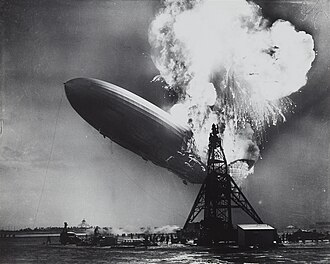
At approximately 7:25 p.m., a fire appeared near the rear of the Hindenburg.
Flames quickly spread through the airship.
The hydrogen inside the gas cells ignited.
The enormous structure began falling toward the ground.
The disaster was captured by photographers and newsreel cameras.
One of the most famous recordings was made by radio reporter Herbert Morrison, whose emotional description of the disaster later became famous.
His reaction helped make the Hindenburg disaster one of the most memorable events in broadcast history.
The Airship Collapses
The Hindenburg was approximately 245 metres long.
Despite its enormous size, the fire destroyed it incredibly quickly.
The rear of the airship rose as the front section fell.
The structure then crashed to the ground.
The entire event took less than a minute.
Passengers and crew members tried to escape.
Some jumped from the airship before it reached the ground.
Others escaped through doors and windows.
The rapid collapse of the airship gave people very little time to react.
People Who Escaped
Despite the terrible fire, many people survived.
Some passengers jumped from the burning airship when it was still relatively close to the ground.
Others escaped from the passenger compartments.
Crew members who were near exits had opportunities to get away.
Of the 97 people aboard, 62 survived.
This was remarkable considering the speed and intensity of the fire.
However, 35 people aboard the airship died.
A member of the ground crew was also killed, bringing the total number of deaths to 36.
Rescue Efforts
Ground crews immediately rushed toward the wreckage.
Firefighters, sailors, and other personnel worked to rescue survivors.
The wreckage was still dangerous because fires continued to burn.
People trapped inside the airship needed immediate assistance.
Survivors were taken away from the crash site.
Many suffered burns and other serious injuries.
The rescue operation continued after the flames had been brought under control.
The Investigation
The Hindenburg disaster immediately raised an important question:
What caused the fire?
Investigators from both the United States and Germany examined the wreckage.
They considered many possible explanations.
These included:
- Hydrogen leakage
- Static electricity
- Weather conditions
- Mechanical problems
- Damage to the gas cells
- Possible sabotage
- Ignition from another source
No single explanation has ever been proven beyond doubt.
The Static Electricity Theory
One of the most widely discussed explanations involves static electricity.
The Hindenburg had flown through stormy weather.
The atmosphere around the airship could have become electrically charged.
When the airship approached the ground, a difference in electrical potential may have developed.
If hydrogen had leaked from one of the gas cells, an electrical spark could potentially have ignited the gas.
This is one of the major theories discussed by historians and aviation researchers.
Hydrogen Leakage
Another important possibility is that hydrogen escaped from one or more gas cells.
For hydrogen to burn, it must mix with oxygen.
A leak could have allowed hydrogen to accumulate in or around part of the airship.
If an ignition source was present, the gas could burn rapidly.
However, investigators never established exactly how a hydrogen leak might have developed.
Sabotage Theories
Because the Hindenburg was a German aircraft and Germany was under Nazi rule, sabotage was also considered.
Some theories suggested that someone might have deliberately caused the fire.
Investigators found no conclusive evidence proving sabotage.
The possibility became part of popular culture, but historians generally continue to debate the exact cause.
The available evidence does not provide a definitive answer.
The Role of the Airship’s Covering
Another theory concerns the outer covering of the Hindenburg.
The airship’s fabric was treated with materials designed to make it durable and weather-resistant.
Some researchers have suggested that the covering could have contributed to the rapid spread of the fire.
However, the role of the covering remains debated.
The hydrogen itself was unquestionably a major factor in the intensity of the fire.
Why the Fire Spread So Quickly
The Hindenburg contained a huge amount of hydrogen.
Once ignition occurred, the fire moved through the airship very rapidly.
The rigid structure contained many gas cells.
When one area caught fire, nearby materials and gas cells were affected.
The enormous airship lost its lifting ability.
The structure collapsed.
This created an extremely dangerous environment for the passengers and crew.
The Famous Radio Broadcast
The Hindenburg disaster became famous partly because it was witnessed and recorded by journalists.
American radio reporter Herbert Morrison was at Lakehurst to report on the landing.
He was making a recording when the airship caught fire.
His emotional description of the disaster was later broadcast to the public.
The recording gave people around the world a vivid sense of what had happened.
It remains one of the most famous recordings in broadcasting history.
Newspaper and Newsreel Coverage
The disaster received worldwide newspaper coverage.
Photographs of the burning Hindenburg appeared in newspapers.
Newsreel cameras captured the disaster.
People who had never seen an airship before could now see the enormous aircraft burning and collapsing.
The event became one of the first major disasters to be experienced through modern mass media.
The Impact on Public Confidence
Before the disaster, large passenger airships were considered an exciting future technology.
They were comfortable.
They were relatively fast.
They could cross oceans without stopping.
Wealthy passengers and celebrities sometimes traveled aboard them.
The Hindenburg disaster changed public opinion.
People began to associate giant passenger airships with danger.
The idea of traveling across the Atlantic inside a hydrogen-filled aircraft suddenly seemed much less attractive.
The End of the Airship Era
The Hindenburg disaster did not immediately destroy every airship operation.
However, it became a major turning point.
After the disaster, confidence in passenger airships collapsed.
Other airship programs also faced increasing problems.
At the same time, airplanes were becoming faster and more capable.
Large fixed-wing aircraft were eventually able to cross the Atlantic more efficiently.
The future of long-distance commercial travel moved toward airplanes.
The Rise of Modern Airliners
During the following decades, passenger airplanes developed rapidly.
Aircraft became larger.
Engines became more powerful.
Navigation improved.
Cabins became more comfortable.
Long-range aircraft could cross oceans without the need for airships.
The development of piston-engine airliners was followed by the introduction of jet aircraft.
By the 1950s and 1960s, jet airliners had become the dominant form of long-distance commercial aviation.
The Human Stories
The Hindenburg disaster was more than a technological failure.
Every person aboard had a story.
Passengers were traveling for business, family reasons, or personal journeys.
Crew members had trained to operate the enormous airship.
Some survivors escaped only seconds before the aircraft collapsed.
Others suffered severe injuries.
The disaster affected families in Germany, the United States, and other countries.
Crew Courage
Many crew members attempted to help passengers escape.
Some crew members stayed at their stations until the final moments.
Others jumped from the airship or escaped through openings in the passenger areas.
Ground personnel also risked their lives while approaching the burning wreckage.
Their actions helped save survivors.
The Hindenburg as a Symbol
Today, the image of the burning Hindenburg is one of the most recognizable images in aviation history.
It symbolizes both technological ambition and the dangers that can accompany new technology.
The airship represented confidence in human engineering.
Its destruction demonstrated how quickly a sophisticated machine could become dangerous.
Lessons from the Disaster
The Hindenburg disaster provided several important lessons.
Flammable Gas Creates Serious Risks
Hydrogen provides excellent lift but is highly flammable.
Weather Matters
Thunderstorms and electrical conditions can create additional hazards.
Landing Operations Require Care
Mooring a giant airship required precise coordination.
Emergency Exits Are Important
Passengers need multiple ways to escape during an emergency.
Fire Safety Is Essential
Aircraft must be designed to reduce the spread of fire.
New Technology Must Be Carefully Tested
Large and complex machines require careful consideration of all possible risks.
Changes in Airship Safety
The disaster encouraged greater attention to airship safety.
Designers examined the materials used in airship construction.
The use of hydrogen was increasingly questioned.
Helium was recognized as a safer lifting gas because it does not burn.
However, helium was expensive and difficult to obtain in large quantities during the period.
The disaster ultimately made the use of hydrogen for passenger airships far less acceptable.
The Role of Helium
Helium would have reduced the risk of a catastrophic hydrogen fire.
It is lighter than air and provides lifting power.
Most importantly, helium is non-flammable.
The United States had the world’s major commercial helium reserves at the time.
Germany could not easily obtain enough helium for the Hindenburg.
This limitation was one of the reasons hydrogen was used.
Modern Air Travel
Modern passenger aircraft use a completely different technology.
Airplanes depend on aerodynamic lift rather than lighter-than-air gases.
They use highly reliable turbine engines.
Modern aircraft have fire-detection systems, emergency exits, fire extinguishers, advanced navigation, and strict safety regulations.
Passengers also receive safety instructions before departure.
The risks are carefully managed through multiple layers of protection.
Historical Importance
The Hindenburg disaster occurred at a critical moment in transportation history.
The world was moving from older forms of transportation toward modern aviation.
The disaster demonstrated the limitations of giant hydrogen airships.
Within a relatively short period, long-distance passenger airplanes became more practical.
The Hindenburg therefore became a symbol of the end of one era and the beginning of another.
Remembering the Victims
The people who died on 6 May 1937 should not be forgotten.
They were passengers, crew members, and a member of the ground team.
Their families suffered a sudden and terrible loss.
Memorials and historical records preserve their names and stories.
Remembering the victims is an important part of understanding the disaster.
Why the Hindenburg Disaster Is Still Famous
The Hindenburg disaster remains famous for several reasons.
First, the airship itself was enormous.
Second, the fire was captured on film.
Third, the radio recording created a powerful emotional record of the event.
Fourth, the disaster marked the end of an important form of transportation.
Finally, the exact cause of the fire has never been established with complete certainty.
These factors have kept the story alive for generations.
Conclusion
The Hindenburg disaster of 6 May 1937 was one of the most important events in the history of aviation.
The German passenger airship LZ 129 Hindenburg was attempting to land at Lakehurst Naval Air Station in New Jersey after crossing the Atlantic from Germany. The enormous airship suddenly caught fire near its rear section and was destroyed in less than a minute.
The Hindenburg carried 97 people. 35 people aboard died, while 62 survived. One member of the ground crew was also killed, bringing the total death toll to 36.
The exact cause of the fire remains uncertain. Theories include hydrogen leakage combined with static electricity, other ignition sources, and, less convincingly, sabotage. Investigators were never able to prove one explanation beyond doubt.
The disaster had a huge effect on public confidence in passenger airships. Before the accident, airships had represented luxury, speed, and the future of international travel. Afterward, people became much more concerned about the dangers of hydrogen-filled aircraft.
At the same time, airplanes were rapidly improving. They became faster, more reliable, and better suited to long-distance travel. Within a few decades, passenger airplanes had replaced airships as the main form of commercial air travel.
The Hindenburg disaster therefore represents more than a tragic accident. It marks the end of the great passenger airship era and the beginning of a new period dominated by airplanes.
The disaster also provided important lessons about fire safety, flammable gases, emergency escape, weather, aircraft design, and the risks of new technology.
More than eighty years later, the image of the Hindenburg burning at Lakehurst remains one of the most powerful images in aviation history. It reminds us that technological progress often comes with risks, and that safety must always develop alongside new ideas.
Most importantly, the Hindenburg disaster should be remembered for the 36 people who lost their lives and the survivors whose lives were changed forever. Their story remains an important part of the history of aviation and a lasting reminder of the human cost of technological failure.

Ajeet Yadav is an aviation enthusiast covering airline news, airports, aircraft, and industry developments through well-researched and reliable reporting.