










China Clipper Crash January 8, 1945
The China Clipper was one of the most famous flying boats in the history of early commercial aviation. It represented a time when airlines used large seaplanes to connect distant countries before long-range land-based passenger aircraft became common. On January 8, 1945, a tragic accident involving the China Clipper occurred in Port of Spain, Trinidad, ending the aircraft’s long career and causing the loss of several lives.
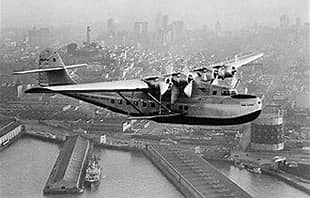
The China Clipper was operated by Pan American Airways, commonly known as Pan Am. The aircraft was a Sikorsky S-42 flying boat, a large aircraft designed to travel long distances over oceans. Although the name “China Clipper” is often associated with Pan Am’s famous trans-Pacific service, the aircraft involved in this accident had become part of the airline’s wider flying-boat operations.
The Age of Flying Boats
During the 1930s and early 1940s, aviation was very different from what it is today.
Modern airports with long concrete runways were not yet available in many parts of the world. Aircraft also had limited range compared with modern passenger jets.
Flying boats offered an important solution.
Large aircraft could take off from and land on rivers, lakes, bays, and sheltered coastal waters. They did not need traditional runways, making them useful for international routes.
Pan Am became one of the world’s leading operators of flying boats. Its aircraft connected the United States with Latin America, Europe, Africa, and Asia.
The China Clipper was part of this important period in aviation history.
The Aircraft
The aircraft associated with the China Clipper service was a large four-engine flying boat.
Flying boats were specially designed for water operations. Their hulls allowed them to float on water, while their wings and engines provided the power needed for takeoff.
Passengers could travel in relative comfort compared with many smaller aircraft of the period.
The aircraft also carried mail and other cargo. In fact, carrying airmail was one of the most important parts of early long-distance airline operations.
The China Clipper became famous because it represented the new possibility of crossing oceans by air.
Pan American Airways
Pan Am was one of the most important airlines in the development of international air travel.
The company pioneered routes across oceans and established bases and facilities in many parts of the world.
Its flying boats became symbols of luxury and technological progress.
A Pan Am flying boat was not simply an aircraft. It represented a new connection between countries and continents.
Passengers could board in one country and travel thousands of miles by air to another part of the world.
By the time of the China Clipper accident in 1945, however, the flying-boat era was already beginning to decline.
World War II had accelerated the development of land-based aircraft, runways, navigation systems, and military transport aircraft.
The January 8, 1945 Accident
On January 8, 1945, the China Clipper was operating in the Caribbean region.
The aircraft was at Port of Spain, Trinidad, where flying boats were able to operate from the harbor.
During the operation, the aircraft suffered an accident while on the water.
The flying boat was damaged severely and could not continue normal service.
Several people lost their lives in the disaster.
Because the aircraft was operating from water rather than a conventional airport, the accident presented special difficulties for rescue workers.
The harbor environment, aircraft structure, and water conditions made emergency operations more complicated.
What Happened
The accident occurred during a period when the aircraft was being operated in an environment that required careful control.
Flying boats had to manage two different aspects of aviation.
First, pilots had to operate the aircraft in the air.
Second, they had to control a large aircraft while it was floating and moving on water.
Water conditions could affect the aircraft’s movement significantly.
Waves, wind, currents, visibility, and the condition of the harbor all mattered.
A flying boat could be difficult to maneuver at low speed, especially near other vessels or obstacles.
The China Clipper’s accident demonstrated some of the challenges involved in operating these large aircraft.
Rescue Efforts
Once the accident occurred, people nearby responded to the emergency.
Because the aircraft was in or near a harbor, rescue personnel and other people in the area could reach the scene.
However, rescuing passengers from a damaged flying boat was not easy.
The aircraft’s large hull could become dangerous if damaged or flooded.
People inside the aircraft needed to escape quickly.
Rescuers had to work carefully around the damaged structure.
The emergency became a tragic event for the passengers, crew, and their families.
The Human Cost
The loss of life was the most painful part of the China Clipper accident.
Every passenger aboard the aircraft had a personal story.
Some people were traveling for business, while others were traveling for personal or wartime reasons.
The crew members were aviation professionals who had experience operating aircraft over long distances.
Their deaths affected their families, friends, and colleagues.
During 1945, the world was already experiencing the enormous human cost of World War II. Air transportation was an important part of the war effort, and many airline employees were working under difficult conditions.
The China Clipper accident added another tragedy to this challenging period.
Investigation
After the accident, authorities examined what had happened.
Investigators considered the aircraft’s condition, the weather, the water conditions, and the actions of the crew.
Flying boats required specialized procedures that were different from those used by land-based aircraft.
Investigators therefore had to consider the circumstances of the accident carefully.
The goal was not only to determine responsibility but also to learn how similar accidents could be prevented.
Aviation safety was developing rapidly during this period.
Each accident provided information that could improve training, equipment, and operating procedures.
Why Flying Boats Were Important
The China Clipper is important even beyond the accident because of its role in aviation history.
Before large land-based aircraft could reliably cross oceans, flying boats provided an effective method of international transportation.
They could operate from large bodies of water, which meant that countries did not always need to construct enormous runways.
Pan Am’s flying boats connected distant places and helped establish international commercial aviation.
The aircraft also carried mail, which was extremely important.
Before the age of email and instant communication, physical mail could take days or weeks to cross oceans.
Air mail dramatically reduced travel time.
The China Clipper became a symbol of this revolution.
The End of the Flying-Boat Era
The accident happened near the end of the great flying-boat era.
During World War II, land-based aircraft improved dramatically.
Aircraft became faster, stronger, and capable of flying much longer distances.
Large military transport aircraft also helped create airports with long runways around the world.
After the war, airlines increasingly preferred land-based aircraft.
These airplanes were generally faster and easier to operate than flying boats.
The development of aircraft such as the Douglas DC-4, Lockheed Constellation, and later jet aircraft changed international travel forever.
Passengers no longer needed to travel from large harbors to cross oceans.
Instead, they could use conventional airports.
As a result, flying boats gradually disappeared from major airline operations.
The Historical Importance of China Clipper
The China Clipper remains one of the best-known names from the early history of international aviation.
It represents courage, innovation, and the determination to connect distant parts of the world.
At a time when crossing the Pacific or Atlantic by air was considered a remarkable achievement, flying boats made regular international service possible.
The aircraft also demonstrated how aviation could change communication and transportation.
The China Clipper’s story therefore includes both achievement and tragedy.
Its accident in 1945 occurred during a period when the technology was already approaching the end of its commercial era.
Lessons for Aviation
The China Clipper accident also reminds us that aviation safety involves more than the aircraft itself.
Pilots must understand weather, water conditions, navigation, aircraft handling, and emergency procedures.
Flying boats required specialized knowledge because they operated from water.
Modern aircraft benefit from decades of safety improvements.
Today, pilots have sophisticated navigation systems, detailed weather information, advanced communication equipment, and extensive training.
Rescue services are also much better equipped.
These improvements came from years of experience, including lessons from accidents involving early aircraft.
Legacy
Although the China Clipper’s career ended tragically, its place in aviation history remains important.
The aircraft belongs to an era when the idea of regular international air travel was still new.
Pan Am’s flying boats helped prove that airplanes could become a practical method of connecting continents.
The name China Clipper became associated with the romance of early ocean aviation.
Large flying boats crossing oceans became symbols of adventure and technological progress.
Even though the era eventually ended, the achievements of these aircraft helped create the international airline industry that exists today.
Conclusion
The China Clipper accident of January 8, 1945, was a tragic event in the history of early international aviation. The accident occurred at Port of Spain, Trinidad, during the final years of the flying-boat era.
The China Clipper represented a remarkable period when large seaplanes connected countries across oceans. These aircraft played an important role in carrying passengers, mail, and cargo before long-range land-based aircraft became dominant.
The accident also demonstrated the difficulties involved in operating large aircraft from water. Weather, waves, harbor conditions, aircraft handling, and emergency procedures all created challenges that pilots and crews had to manage.
Within a few years, the flying-boat era would largely disappear as faster and more capable land-based aircraft became available.
Today, the China Clipper is remembered not only because of the tragedy of January 8, 1945, but also because of what it represented: the pioneering age of international air travel and the remarkable effort to connect the world’s continents by air.

Ajeet Yadav is an aviation enthusiast covering airline news, airports, aircraft, and industry developments through well-researched and reliable reporting.