









Amsterdam Fokker F XXII Crash 14 July 1935
The Amsterdam Fokker F.XXII Crash was a tragic aviation accident that took place on 14 July 1935 near Amsterdam, the Netherlands. The aircraft involved was a Fokker F.XXII, a large four-engine passenger aircraft designed and built in the Netherlands. The accident happened during takeoff from Amsterdam-Schiphol Airport and became an important event in Dutch aviation history.
The crash occurred during a period when commercial aviation was developing rapidly. Aircraft were becoming larger, faster, and more comfortable, and airlines were expanding their networks across Europe. However, aviation technology was still developing, and pilots had to operate aircraft with much less information and fewer safety systems than modern crews.
The Amsterdam accident demonstrated the dangers associated with takeoff and aircraft performance. It also showed the importance of careful aircraft design, engine reliability, pilot training, and airport safety.
Fokker and Dutch Aviation
The Fokker Aircraft Company was one of the most important aircraft manufacturers in the Netherlands.
It had been founded by Dutch aviation pioneer Anthony Fokker.
During the early twentieth century, Fokker became famous for producing aircraft for both military and civilian purposes.
Dutch airlines, particularly KLM, used many Fokker aircraft.
By the 1930s, Fokker was developing larger aircraft for commercial passenger services.
The company wanted to compete with aircraft manufacturers from countries such as Britain, France, Germany, and the United States.
The Fokker F.XXII was one of these large passenger aircraft.
The Fokker F.XXII
The Fokker F.XXII was a four-engine passenger aircraft.
It was designed to carry a relatively large number of passengers compared with the smaller aircraft that had been used during the previous decade.
The aircraft represented an important stage in the development of commercial aviation.
Four engines provided more power than the single- or twin-engine aircraft commonly used on many earlier routes.
The F.XXII was designed with passenger comfort and commercial operations in mind.
However, the aircraft had a relatively short production history.
Only a small number were built.
The accident at Amsterdam became one of the most significant events associated with the aircraft type.
Amsterdam-Schiphol Airport
The accident happened at Amsterdam-Schiphol Airport, one of the most important airports in the Netherlands.
In the 1930s, Schiphol was very different from the modern international airport that exists today.
The airport had far fewer passengers.
Runway and navigation systems were less sophisticated.
Air traffic control was also developing.
Aircraft often relied on visual observation when taking off and landing.
Airport operations were becoming more organized, but aviation technology was still progressing.
Takeoff was one of the most important phases of flight because an aircraft had limited altitude and speed from which to recover if something went wrong.
The Flight on 14 July 1935
On 14 July 1935, the Fokker F.XXII was preparing for a flight from Amsterdam.
The aircraft had passengers and crew aboard.
It was scheduled to depart Schiphol and continue its journey.
The aircraft began its takeoff run.
At first, everything appeared normal.
The engines were operating and the aircraft accelerated along the runway.
As the aircraft became airborne, however, the crew encountered a serious problem.
The aircraft was unable to climb normally.
This created a dangerous situation because the aircraft had little altitude.
The Takeoff Problem
According to historical accounts, the Fokker F.XXII experienced difficulty during takeoff.
The aircraft became airborne but did not gain sufficient height.
The crew attempted to control the situation.
The aircraft remained at a low altitude.
At this stage, there were very few options available.
A pilot may be able to land an aircraft safely after an engine failure if there is sufficient altitude and a suitable landing area.
Immediately after takeoff, however, the aircraft has very little energy available.
Any loss of engine power or other performance problem can therefore become critical.
The Crash
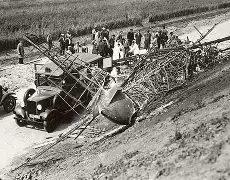
The Fokker F.XXII failed to gain enough height and crashed shortly after takeoff.
The impact caused severe damage to the aircraft.
The accident resulted in fatalities and injuries.
Emergency personnel at Schiphol responded quickly.
Firefighters, medical workers, airport employees, and other rescuers went to the crash site.
The wreckage was examined after the accident to determine why the aircraft had failed to climb.
The Investigation
The crash led to an investigation by Dutch aviation authorities.
Investigators examined the aircraft’s engines and control systems.
They also looked at the aircraft’s weight, takeoff performance, weather conditions, and the actions of the flight crew.
The investigators wanted to answer an important question:
Why had the aircraft failed to climb safely after becoming airborne?
Possible causes included:
- Engine problems
- Loss of power
- Incorrect aircraft configuration
- Excessive weight
- Pilot handling
- Mechanical failure
- Wind conditions
Accident investigations during the 1930s had fewer tools than modern investigations.
There were no flight-data recorders.
There were no cockpit voice recorders.
Investigators therefore had to rely on the wreckage and eyewitness accounts.
Engine Performance
Engine performance was extremely important for a four-engine aircraft.
The Fokker F.XXII depended on its engines to produce enough power for takeoff and climb.
If one engine lost power, the aircraft might still be able to fly.
However, losing more than one engine or suffering a significant reduction in total power could be extremely dangerous during takeoff.
The aircraft’s performance depended on several factors.
These included:
- Aircraft weight
- Fuel load
- Passenger load
- Wind
- Temperature
- Runway length
- Engine power
A small difference in any of these factors could affect takeoff performance.
Aircraft Weight
Aircraft weight was particularly important during takeoff.
A heavy aircraft needs more runway to accelerate.
It also needs more power to climb.
Commercial airlines naturally wanted to carry passengers, baggage, mail, and enough fuel for their journeys.
However, aircraft could not safely exceed their operating limits.
The accident highlighted the importance of calculating aircraft performance before takeoff.
Modern airline crews use highly detailed performance calculations.
These calculations consider runway conditions, temperature, wind, aircraft weight, and engine performance.
The systems available in 1935 were much simpler.
Pilot Training
The role of the pilots was another important part of the investigation.
Commercial aircraft were becoming larger and more powerful.
Flying a large four-engine aircraft required different skills from flying a small single-engine airplane.
Pilots had to understand engine management, aircraft weight, takeoff procedures, and emergency handling.
Training standards were improving, but they were still developing.
An emergency immediately after takeoff gave pilots very little time to respond.
Takeoff as a Dangerous Flight Phase
Takeoff has always been one of the most demanding parts of a flight.
During takeoff, an aircraft is accelerating from rest.
The engines are producing high power.
The aircraft has limited altitude.
If something goes wrong before the aircraft becomes airborne, the pilot may be able to stop on the runway.
But after becoming airborne, the situation becomes more complicated.
The aircraft must gain enough speed and altitude to remain controllable.
The Fokker F.XXII crash demonstrated this danger clearly.
Weather Conditions
Weather can strongly affect takeoff performance.
High temperatures reduce air density.
Strong winds can either help or hurt an aircraft depending on their direction.
Rain can affect runway conditions.
Crosswinds can make directional control difficult.
The pilots of the Fokker F.XXII had to consider the conditions at Schiphol.
Weather information in the 1930s was much less detailed than today’s information.
Pilots received reports from airports and weather stations.
There was no modern weather radar providing a complete picture.
Emergency Response
One positive aspect of an airport accident is that emergency services are usually nearby.
At Schiphol, rescue personnel could reach the crash site relatively quickly.
Firefighters were trained to respond to aircraft accidents.
Medical personnel could assist injured passengers.
The emergency response demonstrated the importance of having rescue facilities at airports.
Airport emergency services became increasingly sophisticated during the following decades.
Modern airports have dedicated fire and rescue units capable of responding within minutes.
The Human Cost
The technical causes of the accident are important, but the human cost was greater.
Passengers had boarded the aircraft expecting an ordinary journey.
They had trusted the airline and its crew.
The accident happened only moments after takeoff.
Such an accident can be particularly frightening because passengers have little warning.
Families and friends of those aboard were left to deal with the sudden loss.
The crash also affected the crew and employees of the airline.
For Dutch aviation, it was a painful reminder of the risks of early commercial flying.
Public Reaction in the Netherlands
The accident attracted public attention in the Netherlands.
Fokker was a famous Dutch aircraft manufacturer.
The country took pride in its aviation industry.
Fokker aircraft were used by airlines around the world.
A serious crash involving a Fokker passenger aircraft therefore received considerable attention.
People naturally wanted to know whether the aircraft design was safe.
The investigation was important for answering these concerns.
The Importance of Aircraft Certification
Aircraft accidents also contributed to the development of stronger certification requirements.
Before an aircraft type could enter widespread passenger service, authorities needed to ensure that its design met safety requirements.
Testing included aircraft structure, engines, controls, and performance.
The development of these requirements became increasingly important as aircraft grew larger.
Manufacturers needed to demonstrate that aircraft could safely operate under different conditions.
Development of Multi-Engine Aircraft
The Fokker F.XXII represented the increasing importance of multi-engine aircraft.
Using four engines offered several advantages.
It provided substantial total power.
It could allow an aircraft to continue flying after a single-engine failure.
It also allowed larger aircraft to carry more passengers.
However, more engines also meant more mechanical systems to maintain.
Engine reliability therefore remained critical.
The development of better engines during the following decades made multi-engine aircraft increasingly dependable.
Fokker’s Aviation History
The Fokker company continued to play an important role in aviation after the accident.
Its aircraft were used by airlines and military organizations.
The company developed many successful designs.
The Fokker name remained strongly associated with Dutch aviation.
The F.XXII itself was not produced in large numbers, but it represented an important stage in the development of larger passenger aircraft.
Aviation Safety in the 1930s
The 1930s were a period of rapid change in aviation safety.
Governments introduced new regulations.
Airlines developed maintenance programs.
Pilots received better training.
Aircraft manufacturers improved structures and engines.
Airports developed better rescue services.
Radio navigation became more important.
Weather forecasting improved.
All of these changes contributed to safer air travel.
The Amsterdam Fokker F.XXII accident occurred in the middle of this development.
Lessons from the Accident
The accident demonstrated several important lessons.
First, aircraft must have sufficient performance during takeoff.
Second, engines must be reliable and carefully maintained.
Third, aircraft weight must be carefully controlled.
Fourth, pilots need strong training for emergencies immediately after takeoff.
Fifth, airports need effective emergency services.
These principles remain important in modern aviation.
Although aircraft and technology have changed enormously, takeoff performance is still carefully calculated before every commercial flight.
The Evolution of Commercial Aviation
By the late 1930s and 1940s, passenger aircraft were becoming increasingly advanced.
Aircraft such as the Douglas DC-3 transformed commercial air travel.
They offered greater reliability and better passenger capacity.
Airline networks expanded.
Radio navigation improved.
Aircraft design became more aerodynamic.
The lessons learned from earlier aircraft accidents helped engineers and regulators improve future designs.
The Fokker F.XXII belongs to this important period of transition.
Historical Legacy
The Amsterdam Fokker F.XXII crash remains part of Dutch aviation history.
It illustrates the risks faced by early passenger aircraft.
It also demonstrates how quickly aviation was developing during the 1930s.
Large four-engine aircraft were becoming possible.
Airlines were expanding.
Airports were becoming busier.
Passengers were increasingly using aircraft as a practical means of transportation.
But the technology was still evolving.
Conclusion
The Amsterdam Fokker F.XXII Crash of 14 July 1935 was a tragic event in the history of Dutch commercial aviation.
The accident involved a Fokker F.XXII, a large four-engine passenger aircraft developed by the famous Dutch Fokker aircraft company. The crash occurred shortly after takeoff from Amsterdam-Schiphol Airport, when the aircraft failed to gain sufficient altitude and came down near the airport.
The accident took place during a period when commercial aviation was developing at great speed. Aircraft were becoming larger, engines were becoming more powerful, and airlines were carrying increasing numbers of passengers. Yet pilots and engineers did not have access to many of the advanced systems used today.
The crash highlighted the importance of takeoff performance, engine reliability, aircraft weight, pilot training, and emergency response. These remain essential areas of aviation safety even today.
Investigators in 1935 had to work without flight-data recorders, cockpit voice recorders, satellite tracking, or modern computer systems. They depended on wreckage, eyewitness reports, aircraft records, and technical examination.
The tragedy also formed part of the continuing development of the Dutch aviation industry. Fokker remained an important aircraft manufacturer, while Schiphol developed into one of Europe’s major airports.
The story of the 14 July 1935 Fokker F.XXII crash is therefore more than the story of one aircraft accident. It is a reminder of the challenges faced by early commercial airlines and the gradual process through which aviation safety improved.
The passengers and crew who lost their lives were part of a new age of transportation. Their journey ended in tragedy, but the lessons learned from accidents during this era contributed to better aircraft design, stronger regulations, improved pilot training, and safer airline operations in the decades that followed.

Ajeet Yadav is an aviation enthusiast covering airline news, airports, aircraft, and industry developments through well-researched and reliable reporting.