











- India’s MRO sector is growing on the back of a rapidly expanding fleet and supportive policy reforms, but the country still sends nearly 80% of high-value work, especially engines and components, overseas due to limited technical depth and OEM restrictions.
- Despite rising domestic infrastructure, improved GST norms, and increasing state interest, India’s MRO ecosystem lacks scale, capability, and talent retention, with productivity and value capture far below global benchmarks like Singapore, Lufthansa Technik, or AFI KLM E&M.
- The path to self-reliance hinges on building deep technical capability: securing technology access from OEMs, investing in engine MRO ecosystems, developing skilled manpower pipelines, and nurturing one or two large “anchor champions” that can position India as the regional hub its geography enables.
India’s Maintenance, Repair and Overhaul (MRO) sector stands at an intriguing crossroads. The numbers, the ambition, and the urgency all align. Yet, the reality on the ground is a patchwork of progress — where every policy breakthrough meets the hard limits of technical depth, scale, and global dependence.
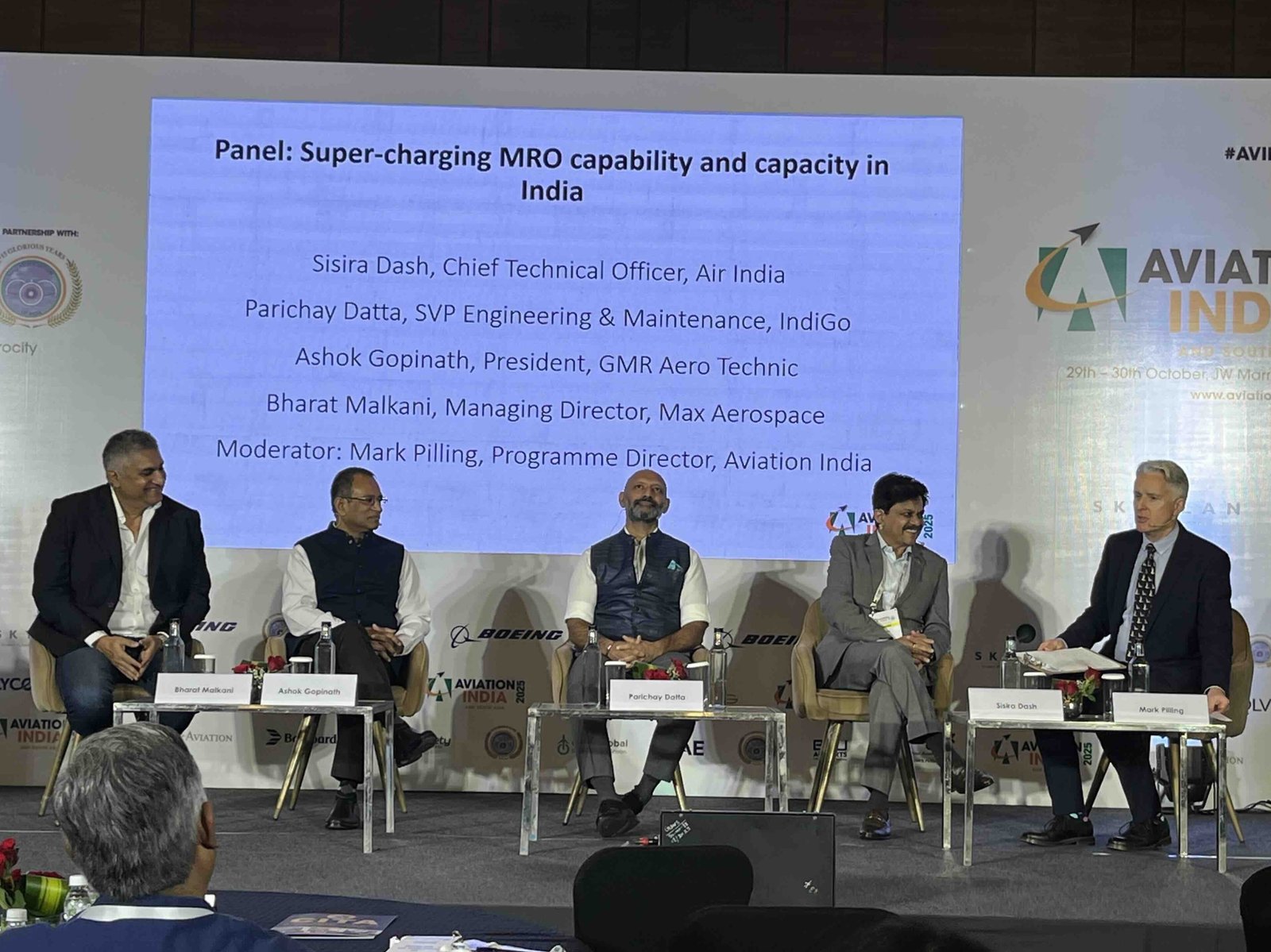
At the recent Aviation India Summit in Delhi, industry veterans described the mood as “cautiously confident.” The optimism is unmistakable, but so is the realism. “We’ve made progress, yes,” said Bharat Malkani, Managing Director of Max Aerospace. “But the MRO business is one of depth and endurance, not just hangars and headlines. India missed the first bus in the 1990s — we cannot afford to miss the second one.”
Fleet Growth, Demand Explosion
The trigger for change is scale. India’s commercial jet fleet, currently nearing 1,000 aircraft, is projected to more than double by 2035, driven almost entirely by single-aisle Airbus models. Aviation Week estimates this expansion will generate over $60 billion in MRO demand over the next decade, with engines alone representing nearly 60% of that value.
That scale should have already created a thriving domestic MRO industry. Instead, roughly 80% of India’s MRO spending still flows overseas. Aircraft flown by Indian airlines routinely have their engines, landing gear, auxiliary power units (APUs), and components shipped to Singapore, Dubai, or Europe for overhaul.
“What comes to us is often just the airframe,” admitted Parichay Datta, Senior Vice President, Engineering & Maintenance at IndiGo. “We take the aircraft apart — the core systems go abroad — and we wait for them to come back. It’s an expensive loop we’ve lived with for decades.”
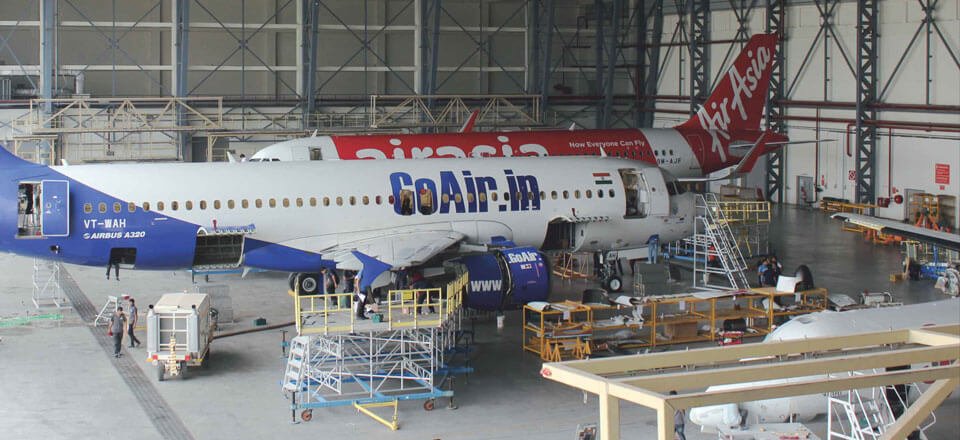
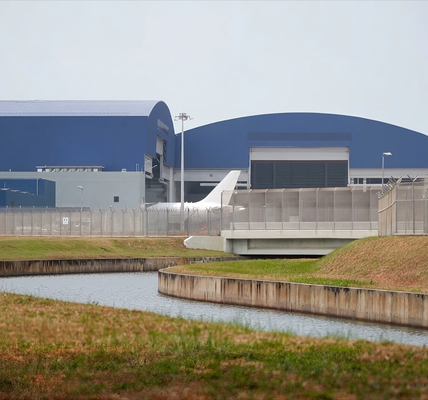
Photo: GMR Aero Technic
That loop, however, has begun to tighten. Over the past five years, the government has treated MRO as a strategic priority within its aviation policy. A sector once burdened with a punitive 18% GST now operates under a more competitive 5% slab, aligning with global norms. The 2020 National Civil Aviation Policy recognised MRO as a critical industry. Customs procedures have been eased, airport royalties rationalised, and 100% FDI allowed under the automatic route.
Prime Minister Narendra Modi, speaking at IATA’s annual general meeting in Delhi earlier this year, pegged India’s ambition clearly: to become a $4 billion MRO hub by 2030, up from roughly $1.7 billion today. “In 2014, there were 96 MRO facilities in India,” Modi said. “Now there are 154. The momentum is visible.”
That visibility, however, is uneven. As Ashok Gopinath, President of GMR Aero Technic, put it: “Structural changes have been implemented, but perception takes longer to change. The ease of doing business is improving, but MRO isn’t an overnight reform story. It’s about sustained trust — between government, OEMs, and operators.”
If India’s MRO story has an Achilles’ heel, it is engines. While airframe and line maintenance are now largely handled domestically, engine and component repair — the high-value segment — remain heavily import-dependent.
Gopinath explained why: “When it comes to components, we are still in the small category. OEMs don’t share the Component Maintenance Manuals (CMMs) or allow independent repair. Without those, even the most advanced facilities can’t perform deep-level maintenance.”

Photo: GMR Aero Technic
It’s a familiar frustration for Indian MRO players. OEMs guard their intellectual property, and airlines, having signed long-term global service agreements, have little incentive to shift work back home. “My customers already have engine maintenance contracts with global players,” Malkani said. “For new entrants, the window is only a sliver.”
The economics of engine MRO are brutal. Each facility can cost between $100 million and $300 million to set up, depending on scope and technology access. “You need not just one facility, but an ecosystem — test cells, component shops, logistics, and certified manpower,” said Datta. “We are still building the first layer of that ecosystem.”
According to a Kearney report, India’s MRO market is projected to grow by 9% annually to touch $4 billion by 2031. Yet, only 15–20% of this value is captured domestically.
The top three Indian players — Air India Engineering Services Ltd (AIESL), Air Works, and GMR Aero Technic — together earn less than $200 million a year. In comparison, Lufthansa Technik or AFI KLM E&M each post revenues of $3.5–4 billion.

The report also notes that Indian MROs add significantly less value per employee — about $60 million per 1,000 employees, compared with $230 million for global peers.
Limited capital investment and low-scale operations have kept productivity and technological sophistication far below international standards.
While India debates the next reform, Singapore and Malaysia have quietly cornered the Asian MRO market. Singapore’s ecosystem benefits from tax credits on reinvestment, a dense component supply chain, and the presence of all major OEMs. Yet, India’s growth trajectory — and its geography — offer a potential pivot.
“Sixty per cent of the world’s population is within six hours of India,” Datta observed. “That’s a massive locational advantage. Airlines from Bangladesh, Nepal, and Sri Lanka already send their aircraft for heavy checks here. We could easily become the regional ‘Big Brother’ for South Asia.”
The Safran engine MRO centre in Hyderabad, expected to start operations soon, is a case in point. It could serve as a nucleus for a broader ecosystem encompassing engines, components, and composites. Southern states like Telangana, Karnataka, and Tamil Nadu are competing aggressively to attract investment with policy incentives and industrial park models tailored for aerospace.
Even as infrastructure expands, manpower remains a persistent constraint. India is one of the world’s largest suppliers of aviation maintenance engineers — but mostly to the Middle East and Asia-Pacific. Domestic MRO salaries are a fraction of what global hubs offer. “We train the best, and they leave,” said Sisira Dash, Chief Technical Officer of Air India, wryly. “Without pay parity and skill development pipelines, it’s difficult to retain technical staff.”
The Kearney study underscores the need for a “talent pipeline partnership” — linking MROs, the National Skill Development Corporation, and industrial training institutes. Countries like the UK and Germany have embedded apprenticeship programs within MRO companies like Lufthansa Technik and Airbus; India, observers argue, must emulate that model.

India’s MRO story today is less about aspiration and more about architecture.
The building blocks — policy reforms, state-level incentives, infrastructure, and global interest — are finally aligning.
But genuine self-reliance will require a strategic shift: from creating hangar capacity to building technical capability.
That means negotiating technology transfers with OEMs, offering tax credits for reinvestment, clarifying customs and GST norms for spare parts, and perhaps even nurturing one or two “anchor champions” — large integrated MRO entities with the scale to pull in global work.
As Malkani summed up, “Every major aviation nation has a homegrown MRO leader. Germany has Lufthansa Technik, Turkey has Turkish Technic, China has Ameco. India needs its own version — not just policy talk, but a company with the depth, capital, and credibility to lead the sector.”
For all its challenges, the momentum is real. India’s MRO sector is expanding faster than ever before; its ambitions have finally caught up with its fleet. Yet, as the industry knows too well, the race isn’t just to build hangars — it’s to build confidence.
The mood was one of “We’re catching up, but we’re still a few engine cycles behind.” The climb to self-dependence, then, will not be a sprint — but a long, methodical taxi to the runway of true capability.
Also Read: Safran’s Hyderabad MRO: India’s Leap into the Global Engine Ecosystem
With more than four decades across print and audiovisual media, Tirthankar (TG) Ghosh is a veteran journalist specialising in aviation, air cargo and logistics. His reporting combines deep industry knowledge, original research and sharp analysis to produce authoritative, evidence-led journalism.