







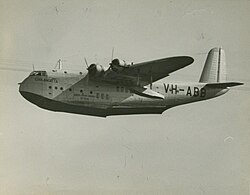
Qantas Short Empire G-AEUH Crash 30 January 1942
The Qantas Short Empire G-AEUH accident was a tragic event in the history of Australian aviation during the early years of the Second World War. The accident happened on 30 January 1942, when a Short Empire flying boat operated by Qantas Empire Airways was lost during a wartime flight in the waters around Australia.
The aircraft, registered G-AEUH and named Corio, was one of the large flying boats used by Qantas for long-distance passenger, mail, and transport services. The aircraft belonged to an important generation of flying boats that connected Australia with Asia and other parts of the world before long-range land aircraft became dominant.
The accident happened at a difficult moment in Australian history. Japan had entered the war, Singapore had fallen under threat, and Japanese forces were moving rapidly through Southeast Asia. Civilian and military aviation services were under enormous pressure.
The loss of G-AEUH was therefore not simply an airline accident. It was part of the wider story of aviation during wartime.
Qantas Empire Airways
Qantas Empire Airways, often known as QEA, was an important Australian airline created through cooperation between Qantas and Imperial Airways.
The airline operated long-distance routes between Australia, Asia, and Europe.
Before the widespread use of modern land-based airliners, flying boats were extremely important for long-distance travel.
They did not require conventional airports with long runways.
Instead, they could land on suitable stretches of water.
This allowed airlines to connect places where airports were not yet developed.
The Short Empire Flying Boat
G-AEUH was a Short Empire flying boat.
The Short Empire was designed and built by the British company Short Brothers.
These aircraft were large, four-engine flying boats designed for long-distance passenger and mail services.
They had a distinctive hull that allowed them to take off from and land on water.
The aircraft also had large wings and four engines.
For the late 1930s, the Short Empire represented advanced long-distance aviation technology.
Flying Boats Before the War
During the 1930s, flying boats were an important part of international aviation.
Airports were still limited in many parts of the world.
A flying boat could use rivers, bays, harbors, and coastal waters.
Qantas used flying boats extensively on routes connecting Australia with Asia.
Passengers could travel long distances by air, although flights took much longer than modern airline journeys.
The aircraft carried passengers, mail, and important cargo.
G-AEUH – Corio
The aircraft involved in the accident was registered G-AEUH.
It was named Corio.
The aircraft had been built for Imperial Airways and was later operated by Qantas Empire Airways.
It was one of the large flying boats that played a major role in Australia’s international air services.
The aircraft had four engines, giving it considerable range and power.
Its size and operating range made it valuable during the difficult conditions created by the war.
The Wartime Situation
The accident occurred in January 1942.
Only a few weeks earlier, Japan had attacked Pearl Harbor.
Japanese forces were advancing rapidly through Southeast Asia.
The British colony of Singapore was under attack.
Malaya was being invaded.
The fall of Singapore was approaching.
Australia suddenly faced a much more direct military threat.
Air routes that had previously been used for civilian travel were being changed or interrupted.
The Importance of Qantas Flights
Qantas flights became increasingly important during the war.
Aircraft were used to transport:
- Passengers
- Government personnel
- Military personnel
- Supplies
- Important documents
Long-distance air transportation was essential because sea travel had become more dangerous.
Japanese submarines and aircraft threatened shipping routes.
Flying provided a faster alternative for some journeys.
The Final Flight
On 30 January 1942, G-AEUH was operating a Qantas service.
The aircraft was being used in the difficult wartime environment of the South Pacific and Australian region.
The flight involved an important passenger and transport mission.
The aircraft took off and continued its journey.
However, the flight ended in tragedy.
The flying boat was lost, resulting in the deaths of those aboard.
The Accident
The accident occurred during a period when flying conditions and navigation were complicated by wartime circumstances.
The aircraft was operating in a region where weather, darkness, long distances, and limited navigation facilities could create serious challenges.
At the time, pilots did not have modern GPS.
There were no satellite navigation systems.
Aircraft depended on:
- Radio navigation
- Magnetic compasses
- Maps
- Dead reckoning
- Visual navigation
- Radio communication
Over water, visual navigation was particularly difficult.
Navigation Over Water
Flying over large areas of water was very different from flying over land.
There were fewer landmarks.
The sea could look almost identical in every direction.
At night, the problem became even greater.
A pilot could not simply look outside and identify a road, mountain, or city.
The crew had to depend on navigation equipment and careful calculations.
Weather and Visibility
Weather was always an important consideration for flying boats.
Clouds, rain, wind, storms, and poor visibility could make navigation difficult.
Weather forecasts in the early 1940s were much less detailed than modern forecasts.
There were no satellites providing continuous images of the entire region.
Pilots often had to work with limited information.
Wartime Navigation Problems
The war created additional difficulties.
Some navigation stations were affected by military restrictions.
Radio facilities could be changed or shut down.
Aircraft crews had to follow special wartime procedures.
Navigation information could also be more difficult to obtain.
This made long-distance flying more challenging.
The Flying Boat Crew
A long-distance flying boat required a skilled crew.
The captain was responsible for the aircraft and the overall flight.
Other crew members assisted with navigation, radio communication, engineering, and passenger duties.
Unlike modern aircraft, flying boats had relatively large crews because many tasks had to be performed manually.
Navigation required constant attention.
Engineers also had to monitor the aircraft’s four engines and other systems.
Four-Engine Reliability
The Short Empire had four engines.
This provided an important level of redundancy.
If one engine failed, the aircraft could normally continue flying.
However, having four engines did not eliminate all risks.
An accident could still happen because of weather, navigation, structural problems, human error, or other circumstances.
The aircraft was also operating in a demanding environment.
Wartime Aviation
By early 1942, aviation was changing rapidly.
Military aircraft were becoming faster and more advanced.
Civilian airlines were increasingly supporting military transportation.
Aircraft that had originally been designed for passengers and mail were being used for wartime duties.
Qantas was an important part of this system.
Its crews operated long and difficult routes under conditions that would have been considered extraordinary during peacetime.
Why the Loss Was Significant
The loss of G-AEUH was significant because flying boats were still an important part of Australian aviation.
The aircraft represented a form of long-distance transportation that was already beginning to disappear.
Land-based aircraft were becoming more capable.
However, during the early years of the war, flying boats remained useful because they could operate from water.
The loss therefore came at an important moment in aviation history.
Australian Aviation in 1942
Australia depended heavily on air connections with the outside world.
The country was geographically isolated.
Distances between major cities and international destinations were enormous.
Flying boats helped overcome these distances.
A Qantas service could connect Australia with places across the Indian Ocean and Southeast Asia.
The war made these connections even more important.
The Human Cost
Behind the aircraft and technical details were people.
The passengers and crew aboard G-AEUH were individuals with families, careers, and personal lives.
The war had already created fear and uncertainty.
The loss of the aircraft added another tragedy.
Families had to receive the terrible news that their relatives had not returned.
The crew members were also experienced aviation professionals whose lives were lost while performing an important transportation mission.
The Role of Qantas Crews
Qantas crews during this period faced demanding conditions.
They flew long distances.
They worked with limited navigation technology.
They sometimes operated at night.
They had to deal with changing weather.
And they were working during a major international war.
Their work required courage and professionalism.
The Development of Safer Aviation
Accidents during this period helped aviation authorities understand the risks of long-distance flying.
Investigators examined:
- Aircraft condition
- Engine performance
- Navigation
- Weather
- Crew decisions
- Radio communication
- Flight planning
The lessons from such investigations could be used to improve future operations.
Navigation Technology After the War
Navigation technology improved dramatically during and after the Second World War.
Radio navigation systems became more sophisticated.
Radar became increasingly important.
Aircraft gained better instruments.
Long-range navigation systems were developed.
Eventually, satellite navigation transformed aviation.
Modern aircraft can determine their exact position using GPS and other systems.
This is a major difference from the technology available to the crew of G-AEUH.
The End of the Flying Boat Era
The Second World War accelerated the development of long-range land aircraft.
Large aircraft such as the Douglas DC-4, Lockheed Constellation, and later jet airliners could travel long distances from conventional airports.
Airports were built and expanded around the world.
As a result, flying boats became less important.
The era of the large international flying boat gradually ended.
Why Flying Boats Were Important
Despite their eventual decline, flying boats played a major role in aviation history.
They made international air travel possible before long runways and modern airports were available.
They connected isolated communities.
They carried mail and passengers across oceans.
They helped establish international air routes.
Qantas was one of the airlines that demonstrated how valuable this technology could be.
Wartime Communications
Air transport also played an important role in communications.
Before modern telecommunications, physical documents had to be transported.
Air mail was much faster than sea mail.
Government officials and military personnel could also travel quickly.
Aviation therefore became an important part of wartime communication and administration.
Lessons From the Accident
The loss of G-AEUH demonstrates several important lessons about early aviation.
First, long-distance flying required extremely careful navigation.
Second, weather could rapidly change the risk of a flight.
Third, flying over water was particularly challenging.
Fourth, wartime conditions could make normal civilian aviation much more difficult.
Finally, aircraft technology and safety procedures needed to continue developing.
The Importance of Historical Records
Historical records of aviation accidents are important because they help us understand how commercial aviation developed.
Aircraft accidents are not only stories about destruction.
They also show the conditions under which early pilots worked.
By studying these events, historians can understand:
- Early aircraft design
- Airline operations
- Navigation methods
- Weather forecasting
- Pilot training
- Wartime transportation
- Aviation safety
Comparing 1942 With Today
A Qantas international flight today would be almost completely different.
Modern aircraft have:
- GPS
- Digital navigation
- Weather radar
- Satellite communication
- Automatic flight systems
- Advanced engine monitoring
- Terrain-warning systems
- Modern emergency equipment
Pilots receive continuous information about their aircraft and route.
Air traffic control can track aircraft over large distances.
In 1942, crews had much less information.
The Human Side of Aviation History
It is easy to look at an aviation accident as a technical event.
But every accident represents a human tragedy.
The people aboard G-AEUH had plans for the future.
The crew expected to complete their flight.
Passengers expected to arrive safely.
Their lives were changed forever by the loss of the aircraft.
Their families and communities were left to deal with the consequences.
Qantas and Its Wartime Role
Qantas continued to play an important role during the Second World War.
Its crews transported people and supplies under extremely difficult conditions.
The airline’s experience with long-distance flying became valuable during wartime.
Its operations helped maintain connections between Australia and other parts of the world.
The wartime period also helped shape the airline’s future.
The Changing Nature of Air Travel
The accident occurred at the end of an important era.
The flying boat had once represented the future of international aviation.
Large aircraft could cross oceans without needing large airports.
But technological developments were rapidly changing aviation.
By the end of the war, land-based aircraft had become much more capable.
The future of commercial aviation would belong increasingly to conventional airliners.
Remembering G-AEUH
G-AEUH, known as Corio, remains part of the history of Qantas Empire Airways and Australia’s flying-boat era.
Its loss represents both the dangers faced by early airline crews and the difficult circumstances of wartime aviation.
The aircraft was part of a generation that helped connect Australia to the world.
Its story should therefore be remembered not only because of the accident but also because of the role it played in the development of international air travel.
Conclusion
The Qantas Short Empire G-AEUH accident of 30 January 1942 occurred during one of the most difficult periods in Australian aviation history.
The aircraft, known as Corio, was a Short Empire flying boat operated by Qantas Empire Airways. These aircraft were an important part of international air transportation before the development of modern long-range land aircraft.
In early 1942, the world had changed dramatically.
Japan had entered the Second World War.
Southeast Asia was under attack.
Singapore was threatened.
Australia was becoming increasingly involved in the war.
Under these conditions, airlines such as Qantas were required to perform difficult transportation duties.
Flying boats were valuable because they could operate from water and connect areas without major airports.
However, the technology available to their crews was limited compared with modern aviation. Pilots depended on radio navigation, maps, compasses, dead reckoning, and weather reports. Over large areas of water, navigation could be especially difficult.
The loss of G-AEUH demonstrates the challenges faced by aviation crews during this period.
It also represents an important chapter in the history of Australian aviation.
The flying-boat era helped establish long-distance air routes across the world. Qantas and other airlines used these aircraft to carry passengers, mail, and important cargo across enormous distances.
After the Second World War, improved land-based aircraft gradually replaced flying boats. Airports expanded, aircraft became faster and more reliable, and navigation technology improved dramatically.
Today, modern aircraft use satellite navigation, digital systems, weather radar, and advanced communications. Pilots have information that the crews of early flying boats could never have imagined.
The story of G-AEUH is therefore part of a much larger story—the story of aviation moving from pioneering flying boats and basic navigation toward the highly advanced and carefully regulated air transportation system of today.
Most importantly, the people who lost their lives should be remembered with respect. Their journey took place during an extraordinary period in history, when aviation was still developing and the world was at war.
The loss of G-AEUH remains a reminder of the courage of early airline crews and of the many challenges faced by those who helped build Australia’s international air connections.

Ajeet Yadav is an aviation enthusiast covering airline news, airports, aircraft, and industry developments through well-researched and reliable reporting.