











R101 Airship Disaster 5 October 1930
The R101 Airship Disaster was one of the worst accidents in the history of British aviation. It happened in the early hours of 5 October 1930, when the British airship R101 crashed near Beauvais in northern France during its first overseas flight. The airship had left Cardington, Bedfordshire, on the evening of 4 October and was heading toward Karachi, then part of British India. There were 54 people aboard, and 48 were killed. Only six survived.
The disaster was especially important because R101 was not simply an ordinary aircraft. It was part of a major British government project to develop large airships for long-distance travel across the British Empire. The accident effectively ended Britain’s ambitious airship programme.
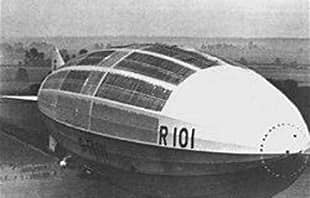
The R101 Airship
The R101 was a huge rigid airship developed by the British government during the late 1920s. It was built at the Royal Airship Works at Cardington, in Bedfordshire.
At the time, large airships were considered a possible future for long-distance passenger travel. They could remain in the air for long periods and travel great distances without needing airports or runways in the modern sense.
The British government hoped that airships could connect Britain with distant parts of the Empire. Routes to India, Australia and other destinations were being considered.
R101 was therefore a symbol of Britain’s technological ambitions.
The project was also part of a competition between Britain and other countries. Germany had developed successful large airships such as the Graf Zeppelin, and Britain wanted to demonstrate that it could build and operate airships capable of similar long-distance journeys.
R101 and R100
Britain was developing two major airships at roughly the same time.
R101 was a government-designed and government-built aircraft. Another airship, R100, was developed by a private team under a government contract.
The two projects followed different approaches, but both were intended to demonstrate the future possibilities of airship travel.
R100 later made a successful flight to Canada and returned safely to Britain in 1930. R101, however, suffered a completely different fate.
The difference between the two projects became very important after the R101 disaster.
Test Flights
Before its final journey, R101 completed several test flights.
The airship first flew in October 1929. Its early flights were used to examine its handling, engines, structure and other systems. The airship was extremely large, and engineers continued making modifications to improve its performance.
The airship was later lengthened to increase its lifting capacity.
This was an important issue because the airship needed enough lifting power to carry fuel, equipment, crew and passengers over the long distance to India.
The modifications meant that R101 had to undergo additional testing.
The final journey was therefore intended to be an important demonstration that the airship was ready for long-distance international service.
The Planned Flight to India
On the evening of 4 October 1930, R101 left its mooring mast at Cardington for its first overseas flight.
The destination was Karachi, then in British India. The journey would take the airship over France, the Mediterranean region and toward the Middle East and India.
The route was part of Britain’s larger plan to establish an Imperial air route.
There were 54 people aboard, including crew members, engineers and important passengers. Among them was Lord Christopher Thomson, Britain’s Secretary of State for Air. Another important passenger was Sir Sefton Brancker, Director of Civil Aviation.
The presence of senior government and aviation officials showed how important the flight was considered.
It was intended to demonstrate the future of British long-distance air travel.
The Beginning of the Journey
R101 left Cardington during the evening of 4 October.
It passed over Bedford and then London before crossing the English coast near Hastings. The airship continued toward France.
For some time, everything appeared normal.
At around midnight, R101 sent a radio message reporting its position and condition. The message stated that the airship was approximately 15 miles southwest of Abbeville, traveling at about 33 knots. It reported a westerly-southwesterly wind of around 35 mph and intermittent rain.
The message indicated that the essential systems were operating normally.
Passengers had eaten dinner and some had relaxed in the passenger areas.
However, weather conditions were becoming increasingly difficult.
Weather Over France
As R101 continued across northern France, the weather deteriorated.
There was rain, strong wind and low clouds. Near Beauvais, witnesses reported that the airship appeared to be struggling against the wind.
This was a major challenge for a huge airship.
R101 was extremely large and was affected by wind and weather conditions. Maintaining the correct altitude was essential.
The airship was also heavily loaded for its long journey.
These factors created a difficult combination.
The Final Minutes
At about 2 a.m. on 5 October, R101 was approaching the area of Beauvais.
According to the official inquiry, the airship suddenly entered a long and steep dive. The movement was severe enough to throw engineers working near the engines off balance. Furniture inside the passenger areas also moved forward.
The airship recovered from the first dive and briefly returned to a more level position.
But the danger had not passed.
A second dive followed.
Orders were given to reduce the engine speed, and members of the crew were warned about the danger. One surviving witness later described how the crew were told that the airship was going down.
R101 then struck the ground near Allonne, just south of Beauvais.
The Fire
The impact itself was not necessarily the only major cause of death.
The greatest danger came immediately afterward.
R101 was filled with hydrogen, which provided the lifting force needed to keep the enormous airship in the sky. Hydrogen is extremely flammable.
When the airship struck the ground, its structure was badly damaged and the hydrogen ignited.
A huge fire quickly developed.
The airship was destroyed in a matter of moments.
Many of the people aboard had little opportunity to escape.
The intense fire caused terrible injuries and made identification of the victims difficult. Bedfordshire Archives records that only 26 of the 48 people who died were eventually identified; Lord Thomson’s body was never identified.
The Survivors
Only six people survived the disaster.
They were mainly engineers and other members of the technical crew.
One survivor was H. J. Leech, a foreman engineer. He was in the navigation area during the final moments and survived by breaking through the wall of the cabin.
Other survivors included engineers A. V. Bell, J. H. Binks, A. J. Cook and V. Savory, along with wireless operator A. Disley.
Their testimony became extremely important during the investigation because they were able to describe what happened inside R101 during the final minutes.
The Investigation
A formal public inquiry into the disaster was held later in 1930.
The inquiry examined the design, construction, modifications, loading, weather conditions and operation of R101.
Investigators had to determine why the airship had suddenly lost altitude and entered the dives that preceded the crash.
The inquiry concluded that R101 had become difficult to control in the weather conditions and that its lifting capacity and overall condition were important factors. The official investigation also examined the structure and the effects of the modifications made to the airship.
The exact sequence of events was complex, but the disaster showed that the airship was operating under very difficult conditions during its first long overseas flight.
Problems with the Design
One major question concerned the design and modifications of R101.
The airship had been lengthened and altered during its development.
These changes were intended to improve its performance and carrying capacity, but they also changed the aircraft’s characteristics.
An airship’s ability to remain safely in the air depends on its lifting capacity, weight, structure and gas volume.
If an airship becomes too heavy, it has less ability to climb when conditions become difficult.
The R101 disaster demonstrated how important it was to have sufficient safety margins.
The Loss of Senior Officials
The disaster was particularly shocking because several important British officials were aboard.
Lord Thomson, Secretary of State for Air, died in the crash.
Sir Sefton Brancker, Director of Civil Aviation, also died.
The deaths demonstrated how strongly the British government had invested in the R101 project.
The disaster was therefore not only an aviation tragedy. It was also a major political and technological setback.
The End of Britain’s Airship Programme
The R101 disaster effectively ended Britain’s large rigid-airship programme.
The surviving British airship, R100, had already demonstrated impressive performance during its successful Canada flight.
However, after R101 crashed, confidence in large passenger airships collapsed.
R100 was withdrawn from service and eventually dismantled.
The government abandoned plans to develop a major British airship network.
The dream of connecting the British Empire through giant airships had come to an abrupt end.
Why the R101 Disaster Was Important
The R101 disaster became one of the most famous airship accidents in history.
It demonstrated the enormous risks involved in operating very large hydrogen-filled aircraft.
The disaster also showed the importance of:
- Careful aircraft design
- Adequate lifting capacity
- Thorough testing
- Weather assessment
- Structural strength
- Emergency procedures
- Conservative safety margins
The accident occurred at a time when aviation technology was developing rapidly. Engineers were experimenting with aircraft that were much larger and more ambitious than earlier machines.
The tragedy showed that technological ambition had to be balanced with safety.
The Legacy of R101
Today, the R101 disaster remains closely connected with Cardington and the history of British airships.
The enormous hangars at Cardington still survive and are reminders of the period when Britain hoped to build a network of giant airships.
The disaster also had a lasting impact on the local community. Many of those killed lived in Bedfordshire, particularly around Cardington and Shortstown.
Several roads in Shortstown were later named after prominent victims, including Lord Thomson, Sir Sefton Brancker and Major George Herbert Scott.
Conclusion
The R101 Airship Disaster of 5 October 1930 was one of the greatest tragedies of early British aviation. R101 left Cardington on 4 October 1930 on its planned first overseas flight to Karachi, but crashed near Beauvais, France, shortly after 2 a.m. the following morning.
The airship entered a steep dive, recovered briefly, and then descended again before striking a hillside near Allonne. The hydrogen-filled airship immediately caught fire. Forty-eight of the 54 people aboard died, while only six survived.
The disaster ended Britain’s ambitious programme to develop large rigid airships for long-distance Imperial routes. The R101 tragedy showed the dangers of combining enormous aircraft, difficult weather, complex engineering and limited safety margins.
Although the R101 was a failure, its story remains an important part of aviation history. It represents a time when engineers and governments were attempting to create a completely new form of international transportation. The terrible loss of life on 5 October 1930 demonstrated the cost of that ambition and helped bring the great British airship era to an end.

Ajeet Yadav is an aviation enthusiast covering airline news, airports, aircraft, and industry developments through well-researched and reliable reporting.