








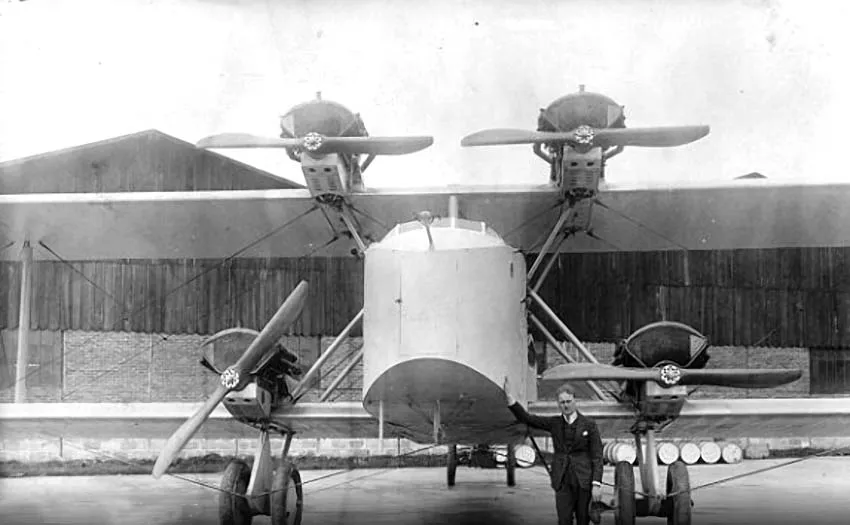
Air Union Blériot 155 Leigh Crash
On 2 October 1926, an Air Union Blériot 155 named Clément Ader, registration F-AICQ, crashed at Leigh, Kent, England, while attempting an emergency landing after an in-flight engine fire. The aircraft was operating a scheduled passenger service from Le Bourget Airport in Paris to Croydon Airport near London.
There were seven people on board, including two crew members and five passengers. Tragically, all seven people were killed. The aircraft crashed in the grounds of a house called Southwood, near Leigh, after the fire spread from the port upper engine to the wing. The pilot attempted to divert toward Penshurst Airfield, but the aircraft lost control and crashed before reaching the airfield.
The Blériot 155
The Blériot 155 was a large French four-engined passenger aircraft developed by Blériot during the 1920s. It was derived from earlier Blériot designs and was intended for commercial passenger and mail services.
Only two Blériot 155 aircraft were built, and both were operated by Air Union on its international Paris–London route. The two aircraft were named Wilbur Wright and Clément Ader.
The aircraft involved in the Leigh accident was F-AICQ, named Clément Ader. It was construction number 1 and had been registered to the Air Union in 1926.
The Blériot 155 was an important aircraft for its period because it was designed for scheduled international passenger operations. However, aviation technology was still developing rapidly in the 1920s, and long-distance commercial flying carried considerable risks.
The Flight From Paris
On 2 October 1926, F-AICQ departed Le Bourget Airport near Paris at about 1:30 p.m. local time, or approximately 12:30 p.m. GMT.
Its destination was Croydon Airport, which served as London’s main airport for international scheduled flights at that time. The aircraft was therefore flying one of the important cross-Channel routes connecting France and Britain.
There were seven people aboard:
- Two crew members
- Five passengers
The aircraft was also carrying approximately 1,800 pounds (820 kg) of cargo, including motor spare parts and furs.
The flight initially appeared to be proceeding normally. After crossing the English Channel, the aircraft continued toward London.
Radio Message From Tonbridge
One of the important details of the accident was the radio communication shortly before the fire.
At approximately 3:24 p.m. GMT, the pilot contacted the authorities near Croydon while the aircraft was passing over Tonbridge.
The message indicated that everything was normal. Contemporary accounts record the pilot reporting that they were passing over Tonbridge and that all was well.This message became significant because only a few minutes later the aircraft was seen with one of its engines on fire.
At about 3:27 p.m. GMT, witnesses on the ground noticed flames coming from the aircraft.
The emergency had developed extremely quickly.
Fire in the Port Upper Engine
The port upper engine of the Blériot 155 caught fire while the aircraft was flying over Kent.
The fire was seen spreading from the engine toward the wing. The aircraft was then observed changing direction, apparently in an attempt to reach Penshurst Airfield, which was nearby.
For the crew, the situation was extremely dangerous.
The aircraft was a large four-engined machine, but an engine fire was very different from a simple engine failure. A mechanical failure might allow an aircraft to continue flying on its remaining engines. A fire could spread rapidly through the structure, fuel system or wing and could make control of the aircraft increasingly difficult.
The pilot therefore had very little time to find a place to land.
Attempt to Reach Penshurst Airfield
The pilot attempted to divert toward Penshurst Airfield to make an emergency landing.
Eyewitnesses reported seeing the aircraft trying to gain some height while its tail appeared to sink. The aircraft then rolled over and descended rapidly toward the ground.
The emergency landing could not be completed.
Instead of reaching the airfield safely, the aircraft crashed in the grounds of Southwood, a house in Leigh, Kent.
The aircraft was destroyed by the impact and the fire.
The Crash at Southwood
The Blériot 155 came down in the grounds of Southwood.
The crash was extremely violent. The aircraft was badly damaged and quickly became engulfed in flames.
People nearby attempted to help the occupants.
Three members of the public and a policeman went toward the wreckage in an effort to rescue those aboard. One female passenger was pulled from the aircraft, but she was already dead. The pilot had been thrown clear during the crash and was also killed.
The mechanic and the other passengers remained trapped inside the burning wreckage.
During the rescue attempts, a petrol or oil tank exploded, making the wreckage even more dangerous. Eventually, the rescuers were unable to save anyone else and the aircraft was allowed to burn itself out.
Rescue and Recovery
The crash site presented major difficulties for the people attempting to recover the victims.
The wreckage remained smouldering after the main fire had burned through the aircraft. Police guarded the site overnight to protect the wreckage and preserve evidence for the investigation.
The bodies of the victims were taken to the coach-house of Southwood, where it was used as a temporary morgue.
The accident attracted enormous public attention.
Reports indicate that approximately 6,000 sightseers came to the area to see the wreckage. The large crowd caused congestion on the narrow local roads. Authorities had to restrict access around the crash site so that investigators could examine the wreckage and evidence without interference.
Seven People Were Killed
The Leigh accident was particularly tragic because nobody aboard survived.
The aircraft carried:
- 2 crew members
- 5 passengers
- 7 total occupants
- 7 fatalities
- 0 survivors
The two crew members were French citizens, while all five passengers were British.
The accident therefore became one of the major aviation tragedies on the Paris–London route during the early years of commercial air travel.
The Pilot
The pilot was an experienced aviator.
Historical accident records state that he had accumulated more than 2,000 hours of flying experience and had been employed by Air Union since 1920. He had also completed approximately 61 return flights between Paris and London.
This was important during the investigation because the accident did not appear to have been caused simply by a lack of flying experience.
The pilot had successfully operated the Paris–London route many times before. When the fire started, he immediately changed course and attempted to reach Penshurst Airfield.
The rapid development of the fire left him with very little time to respond.
Investigation Into the Accident
An investigation was carried out by the British authorities following the crash.
The aircraft had been inspected before the flight, and a certificate from Bureau Veritas indicated that the aircraft was considered fit for flight.
This meant investigators had to focus particularly on what happened to the engine during the flight.
The aircraft had been operating normally shortly before the accident. At 3:24 p.m. GMT, the crew had reported that everything was well. Only about three minutes later, the port upper engine was observed burning.
The short period between the normal radio report and the fire showed how quickly the emergency developed.
Cause of the Fire
The exact internal mechanical cause of the fire could not be established with certainty.
According to the historical accident record, Major Cooper of the Air Ministry stated during the investigation that there had never previously been a recorded case of an airliner catching fire in the air. Because of this lack of precedent and the destruction of the aircraft in the subsequent fire, investigators could not determine the precise cause of the engine fire. The known sequence was clear, however.
The port upper engine caught fire, the flames spread toward the wing, the pilot attempted to divert to Penshurst, and the aircraft subsequently lost control and crashed at Leigh.
Thus, the accident is generally described as an in-flight fire followed by an attempted emergency landing.
The Role of Early Aviation Technology
The Leigh crash also shows the difficulties faced by commercial aviation during the 1920s.
Air travel was becoming increasingly important, but aircraft technology was still relatively young. Engines, fuel systems, fire protection, navigation equipment and emergency procedures were not as advanced as they would become in later decades.
The Blériot 155 itself represented an attempt to provide a large, multi-engined aircraft for regular international passenger operations. Four engines provided additional power and some redundancy, but an engine fire created a much more serious problem than an ordinary engine failure.
The crew also had limited time to react because the aircraft was already close to London and the fire developed suddenly.
Air Union and the Paris–London Route
Air Union was one of the important French airlines operating international services during the early development of European commercial aviation.
Its Paris–London service connected Le Bourget with Croydon, carrying passengers and commercial cargo across the English Channel.
These flights were an important part of the development of European air transport. However, they also exposed airlines to risks associated with long overwater flights, changing weather and the mechanical limitations of early aircraft.
The Leigh crash occurred during a period when airlines were trying to make international passenger travel more regular and dependable.
The Two Blériot 155 Aircraft
The Leigh accident had an additional significance because F-AICQ Clément Ader was one of only two Blériot 155 aircraft ever built.
The other aircraft was F-AIEB Wilbur Wright.
The two aircraft were both operated by Air Union and both were used on the Paris–London service.
However, both aircraft were lost in accidents during 1926.
The first accident occurred on 18 August 1926, when F-AIEB Wilbur Wright crashed at Hurst, near Aldington, Kent, while attempting a forced landing after an engine failure in poor weather. The second accident was the 2 October 1926 Leigh crash, when F-AICQ Clément Ader caught fire in flight and crashed.
Therefore, within a period of only a few months, both Blériot 155 aircraft operated by Air Union had been destroyed.
Significance of the Leigh Crash
The Leigh accident was significant in the history of commercial aviation because it involved an airliner catching fire in flight.
At the time, the event was unusual enough that investigators had little previous experience with a similar airliner accident. The statement attributed to Major Cooper emphasized that there had not previously been a known case of an airliner suffering an in-flight fire.
The accident demonstrated the dangers associated with aircraft fuel and engine systems and highlighted the need for better fire prevention and protection in commercial aircraft.
It also showed the importance of having suitable emergency landing areas close to busy air routes.
Aircraft Destroyed
The Blériot 155 F-AICQ Clément Ader was completely destroyed in the accident.
The combination of the crash impact and the intense fire left very little of the aircraft usable.
Its operational history therefore ended at Leigh on 2 October 1926.
The aircraft was one of only two Blériot 155s ever constructed, making its loss particularly significant in the short history of the type.
Conclusion
The Air Union Blériot 155 Leigh crash occurred on 2 October 1926, when F-AICQ Clément Ader was flying from Paris Le Bourget to Croydon with five passengers and two crew members.
The flight initially appeared normal. At approximately 3:24 p.m. GMT, the pilot reported that the aircraft was passing over Tonbridge and that all was well. Only three minutes later, witnesses saw the port upper engine on fire. The fire spread toward the wing, forcing the pilot to change course and attempt an emergency landing at Penshurst Airfield.
The aircraft could not reach the airfield. It lost control and crashed in the grounds of Southwood at Leigh, Kent, where it was consumed by fire.
All seven people aboard were killed. The victims included two crew members and five British passengers. The pilot was an experienced aviator with more than 2,000 flying hours, and the aircraft had been inspected before departure.
The exact mechanical cause of the engine fire could not be determined with certainty. The accident became an important event in early commercial aviation because it demonstrated the serious danger posed by an in-flight fire on a passenger aircraft.
It was also the second and final loss of a Blériot 155 operated by Air Union in 1926. The other aircraft, F-AIEB Wilbur Wright, had crashed only weeks earlier at Hurst, Kent. Thus, both Blériot 155 aircraft built for Air Union were destroyed in accidents during the same year.
Article reference: The supplied material identifies the second Air Union Blériot 155 as F-AICQ Clément Ader and records its destruction at Leigh on 2 October 1926 after an in-flight fire.

Ajeet Yadav is an aviation enthusiast covering airline news, airports, aircraft, and industry developments through well-researched and reliable reporting.