








- Artificial Intelligence promises to transform Air Traffic Management (ATM), improving efficiency, safety, and decision-making.
- Despite its potential, challenges like regulatory complexities and integration barriers must be addressed.
While the concept of Artificial Intelligence (AI) has been in existence since the 1950s, its development has significantly accelerated in the last few decades supported by three factors: a) significant improvement in the capacity to collect and store massive amounts of data, b) significant increase in computing power and c) development of powerful algorithms and methods. The use of AI is spreading rapidly in every industry, with aviation and Air Traffic Management (ATM) making no exception. The progressive introduction of AI is expected to create a new ATM environment which will address issues like a) minimisation of delays, b) accommodating a diverse array of autonomous aircraft, c) operating in adverse weather, d) smoothing out 4D aircraft trajectories, and e) minimising environmental impact. This article discusses various aspects of ATM which can benefit from AI and challenges expected to be faced with the implementation.
Introduction
Increased traffic density and new airspace users (e.g. very high-altitude operators, next-generation supersonic commercial aircraft and drones) sharing the air space combined with diverse communication technologies, flight and speed patterns are expected to unprecedented levels of heterogeneity and complexity, requiring automation, connectivity and interoperability of the aviation systems. The thirteenth ICAO Air Navigation Conference (ANC) held in Montreal, Canada, held from 9 to 19 October 2018, discussed the potential use of AI in the implementation of the Global Air Navigation Plan (GANP – Doc 9750). It was suggested that ATM can exploit the power of AI to boost productivity through capability of decision making under uncertainties and provision of optimised situational strategies that procedures or simple algorithms cannot provide. It is expected that AI will become a useful assistant to all ATM actors, from planning to operation across airspace users. Additionally, AI is expected to drive the development of new ATM services to serve drones and will increase safety through the provision of new conflict detection, traffic advisories and resolution tools, as well as cyber resilience.
Artificial Intelligence
‘Artificial Intelligence’ term was first used in 1956 for the “Dartmouth Summer Research Project on Artificial Intelligence” and is generally referred to any machine that exhibits traits associated with a human mind, such as learning and problem solving. Before we proceed further, let us develop a consensus on the terms generally associated with the broader term ‘Artificial Intelligence’. Single European Sky ATM Research (SESAR) Joint Undertaking (JU) defines the related terms as follows Fig -1):
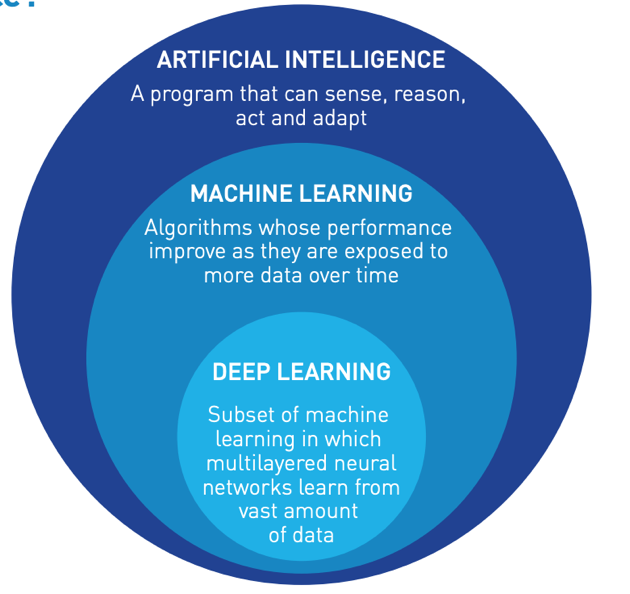
Artificial Intelligence (AI): Artificial Intelligence (AI) refers to systems that display intelligent behaviour by analysing their environment and taking actions – with some degree of autonomy – to achieve specific goals. AI systems are software (and possibly hardware) systems designed by humans, that, given a complex goal, act in physical and digital dimension by perceiving their environment through data acquisition, interpreting the collected structured/unstructured data, reasoning on the knowledge, or processing the information, derived from this data and deciding the best action(s) to be taken to achieve the given goal. |
Machine Learning (ML): Machine Learning (ML) refers to the ability of algorithms to learn. It is the algorithms which model systems by learning from input and output data that characterise them. Once the models are adjusted after training, they are able to predict the outcome of any input, even if it has not been processed before.
Deep Learning (DL): Deep Learning is the most advanced type of machine learning. In recent years, the availability of large amount of data (Big Data) and the leap forward in computing power have paved the way towards unprecedented levels of performance, allowing for new levels of automation.
AI/ML/DL are already contributing to a wide spectrum of opportunities in aviation and in particular to ATM systems from non-safety critical to safety critical, as shown in Fig – 2.
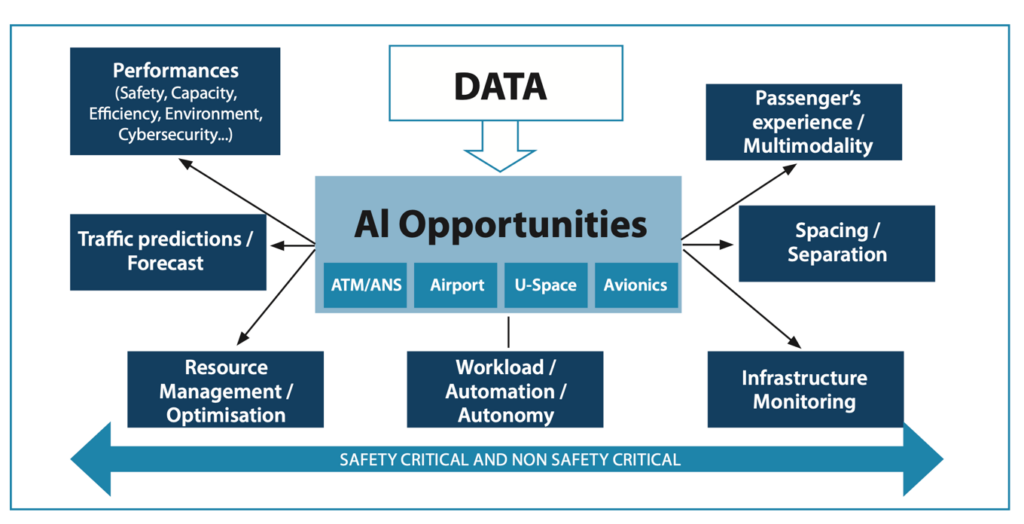
USE OF AI, ML AND DL IN ATM
The primary responsibility of Air Traffic Management (ATM) is to prevent collision between aircraft and any other object (including other aircraft). The secondary responsibility is to expedite air traffic without affecting safety. Currently, these responsibilities are performed by human air traffic controllers. An increasing number of flights are straining the system, so various initiatives are being taken to use computers to assist controllers in performing certain functions. ATM is considered an ideal candidate for greater automation and augmentation through AI. With its repetitive procedures generating huge amounts of data, ATM can make use of AI and automation to improve the efficiency of operations and allow human operators to focus on safety-critical tasks. In the era of digitalisation and Big Data, an incremental modernisation of the ATM system is expected in the coming years with the pervasive implementation of AI and ML. It is now being felt that AI can be used for various tasks, such as predicting weather patterns, identifying potential conflicts and recommending optimal routes. Machine Learning can also be used to help systems learn from data and improve performance. Some applications are discussed below:
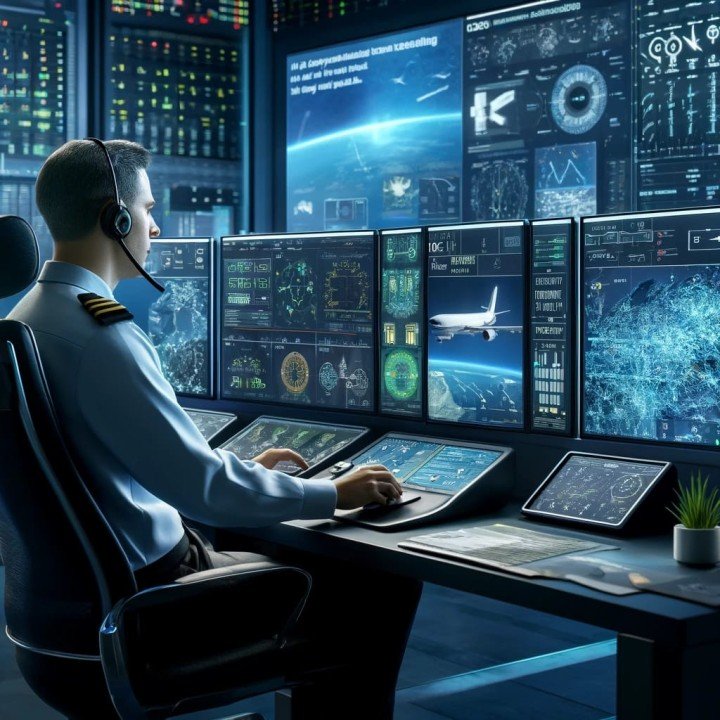
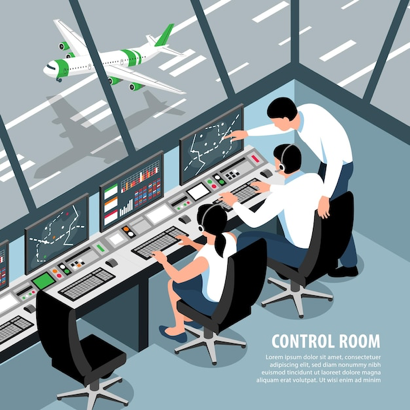
- Decision Support System (DSS): These systems are powered by AI to provide air traffic controllers (Fig – 3) with real-time data analysis and recommendations, which not only enhance their situational awareness but also help them make more informed decisions. An AI-powered DSS for ATM leverages artificial intelligence algorithms to analyse real-time data on aircraft positions, weather conditions and airspace capacity, providing controllers with predictive insights and suggested actions to optimise flight paths, prevent traffic conflicts, and enhance overall efficiency and safety in airspace; essentially acting as a sophisticated decision-making assistant for controllers.
AI-based flow management function predicts and resolves traffic hotspots, supports hotspot analyses and resolves integrating constraints.
Automated Conflict Detection: This system utilises AI to alert controllers of potential conflicts (Fig – 4), while also suggesting manoeuvres to prevent collisions by continuously monitoring aircraft positions. A machine learning-based framework to learn and predict air traffic conflict resolution strategies supports air traffic control system. Similar and contrasting ATCO’s conflict resolution strategies are collected through human-in-loop experiments, using a real-time, high-fidelity simulation environment for model training and evaluation. Developing autonomous systems which incorporate ATCOs’ behaviours in air traffic control is important for the systems to be acceptable in the operational environment. These systems have potential usage as advisory tools to alleviate ATCO’s workload in conflict scenarios.
Traffic Prediction and Management: AI is expected to address capacity issues in ATM, enabling better use of data, leading to more accurate predictions (Fig – 5) and more sophisticated tools resulting in increased productivity and enhancing the use of airspace and airports. In this critical area of air traffic management (ATM), AI helps controllers make proactive decisions by analysing large amounts of flight data. The most important points of this data include predicting air traffic patterns, optimising flight routes and reducing congestion. Combined, this leads to fewer delays and increased safety. AI is now being used in air traffic prediction by analysing vast amounts of flight data to anticipate air traffic patterns, identify potential conflicts in airspace, and suggest optimal flight routes, ultimately helping air traffic controllers make proactive decisions to minimise delays and enhance safety and efficiency.

- Route Prediction: Several uncertainties hamper the accuracy of predicted flight trajectories, such as future air traffic clearances that will cause the flight to deviate from the original flight plan. By using modern AI algorithms these deviations can be predicted. One example can be the activation of a restricted air space, the trajectory can be changed predictably to meet the contingency.
- 4D Trajectory Prediction: The next level of prediction can include added dimensions of time and vertical movement, thus making it 4 Dimension prediction. It is expected that rather than addressing specific elements of prediction individually (e.g. route, entry point), the AI algorithm will take full output of the existing deterministic trajectory prediction logic embedded in legacy systems and then transform the predicted trajectory to a more accurate forecast, taking into account additional data. The algorithm is expected to support ‘what if’ functionality, allowing the users to tentatively probe the impact of regulations and airspace restrictions on the predicted trajectory.
- Sector Sequence Prediction: Differences exist between the sectors that are geographically crossed by a flight and sectors that take control of the flight, even after accounting for documented deviations (such as hand-over procedures in Letters of Agreements with other ATC units). Differences stem from the working habits of air traffic controllers that are driven by traffic patterns. An AI algorithm is expected to be developed that will predict, for a given trajectory, which sectors will take control of the flight and which sectors will be skipped/bypassed; intention is to improve sector workload predictability.
- Weather Forecasting: Weather conditions (Fig – 6) have been a major factor contributing to delays in aviation. In the last couple of decades, a lot of innovative work has been done for predicting weather, but most of this innovation has been confined to predicting weather over a short time frame. The unique context of international flights covering long distances across continents and oceans, with flight durations from 10 to 20 hours, underscores the necessity for delay prediction over extended periods of time.

Weather compromises flight safety. Severe turbulence can lead to injuries among passengers and crew members. Additionally, low-visibility situations like fog, heavy rain or snowfall present further complications for pilots.
Weather AI (adopted by FAA), or Artificial Intelligence for weather forecasting for aviation, proposes to use AI to improve weather forecasting, prediction and insight delivery for the aviation industry. It is expected to be used as a powerful tool to enhance aviation operations by providing more accurate and timely forecasts of complex weather patterns. These forecasts will provide decision-making support for ATM operations. Some significant differences between traditional weather prediction methods and Weather AI are listed below:
- Data-Driven Approach: It will rely on analysing historical climate records, real time atmospheric observations such as wind speed, temperature etc to recognise distinct patterns associated with different weather phenomena.
- Machine Learning Technology: It expects to learn from sophisticated machine learning models like neural networks and deep learning techniques to continuously learn from new data inputs and refine the predictive abilities over time.
- High-Resolution Modeling: Unlike conventional numerical models that handle moderate spatial scales, Weather AI will be able to use microscale meteorological processes at finer resolutions – enabling sharper insights into localised events such as microbursts or runway conditions during adverse weather conditions.
- Adaptive Forecasts: Weather AI will dynamically tailor its output considering various parameters specific to each flight route – altitude, speed, onboard systems – ensuring that the selected predictions remain relevant amidst constantly changing flight conditions.
2. Voice Recognition and Assistance: Although the idea of using data links has been around for more than three decades, voice communication between ATC and Pilots using radio equipment is still the main communication channel used in air traffic control. Whenever the information is required to be digitised, ATCOs are burdened to manually enter the information. Automatic Speech Recognition (ASR) transforms the analog voice signal into a spoken sequence of words. Next, Automatic Speech Understanding extracts the meaning from the above sequence of words. This advanced AI-driven voice recognition system helps to reduce the controller’s workload by transcribing and understanding pilot-controller communications. This maximises efficiency in ATC since automating routine tasks like this allows controllers to focus on more critical matters.
Ever since the emergence of Alexa, Google Assistant, and Siri, voice recognition technologies have seamlessly integrated into our everyday lives.
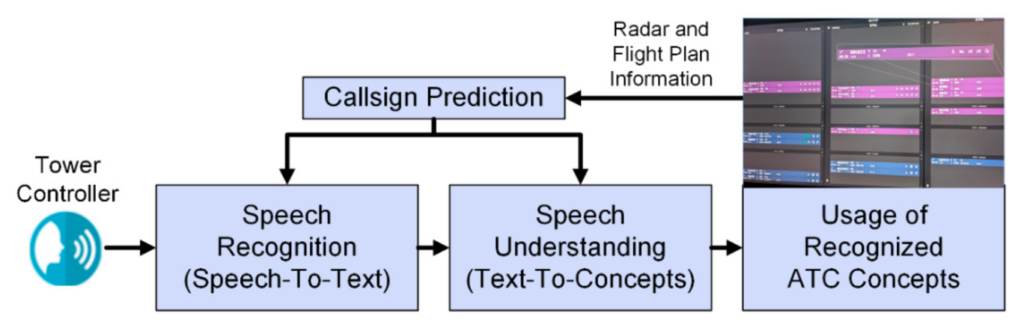
Assistance-Based Speech Recognition (ABSR) systems (Fig – 7) are based on a number of models based on deep neural networks trained by machine learning methods. The two main steps are a) Speech Recognition, i.e. automatic speech-to-text transcription and b) speech understanding, i.e. automatic semantic text-to-concept annotations from the transcription inputs. The block diagram above is a very simplistic presentation of the concept. In real application, a number of validation exercises are carried out to meet the safety requirements.
Challenges
Air Traffic Management (ATM) system has often been defined as a “Joint Cognitive System” of humans, teams and artifacts that adapts to the challenges and demands posed by familiar and unfamiliar situations in a dynamically evolving operational context. Innovative technologies not only provide capacity enhancement opportunities and other performance improvements but also raise new regulatory, safety, cognitive and operational challenges and tradeoffs. The information provided above describes the potential use of AI to enhance and assist humans in the loop. This section lists some of the challenges discussed in the International Federation of Air Traffic Controllers Associations (IFATCA) paper “Challenges from Introduction of Artificial Intelligence in the European Air Traffic Management System” (2022).
- Regulatory
- Complexity and novelty of AI related product certification
- Obsolescence of traditional development assurance framework that are not adapted to AI and ML
- State sovereignty concern.
- Legal differentiation between Air Traffic Services and ATM Data Service Providers
- Definition, sharing and applying a common polity on ethics related to AI.
- Air Navigation Services Providers (ANSP)
- Organisation transformation issues
- Insurance and Liability
- Unclear cost-effectiveness benefits
- Costly reinforced cybersecurity infrastructure
- Disruption of established knowledge sharing
- Technical
- Complexity of sharing of AI infrastructure between countries
- Curse of dimensionality, which refers to extraordinary rapid growth of complexity as number of variables increases.
- Significant difference of AI solutions for different control positions (like Tower, Approach, Area) etc.
- Tailor made AI solutions for each use case that cannot be easily generalised across same type of units in different geographical areas.
- Develop backup systems to face failure or unusual situations in complex AI systems.
- Define effective AI methods to detect, frame into context, and interpret into decision signals.
- Operational
- Scale shift in complexity in terms of density of interdependencies across processes and activities.
- Synchronisation of operational procedures between Air Traffic Services units (ATSUs) and Network Managers.
- Incompatibility with existing Concept of Operations (CONCOPs) and the need of development of new ones.
- Function allocation issues.
- Develop, validate and harmonise the integration of AI technologies in the whole system, among all users (ATCOs, pilots, aerodrome operators etc.)
- Air Traffic Controllers (ATCO)
- Keeping the ATCOs ‘in the loop’ and situationally aware and able to intervene.
- Disruption of established patterns in coordinated activity between ATCOs and between ATCOs and flight crew.
- Increased space for potential and new types of errors that cannot be easily foreseen.
- Demands for new kind of knowledge and skills.
- Demand for development of new mental models, how the AI system works, how it fails, why it fails, and how to adapt.
- De-skilling of ATCOs
- ATCOs intervening during failures and contingencies.
- Vigilance/boredom tradeoffs.
- Managing of social aspects (e.g. relocation and mobility of ATCOs).
- Resistance from ATCOs who could legitimately fear for their jobs.
Conclusion
Following global trends, India is also taking steps to revolutionise its aviation sector. Addressing the 40th Asia Pacific Regional Meeting (APRM) of IFATCA on 1 September 2024, the Secretary of the Ministry of Civil Aviation, Govt. of India, called for the integration of generative AI into air traffic management systems. It is expected that the adoption of AI in ATM could optimise flight routes, manage airspace congestion, and improve the overall safety of aviation operations. Adoption of AI for ATM is now primarily focused on utilising AI-powered systems at major airports like Hyderabad, where a first-of-its-kind powered operations centre has been launched, leveraging real-time data from various sources to optimise operations and minimising disruptions, demonstrating a significant step towards integrating AI in managing air traffic within the country.
Dr. SK Saraswati – He joined Civil Aviation Department in 1972 through Engineering Services Examination and has an extensive experience in planning, procurement, installation, commissioning, maintenance, calibration, as instructor of Communication, Navigation, Surveillance and ATM Automation. He also served as Airport Director (Bangalore, Hyderabad) and Regional Executive Director. He served ICAO and after retirement was Consultant to Tata Advanced Systems Ltd.