







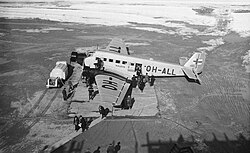
Kaleva / Aero Flight 1631 14 June 1940
The Kaleva / Aero Flight 1631 incident was a tragic aviation event that took place on 14 June 1940 during one of the most dangerous periods in European history. The aircraft was operated by Aero O/Y, the Finnish airline that later became known as Finnair. The aircraft was a Junkers Ju 52, a well-known passenger aircraft of the period.
The aircraft was flying from Tallinn, Estonia, to Helsinki, Finland, when it was intercepted and destroyed over the Gulf of Finland. All people aboard the aircraft were killed.
The incident happened during the early days of the Second World War and at a time when Estonia and Finland were surrounded by military tensions. The Kaleva disaster remains one of the most important and tragic events in the early history of Finnish civil aviation.
Aero O/Y
Aero O/Y was Finland’s national airline during the 1930s.
The company was founded in 1923 and developed air services connecting Finland with other European countries.
Aero played an important role in connecting Finland with the rest of Europe.
Its aircraft carried:
- Passengers
- Freight
- Business travelers
- Official communications
In the years before the Second World War, Aero operated regular services between Finland and nearby countries.
The Junkers Ju 52
The aircraft involved in the disaster was a Junkers Ju 52.
The Ju 52 was one of the most famous European aircraft of the 1930s.
It was a three-engine aircraft with an all-metal structure.
The aircraft was widely used for passenger and cargo services.
It was also used by military organizations in several countries.
The Ju 52 had a strong reputation for reliability.
However, during wartime, even a reliable civilian aircraft could face serious dangers.
The Flight From Tallinn
On 14 June 1940, the aircraft known as Kaleva was operating Aero’s Flight 1631.
The flight was traveling from Tallinn, Estonia, to Helsinki, Finland.
The distance between the two cities is relatively short.
The aircraft was flying across the Gulf of Finland.
The flight was expected to be a routine international journey.
Passengers had boarded the aircraft in Tallinn.
The crew prepared the aircraft for the flight to Helsinki.
However, the aircraft never reached its destination.
Europe in June 1940
The political situation in Europe was extremely dangerous.
The Second World War had begun in September 1939.
By June 1940, Germany had occupied or invaded several countries.
German forces had entered France.
The Baltic region was also facing enormous political pressure from the Soviet Union.
The Soviet Union was increasing its military and political control in the region.
The Gulf of Finland was therefore an area of major strategic importance.
The Soviet Union and the Baltic Region
The Soviet Union had military forces operating around the Baltic Sea.
In June 1940, Soviet pressure on Estonia, Latvia, and Lithuania increased dramatically.
The Baltic states were soon occupied by the Soviet Union.
This created a highly dangerous environment for civilian aviation.
Military aircraft were operating in the region.
Civilian aircraft could potentially be intercepted.
Communication between governments and military forces was difficult.
The Interception
During the flight, Kaleva was intercepted by Soviet military aircraft.
The Soviet aircraft approached the Finnish civilian airliner.
According to historical accounts, the Kaleva was attacked and destroyed over the Gulf of Finland.
The aircraft crashed into the sea.
Everyone aboard died.
The incident shocked Finland and Estonia.
The People Aboard
The aircraft carried several passengers and crew members.
They included Finnish and foreign nationals.
Among the passengers were people connected with diplomatic and business activities.
The passengers were traveling for normal civilian reasons.
They were not military personnel.
The crew was also operating a regular commercial flight.
The destruction of the aircraft therefore had a major civilian impact.
The Importance of the Flight
The flight was important because it was part of the regular connection between Tallinn and Helsinki.
Before the war, people could travel between Finland and Estonia relatively easily.
Air travel provided a fast connection across the Gulf of Finland.
The disaster demonstrated how the war had transformed ordinary civilian travel.
Why the Aircraft Was Attacked
The exact circumstances surrounding the attack have been debated by historians.
The Soviet authorities reportedly considered the aircraft suspicious.
There were concerns about military activity in the region.
The Soviet Union was preparing to take greater control over Estonia.
However, the Kaleva was a civilian aircraft operating a scheduled route.
The reasons for the attack remain an important part of the historical discussion.
No Modern Aircraft Tracking
Today, aircraft can be tracked using several systems.
In 1940, this was not the case.
There was no GPS.
There was no satellite tracking.
There were no modern air traffic control networks covering oceans and remote areas.
A civilian aircraft could disappear from radar or visual observation and leave investigators with very little information.
Navigation in 1940
Pilots used traditional navigation techniques.
These included:
- Magnetic compass
- Maps
- Dead reckoning
- Radio navigation
- Visual landmarks
The Gulf of Finland was relatively narrow compared with an ocean, but the aircraft still needed accurate navigation.
Military aircraft could approach from different directions.
Radio Communication
The Kaleva was equipped with radio equipment.
Radio communication allowed the crew to communicate with ground stations.
However, wartime radio conditions could be complicated.
Military forces monitored communications.
Radio signals could be interrupted.
There was no satellite communication.
The crew could not rely on the advanced emergency communication systems used today.
The Gulf of Finland
The Gulf of Finland is an eastern arm of the Baltic Sea.
It separates Finland from Estonia.
It was an important route for ships and aircraft.
The region also had major strategic importance because it provided access to the Baltic Sea and the approaches to Leningrad, now Saint Petersburg.
During the Second World War, military forces operated extensively in the area.
The Crash
After the attack, the Kaleva fell into the Gulf of Finland.
The aircraft was destroyed.
The people aboard had no opportunity to survive.
The crash site was in the sea, making recovery difficult.
The tragedy immediately became an international concern.
Search for the Aircraft
Finding an aircraft in the sea was difficult in 1940.
Search teams had limited technology.
There were no modern sonar systems designed specifically for aircraft recovery.
There were no satellite coordinates.
Investigators had to use eyewitness information and known flight positions.
The location of the wreckage was eventually identified.
Recovery of Evidence
Recovery operations were complicated by the circumstances of the crash.
Investigators wanted to determine what had happened.
They examined available evidence.
Witness accounts were important.
Military records were also relevant.
However, because the incident happened during a tense political period, obtaining complete information was difficult.
Finnish Reaction
The incident caused serious concern in Finland.
Finland had already fought the Soviet Union during the Winter War, which ended in March 1940.
Relations between Finland and the Soviet Union remained tense.
The destruction of a Finnish civilian aircraft increased fears about Soviet intentions.
Estonian Reaction
The aircraft had departed from Tallinn.
Estonia was facing its own political crisis.
Only days after the incident, the Soviet Union would move toward full occupation of Estonia.
The Kaleva disaster therefore occurred during the final days of independent Estonia.
This gives the event an even greater historical importance.
Diplomatic Passengers
The flight reportedly carried diplomatic-related passengers.
This increased the significance of the incident.
International aviation was closely connected with diplomacy.
Airlines often transported government officials and diplomatic communications.
The loss of passengers with official connections could therefore create serious political concerns.
Civilian Aviation During War
The Kaleva disaster demonstrated one of the greatest problems of wartime aviation.
Civilian aircraft could be caught in military conflicts even when they had no military purpose.
Pilots could not always know where military forces were operating.
Military aircraft could also have difficulty identifying civilian aircraft.
This created a dangerous situation.
The Problem of Airspace
Modern airspace is carefully controlled.
Aircraft receive flight plans.
Air traffic controllers monitor their positions.
Restricted military areas are clearly identified.
Military and civilian authorities coordinate aircraft movements.
In 1940, these systems were far less developed.
A civilian aircraft could enter an area where military forces were operating without fully understanding the danger.
The Importance of Identification
Civilian aircraft usually carried national and airline markings.
Kaleva displayed the markings of Aero O/Y.
These markings were intended to identify the aircraft.
However, military pilots approaching an aircraft at high speed might have limited time to recognize it.
This was one of the major problems of aviation during wartime.
Investigation
The circumstances of the disaster were investigated.
The available evidence pointed toward an attack by Soviet military aircraft.
However, because the incident occurred during a period of major political change, the full circumstances were not immediately clear.
The Soviet authorities did not provide a complete public explanation that satisfied all parties.
Historical Debate
The Kaleva incident has remained a subject of historical research.
Researchers have examined:
- Soviet military records
- Finnish records
- Estonian sources
- Witness accounts
- Diplomatic documents
- Aviation records
Different sources have provided information about what happened.
The political situation has made interpretation difficult.
The Soviet Occupation of Estonia
Only a few days after the Kaleva disaster, the Soviet Union imposed its control over Estonia.
On 17 June 1940, Soviet forces entered Estonia.
The country lost its independence.
The timing is important.
The Kaleva disaster happened just three days before the Soviet occupation.
This made the incident part of a much larger historical crisis.
Impact on Aero
The disaster was a major tragedy for Aero O/Y.
The airline had lost an aircraft, crew members, and passengers.
The wider war also disrupted the company’s international operations.
Finland’s aviation connections were increasingly affected by military and political developments.
Finland During the War
Finland would soon face another major conflict.
In June 1941, Finland entered the Continuation War against the Soviet Union alongside Germany.
The region remained a major battlefield for several years.
Civilian aviation became extremely limited.
Military requirements dominated air transportation.
Aviation Technology
The Kaleva disaster also shows the limitations of aviation technology at the time.
Aircraft were advanced compared with those of the 1920s.
But they did not have:
- GPS
- Radar-based civilian tracking
- Collision avoidance systems
- Satellite communications
- Modern emergency beacons
- Digital flight recorders
This made aviation much more vulnerable.
Modern Aviation Safety
Modern commercial aviation has developed many safeguards.
Aircraft identification is easier.
Air traffic controllers track aircraft.
Governments publish restricted airspace.
Military authorities receive information about civilian flights.
Airlines monitor geopolitical risks.
These systems help prevent civilian aircraft from accidentally entering dangerous military areas.
Lessons From the Kaleva Disaster
The Kaleva disaster offers several important lessons.
First, civilian aviation cannot be separated completely from international politics.
Second, clear communication between civilian and military authorities is essential.
Third, aircraft identification must be reliable.
Fourth, airlines need accurate information about dangerous airspace.
Finally, international aviation requires cooperation between governments.
The Human Story
Behind the historical and political issues were ordinary people.
The passengers were traveling between Tallinn and Helsinki.
Some were traveling for business.
Others were connected with diplomatic or official work.
The crew was performing a normal airline duty.
None expected that the flight would end in tragedy.
Their loss affected families in Finland, Estonia, and other countries.
Remembering the Victims
Remembering the victims is an important part of studying the Kaleva disaster.
Historical aviation accidents are often discussed through aircraft types, military actions, and political events.
But the people involved should not be forgotten.
They were individuals with families, careers, and personal lives.
Significance in Finnish Aviation History
The Kaleva disaster remains one of the most notable tragedies in the early history of Finnish civil aviation.
It happened during a critical period.
Finland was still recovering from the Winter War.
Estonia was about to lose its independence.
Europe was already at war.
The aviation industry was facing unprecedented challenges.
Significance in Baltic History
The disaster is also important in the history of the Baltic region.
The Gulf of Finland became a major strategic area.
The Soviet occupation of Estonia followed only days later.
The Kaleva incident therefore occurred at the beginning of a major transformation in Baltic political history.
The End of an Era
The Kaleva flight represented the old idea of peaceful international travel.
Before the war, passengers could cross European borders by air.
Airlines connected neighboring countries.
Commercial aviation symbolized international cooperation.
The events of June 1940 showed how fragile that system had become.
Long-Term Aviation Development
The Second World War produced major advances in aviation.
Radar became more important.
Navigation systems improved.
Aircraft engines became more powerful.
Radio communications became more advanced.
After the war, many of these technologies were adapted for civilian use.
The commercial aviation system became more organized and safer.
From Aero to Finnair
Aero O/Y continued its development after the war.
The company eventually became known as Finnair.
Finnair grew into Finland’s major international airline.
Its history therefore reaches back to the early days of European commercial aviation.
The Kaleva disaster remains one of the darkest events in that history.
Why the Kaleva Disaster Matters
The tragedy is important for several reasons.
It was a civilian aviation disaster.
It occurred during a major international conflict.
It involved the destruction of a scheduled airline aircraft.
It happened immediately before the Soviet occupation of Estonia.
It also demonstrates the dangers created when civilian and military aviation operate in the same airspace during wartime.
Conclusion
The Kaleva / Aero Flight 1631 disaster of 14 June 1940 was one of the most tragic events in the history of early Finnish civil aviation.
The aircraft, a Junkers Ju 52 operated by Aero O/Y, was flying from Tallinn to Helsinki across the Gulf of Finland. It was a normal civilian flight carrying passengers and crew.
However, the political situation around the aircraft was anything but normal.
Europe was in the middle of the Second World War. Germany was advancing across Western Europe, the Soviet Union was increasing its control over the Baltic region, and Estonia was only days away from losing its independence.
During the flight, the Kaleva was intercepted by Soviet military aircraft and destroyed over the Gulf of Finland. Everyone aboard died.
The exact circumstances and motivations surrounding the attack have remained subjects of historical discussion. The incident demonstrates how dangerous civilian aviation became when military forces controlled the surrounding airspace.
In 1940, aviation lacked many of the systems that protect aircraft today. There was no GPS, satellite tracking, modern radar coverage, digital communication, or sophisticated aircraft identification system. Pilots and military forces depended heavily on radio communication and visual identification.
The Kaleva disaster also occurred at a major historical turning point. Three days later, Soviet forces occupied Estonia. The event therefore became connected not only with aviation history but also with the dramatic political changes taking place in the Baltic region.
The tragedy had a lasting effect on Finnish aviation history. Aero O/Y continued operating despite the difficulties created by the war and later developed into Finnair, one of Europe’s well-known airlines.
Today, the Kaleva disaster is remembered as a warning about the dangers that arise when civilian aviation operates in a region affected by military conflict. Modern airlines carefully study conflict zones and avoid dangerous airspace. Aircraft are tracked, identified, and supported by sophisticated communication and navigation systems.
The story of Kaleva Flight 1631 is therefore more than the story of an aircraft lost over the sea. It is a story about ordinary passengers and crew caught in extraordinary political circumstances. It shows how quickly war can destroy the safety and freedom associated with peaceful international travel.
The victims of the Kaleva disaster remain an important part of the history of Finnish, Estonian, and European aviation. Their story also reminds us why protecting civilian aircraft from military conflict remains one of the most important principles of modern international aviation.

Ajeet Yadav is an aviation enthusiast covering airline news, airports, aircraft, and industry developments through well-researched and reliable reporting.