















Luft Hansa Junkers G 24 Godstone Crash 6 November 1929
The Luft Hansa Junkers G 24 Godstone Crash was a tragic aviation accident that happened on 6 November 1929 near Godstone in Surrey, England. A Junkers G 24 operated by the German airline Luft Hansa crashed into trees shortly after leaving Croydon Airport on an international flight to Amsterdam. The aircraft was flying in thick fog when the crew decided to return toward Croydon. During the low-level flight, the aircraft struck trees at Marden Park and caught fire. Seven people were killed, while only one passenger survived the disaster.
The accident was one of the serious international airline disasters of 1929. It showed the dangers faced by pilots who had to operate large passenger aircraft in poor visibility when modern navigation and landing systems were not yet available.
The Junkers G 24 Aircraft
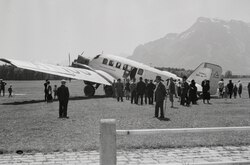
The aircraft involved was a Junkers G 24bi, a three-engine German passenger aircraft. It carried the registration D-903 and was named Oberschlesien. Its construction number was 911. The aircraft was operated by Luft Hansa, the German airline that later became part of the history of modern Lufthansa.
The Junkers G 24 was an important aircraft of the 1920s. It was designed for commercial passenger and mail services at a time when airlines were beginning to establish regular international routes.
Unlike the small aircraft used during the earliest years of aviation, the G 24 was a larger commercial aircraft capable of carrying passengers over significant distances. It was designed with three engines, which provided greater power and some additional reliability for long-distance flights.
However, even aircraft of this size were still operated with relatively basic navigation equipment. Pilots depended heavily on landmarks, weather information, visual navigation, and their own judgment.
The International Flight
On the morning of 6 November 1929, the Oberschlesien was preparing for a scheduled international service from Croydon Airport.
The planned journey was from Croydon to Amsterdam, with the aircraft continuing toward Berlin. Amsterdam was an important stop on international European routes, and Croydon was one of the major airports serving London at the time. The aircraft departed Croydon at approximately 9:54 a.m.
There were passengers and crew aboard the aircraft. Historical records differ slightly in how they count the occupants, but the commonly cited account records eight people aboard, with seven fatalities and one survivor. The people aboard included the pilot, other crew members, and passengers.
The flight began normally, but the weather was poor.
Thick Fog
Fog was one of the greatest dangers for aircraft during the early years of commercial aviation.
Modern airliners can use sophisticated instruments and navigation systems to determine their position and follow precise routes even when visibility is poor. In 1929, pilots had much fewer options.
The crew of the Junkers G 24 encountered thick fog soon after leaving Croydon. Visibility became extremely limited, making it difficult to see the ground and identify landmarks.
The aircraft was flying in an area where hills and trees created additional hazards.
The pilot had an important decision to make. Continuing toward Amsterdam in such conditions could be dangerous, especially when the crew could not maintain reliable visual references.
The decision was made to return toward Croydon.
Attempt to Return to Croydon
The aircraft began turning back toward the airport.
However, the return flight was complicated by the fog. Historical accounts indicate that the pilot reduced altitude in an attempt to maintain visual contact with the ground. This was a dangerous situation because flying at low altitude in fog left very little time to react if an obstacle appeared.
The crew was trying to navigate through difficult weather while also attempting to locate the airport.
The aircraft was flying near Godstone, in Surrey, when it came close to the ground.
The surrounding area included hills, trees, and woodland. In the fog, these obstacles could be almost impossible to see from the cockpit.
The Crash at Marden Park
The aircraft eventually reached the area of Marden Park near Godstone.
At approximately 10:10 a.m., the Junkers G 24 struck trees on a hill. The aircraft crashed into the wooded area and was badly damaged.
The collision was extremely violent.
The aircraft’s structure was destroyed and a fire broke out after the impact. Because the crash occurred in woodland and the aircraft caught fire, escape became very difficult.
Several people died immediately or were trapped inside the wreckage.
The disaster quickly became one of the most serious aviation accidents in the area.
The Fire
The fire greatly increased the danger.
Aircraft of the period carried fuel in tanks located within the aircraft structure. When an aircraft crashed, the tanks could rupture and release fuel. Any ignition source could then cause a major fire.
The Junkers G 24 caught fire after striking the trees.
People nearby and emergency responders had to deal with both the wreckage and the flames.
The burning aircraft made rescue extremely difficult. Several occupants could not escape before the fire reached them.
Seven people ultimately lost their lives in the disaster.
The Survivors
The story of the sole survivor was remarkable.
The passenger Lieutenant Commander George Pearson Glen Kidston, a well-known British racing driver and aviator, escaped from the burning wreckage. His clothes were on fire when he got out of the aircraft.
Kidston managed to extinguish the flames by rolling on the grass. Although he was injured, he survived the crash.
His survival was remarkable considering the severity of the accident.
Historical records also mention Prince Eugen of Schaumburg-Lippe, who was serving as the second pilot. He escaped from the wreckage but suffered very serious injuries. He later died from those injuries, meaning that he was not counted among the final survivors.
Kidston’s actions after the crash were also important. He raised the alarm and reported the disaster to Croydon Airport, helping authorities learn that the aircraft had crashed.
The Victims
The accident claimed the lives of most of the people aboard the aircraft.
British aviation records identify several of the victims, including:
- Bruno Rodschinka, the first pilot
- Prince Eugen of Schaumburg-Lippe, the second pilot, who later died from his injuries
- Wilhelm Ullrich, a mechanic
- Heinrich Niklas, a wireless operator
- Herbert John Gaspar, a passenger
- David Leo Jones, a passenger
- Granville Thomas Guthrie Milne, a passenger
These names are recorded in historical records of fatal aviation accidents in Britain.The loss of so many people demonstrated how dangerous an aircraft accident could be in the early days of commercial aviation.
What Caused the Accident?
The main circumstances surrounding the crash were poor visibility, fog, low-level flight, and controlled flight into terrain.
The aircraft was not necessarily suffering from a major mechanical failure. Instead, the crew was dealing with difficult weather conditions while attempting to return to Croydon.
The pilot reduced altitude in an effort to maintain visual contact with the ground. However, this placed the aircraft dangerously close to hills and trees.
The aircraft eventually struck the trees because the crew could not safely see the terrain ahead.
Today, this type of accident is often described as controlled flight into terrain, or CFIT. It occurs when an aircraft that is still under the control of its pilots unintentionally flies into the ground, a hill, or another obstacle.
The Problem of Early Navigation
The Godstone accident highlights one of the major weaknesses of aviation during the 1920s.
Pilots had limited navigation technology.
There was no satellite navigation. There were no modern ground-proximity warning systems. There were no computerized maps or terrain-alert systems.
Pilots often depended on visual landmarks.
If fog covered the ground, this method became extremely unreliable.
The crew might know approximately where the aircraft was located but still be unable to determine its exact position or altitude relative to nearby hills.
This made flying in poor weather extremely dangerous.
The Importance of Radio
Radio communication was already being used in aviation during this period, but systems were still developing.
The Junkers G 24 carried a wireless operator, showing how important radio communication had become on international flights. However, radio navigation was not as advanced as modern systems.
A wireless operator could communicate with ground stations, but communication alone did not provide the precise navigation and terrain information available to modern aircraft.
The Godstone crash therefore demonstrated the need for better navigation systems as commercial aviation expanded.
Impact on Aviation Safety
Accidents involving poor visibility encouraged aviation authorities and airlines to improve their procedures.
Better weather forecasting became increasingly important.
Airlines also needed to develop clearer rules about when aircraft should take off, continue a flight, or return to an airport.
Pilot training for instrument flying gradually became more important.
Aircraft eventually received improved instruments that allowed pilots to determine altitude, heading, and position without depending entirely on outside visual references.
Airports also developed better systems for guiding aircraft during approaches in bad weather.
These improvements took many years, but accidents such as the Godstone disaster helped demonstrate why they were necessary.
The Significance of Croydon Airport
The crash was also significant because Croydon Airport was one of the most important airports in Britain at the time.
Croydon served international flights connecting London with other European cities.
Because of its importance, many international aircraft operated through the airport. This made the safety of routes around Croydon especially important.
The Godstone accident occurred only a short distance from the airport, showing that even the beginning and end of a flight could be dangerous in poor weather.
An aircraft did not need to be far from an airport to face serious navigation problems.
The Junkers G 24 After the Accident
The Oberschlesien, registration D-903, was destroyed in the crash.
The accident became part of the history of the Junkers G 24 and Luft Hansa. The G 24 continued to be used by airlines in Europe and other parts of the world.
The aircraft type itself became an important part of the development of early commercial aviation.
However, the Godstone crash demonstrated that even a modern and capable passenger aircraft could be vulnerable when operated in severe weather without the navigation technology available today.
Conclusion
The Luft Hansa Junkers G 24 Godstone Crash of 6 November 1929 was a tragic event in the early history of international aviation. The aircraft D-903 Oberschlesien departed from Croydon Airport on a scheduled flight toward Amsterdam and Berlin. Soon after takeoff, the crew encountered thick fog and decided to return toward Croydon.
While flying at low altitude near Godstone, the aircraft struck trees at Marden Park and crashed. The aircraft caught fire, and seven people died. Glen Kidston was the only person to survive the disaster, escaping from the burning aircraft despite suffering injuries. The accident showed the serious dangers of flying in fog during the early years of commercial aviation. Without modern navigation equipment and terrain-warning systems, pilots had to depend heavily on what they could see outside the aircraft.
The Godstone disaster became another painful lesson in the development of aviation safety. Better weather information, pilot training, instrument flying, radio navigation, airport procedures, and terrain-warning technology would gradually reduce these risks.
For that reason, the 6 November 1929 Junkers G 24 crash at Godstone is remembered not only as a tragic loss of life but also as part of the long history of lessons that helped make international air travel safer.

Ajeet Yadav is an aviation enthusiast covering airline news, airports, aircraft, and industry developments through well-researched and reliable reporting.