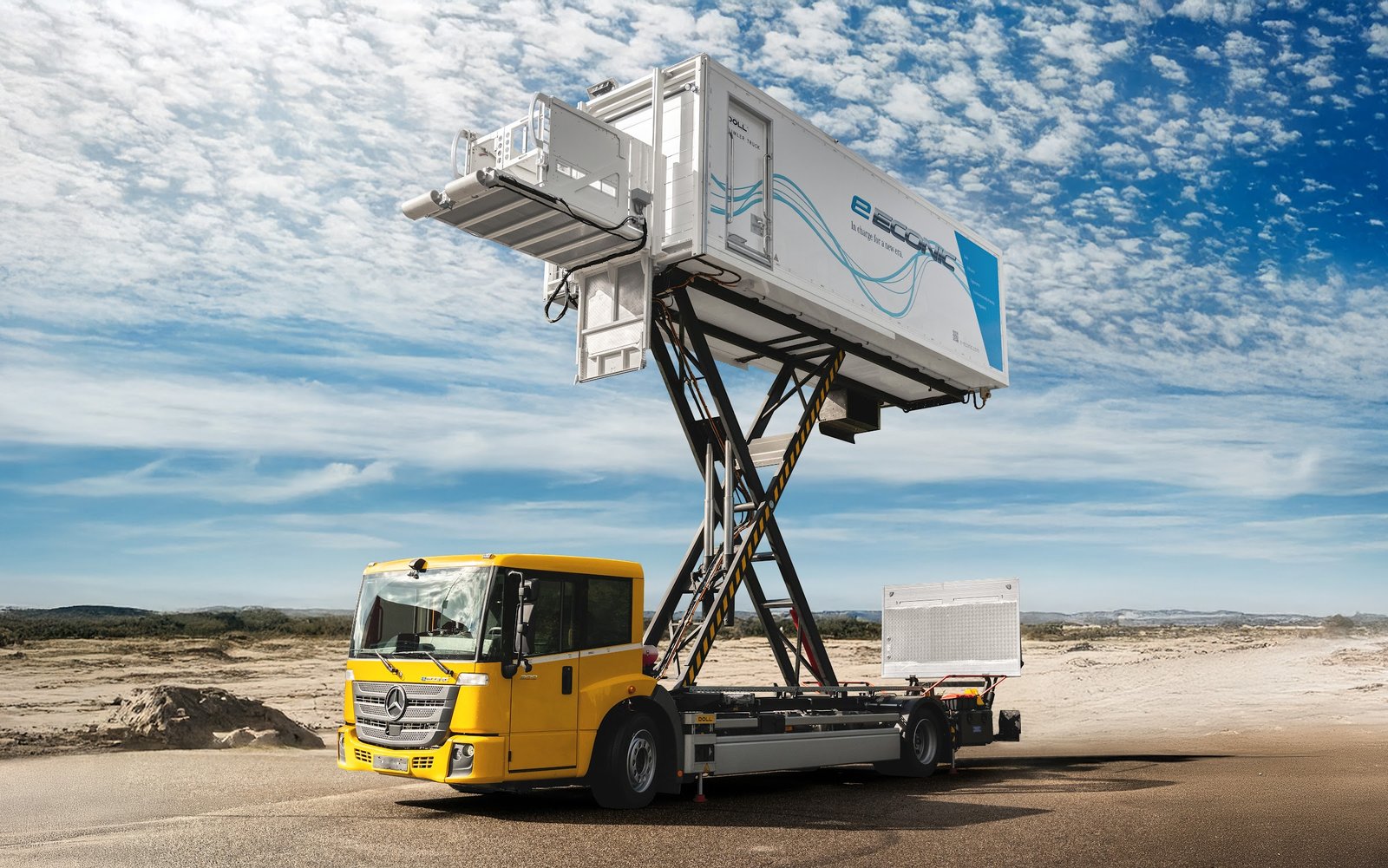




















The Ramp Goes Electric – How to Successfully Electrify Entire Fleets

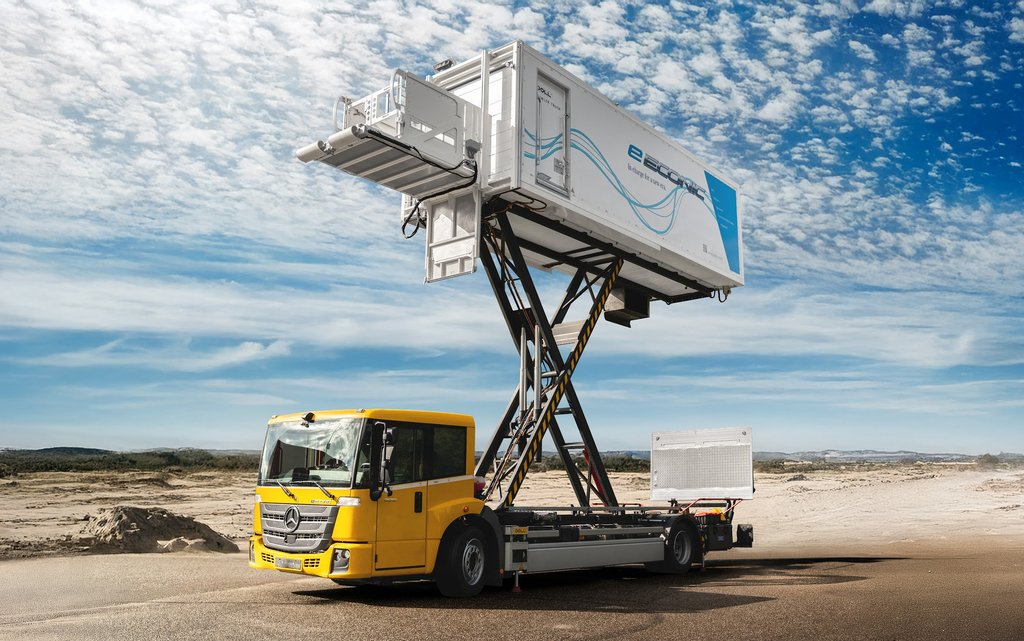
At Vienna Airport, a highloader approaches an aircraft on the ramp, quietly and without producing any exhaust emissions thanks to its electric drivetrain. To charge the pilot vehicle, the airport installed a dedicated charging station and routed a power cable over the roof of a building.
This is a practical solution for a single vehicle. But once entire ramp fleets are to go electric, individual solutions like this are no longer sufficient. In addition to procuring new electric vehicles, fleet electrification then becomes a complex infrastructure challenge: Charging requirements, grid connections, and operational processes must be planned as an integrated system.
More and more vehicles at airports around the world are going electric. Amsterdam Airport Schiphol aims to make all ground traffic emission-free by 2030, including vehicles operated by its partner companies.
Cologne Bonn Airport has set itself the goal of converting all vehicles and equipment used in ramp operations to zero-emission powertrains by 2035. At Madrid-Barajas and Barcelona-El Prat, the share of sustainably powered vehicles used in ground handling is also set to increase to 78 per cent by 2030.
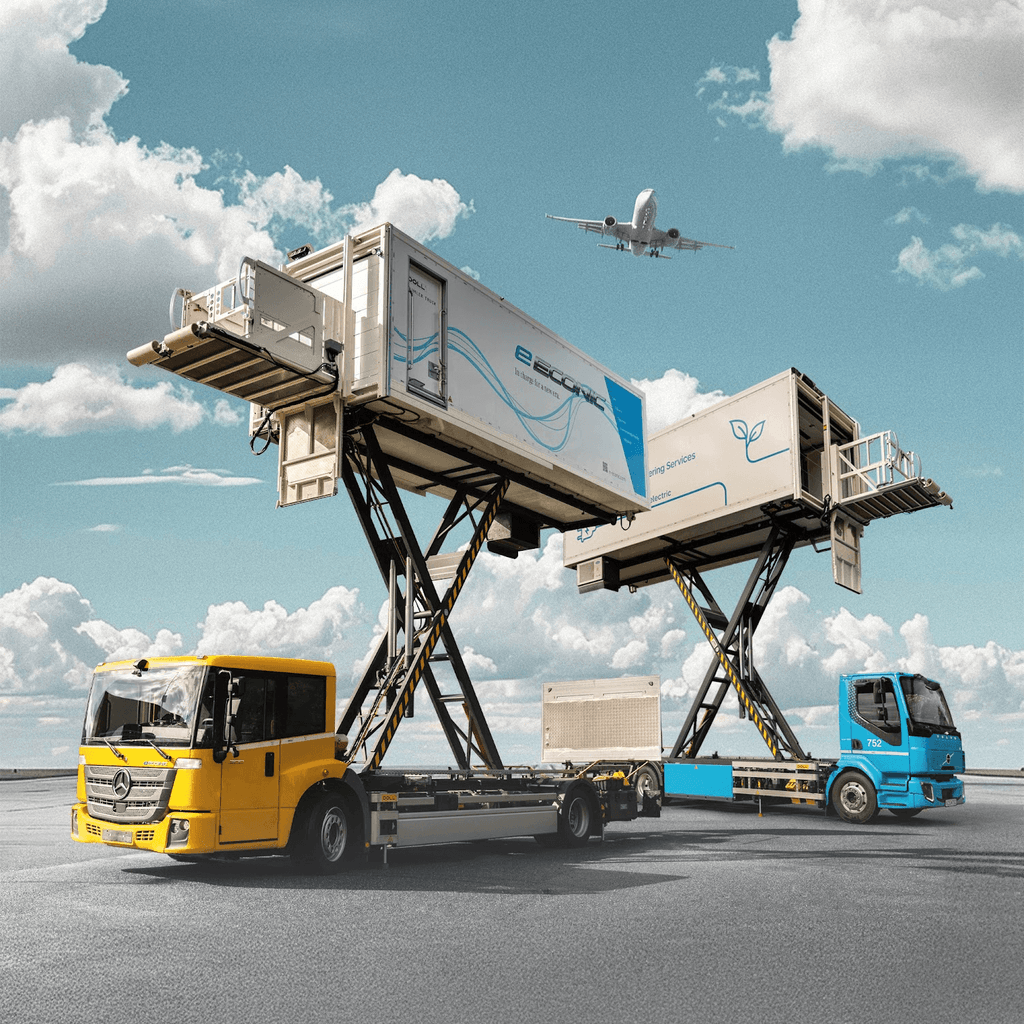
“The ramp is particularly well suited to electric vehicles: Travel distances are short, speeds are low, and many vehicles regularly return to fixed locations where they can be charged,” says Bruno Brandt, Head of Customer Operations Management at DOLL Airport Equipment. The company is one of the world’s leading manufacturers of catering highloaders for aircraft catering operations.
Ten years ago, DOLL developed its first fully electric highloader in collaboration with Mercedes-Benz and deployed it in airport operations.
Today, DOLL’s fully electric catering highloaders are being piloted at several airports around the world. “Since then, we have developed the vehicle technology to production readiness,” says Brandt. “The pilot projects are now providing the data operators need to plan larger fleets and the charging and grid infrastructure required to support them.”
Brandt accompanies the projects from configuring the vehicles for their specific duty cycles through evaluating energy consumption and total cost of ownership (TCO) data from ongoing operations. He explains what airport operators, airlines, caterers, and ground handlers need to consider when building entire electric fleets.
Analyze Duty Cycles
Small transport vehicles, baggage tractors, and belt loaders are already electric at many airports. More complex vehicles that require additional energy to perform their functions call for a more detailed analysis.
“The specific duty cycle is what matters. What routes does the vehicle travel? Which auxiliary systems draw power?” says Brandt. “A catering highloader, for example, not only has to drive and lift, but also keep its cargo compartment refrigerated throughout its shift. If the catering facility is located outside the airport grounds, the vehicle also has to cover longer distances. Our operations to date show that the battery reliably lasts for all scheduled runs even when the highloader’s refrigeration system operates continuously,” Brandt adds. The vehicles are charged overnight and during scheduled breaks in operations.
Plan the Fleet Transition in Stages
Based on these duty cycles, fleet operators should develop a specific transition plan. At most airports, this involves several companies: The airport owns the premises, while the vehicles operating on the ramp are often owned by ground handlers, caterers, or airlines. The objective is not to replace as many diesel vehicles as possible at once.
A phased transition makes more sense because the requirements vary. Broad averages are not sufficient for detailed planning. What matters are the actual operating cycles, idle periods, and peak loads at the individual airport. This creates a concrete, step-by-step roadmap for fleet electrification. That roadmap provides the basis for determining the required charging and grid infrastructure in the next step.
Plan Charging and Grid Infrastructure Early
For individual pilot vehicles, a charging solution can usually be created in cooperation with the airport operator. However, Brandt emphasizes: “As the fleet grows, power demand and peak loads increase. This also raises the requirements for grid connections, cable routes, buildings, and permits. Airport operators and the companies involved at the site should therefore coordinate at an early stage to determine which fleets will be electrified, on what timeline, and what infrastructure they will require.”
A 2023 study by the World Economic Forum and McKinsey illustrates the potential scale of this development. According to the study, electricity demand at large airports could increase five- to tenfold by the middle of the century. The analysis also accounts for the energy requirements of alternative aircraft propulsion systems.
The Vienna example shows just how early infrastructure planning needs to begin. The power cable routed over the roof of a building specifically to supply the electric highloader at its charging location works for the pilot project, but cannot simply be replicated for a larger fleet.
“Anyone planning to electrify a large share of their fleet in the 2030s needs to start planning the infrastructure today,” says Brandt. “Vehicles can be procured comparatively quickly. But upgrading grid connections and creating viable cable routes for numerous charging stations takes considerably longer.”
Prepare Maintenance Facilities and Personnel
Very little changes for drivers. “Driving, lifting, lowering, and docking at the aircraft work exactly as they do with a diesel powered vehicle,” Brandt explains. “For the driver, operation remains virtually unchanged. What they notice most when working directly with the vehicle is that the driving experience is more pleasant, the vehicle is quieter, and it produces no tailpipe emissions.”
In the maintenance shop, however, the electric drivetrain introduces new requirements. Only appropriately qualified technicians are permitted to work on high-voltage systems. Fleet operators should therefore arrange appropriate training for their maintenance personnel well in advance.
Systematically Evaluate Operational Experience
The economics of an electric highloader cannot yet be conclusively assessed. Depending on the configuration, the purchase price can be as much as twice that of a comparable diesel model, according to Brandt. However, operating costs have been lower in the deployments to date. Only long-term operating data will show how the investment performs over the vehicle’s service life.
“A pilot project must do more than demonstrate that the vehicle works from a technical perspective,” says Brandt. “It also provides valuable data for fleet planning. Operators should work with the manufacturer to systematically record and evaluate energy consumption, charging times, and maintenance requirements.”
On this basis, operators can assess how the vehicle performs in service, what infrastructure is required, and how best to plan the next stages of the fleet transition. Each company must also evaluate the economics individually based on its actual operating conditions and existing infrastructure.
Technology Alone Is Not Enough
“The vehicles are available. The task now is to integrate them effectively into airport operations,” Brandt summarises. Whether electric highloaders and other electric vehicles will be deployed on a large scale on airport ramps in the coming years will depend primarily on charging infrastructure and operational planning.
“Anyone who analyzes duty cycles, plans charging stations, and evaluates initial operating data today is creating the conditions for the transition,” says Brandt. “Vehicles on the ramp are often not owned by the airport, but by ground handlers, caterers, and airlines. Whoever supplies the power therefore needs to know what the others are planning.”

Aviation Jeta is an aviation news platform covering airlines, airports, aircraft, and global aviation developments. We publish accurate, well-researched, and detailed aviation news and industry insights from around the world.