











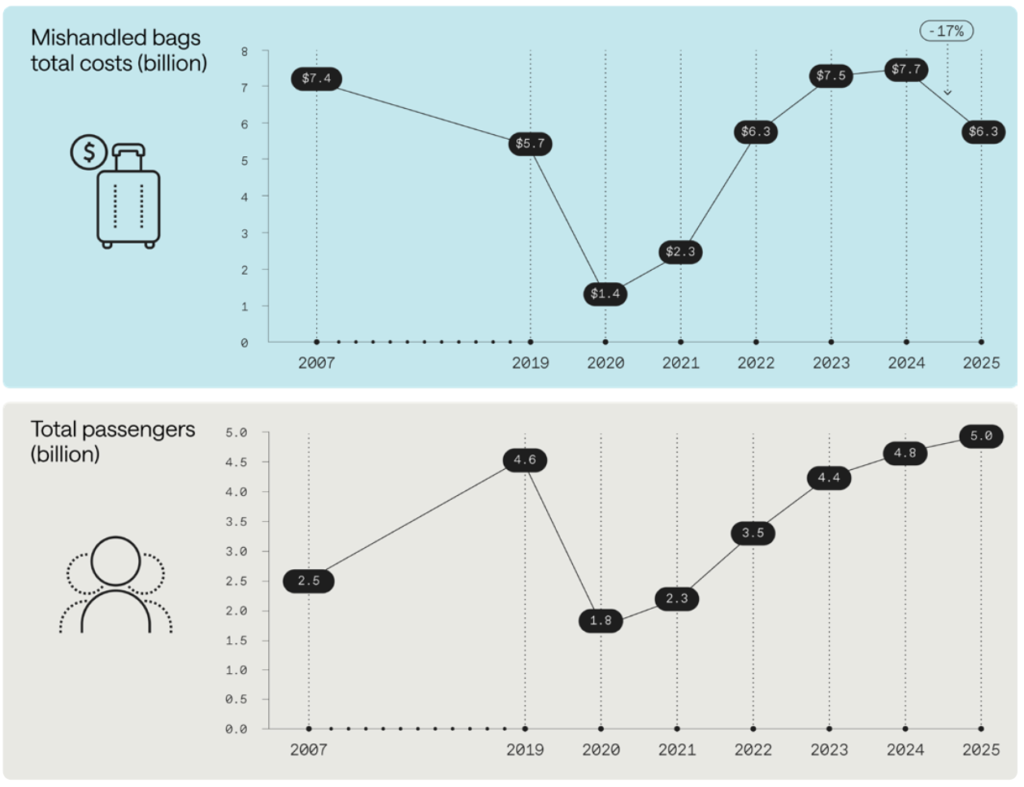
- The 2025 mishandled baggage cost was about 15% of the airline industry’s estimated $41 billion profit, despite a 23% fall in mishandling rates.
- SITA’s revised benchmark puts the average cost of a mishandled bag at $260, far above the earlier $150 estimate.
- Real-time tracking, AI, automation and passenger location data are helping airlines reduce baggage delays and recovery costs.

For passengers, baggage has become part of the overall reliability of air travel, rather than a separate process that begins at check-in and ends at the arrivals belt.
Travellers now move through airports with mobile boarding passes, live flight alerts and digital payment tools, while in other parts of daily life they are used to tracking parcels from dispatch to delivery.
This has raised expectations for baggage handling, making a delayed or lost bag not only an inconvenience at the end of a flight but a visible break in a journey that is otherwise becoming more digital.
SITA’s 2026 Baggage IT Insights reveal that baggage has become both a passenger service issue and a cost burden for airlines. In 2025, mishandling rates fell by 23% and total mishandled bag volumes declined by 19%, reaching one of their lowest levels in recent years. Industry costs also fell by 17% as performance improved, but mishandled baggage still cost airlines $6.3 billion, a significant operating expense for carriers working on thin margins.
SITA’s revised benchmark puts the average cost of a mishandled bag at $260, replacing the widely used $150 figure that the company describes as outdated and insufficiently transparent. The new estimate is based on third-party analysis, workshops, expert interviews and a survey of 115 airline and ground-handling professionals across six regions, with more than 35 process steps and over 200 cost drivers reviewed across the mishandled baggage process.
SITA CEO David Lavorel put the cost in margin terms, saying each mishandled bag costs airlines $260 on average while net profit per passenger averages $8. “Every mishandled bag can equal the profit from more than 30 seats sold. Just five mishandled bags can erase the profit from an entire flight,” he said. Lavorel also put the annual cost of mishandled bags at $6.3 billion, equivalent to 15% of the airline industry’s estimated 2025 profit of $41 billion.
Cost and Performance
The improvement in 2025 shows that airlines, airports and ground handlers are making progress, but the cost structure of mishandled baggage explains why the issue remains difficult to remove from airline accounts. Delayed bags account for 75% of mishandled bag volume and about 70% of total cost, or roughly $4.4 billion, because they require repeated operational action after the passenger has travelled: tracing, recovery, storage, rerouting, reflighting, local delivery and communication.
Lost bags are much fewer in number, representing only 4% of cases, but they account for 10% of the cost because the compensation burden is much higher when the bag cannot be returned.
Damaged bags involve fewer recovery steps than delayed bags, but compensation keeps their average cost almost at the same level.
SITA estimates a delayed bag at $245, a damaged bag at $255 and a lost bag at $635, which means delays create the largest bill because they happen most often, while lost and damaged bags cost more per case.
Transfers remain the most common source of delayed baggage. Transfer baggage mishandling accounted for 39% of delay causes in 2025, down from 41% in 2024, while ticketing errors, bag switches and security accounted for 18%, failed loading for 16%, airport, customs, weather and space-weight restrictions for 11%, loading or offloading errors for 8%, and tagging errors and arrival-station mishandling for 4% each.
The breakdown shows why transfer baggage remains difficult to manage: a bag may have to move between flights, teams and handling systems within a short transfer window, where even a small delay in identification, loading or reassignment can leave it behind.
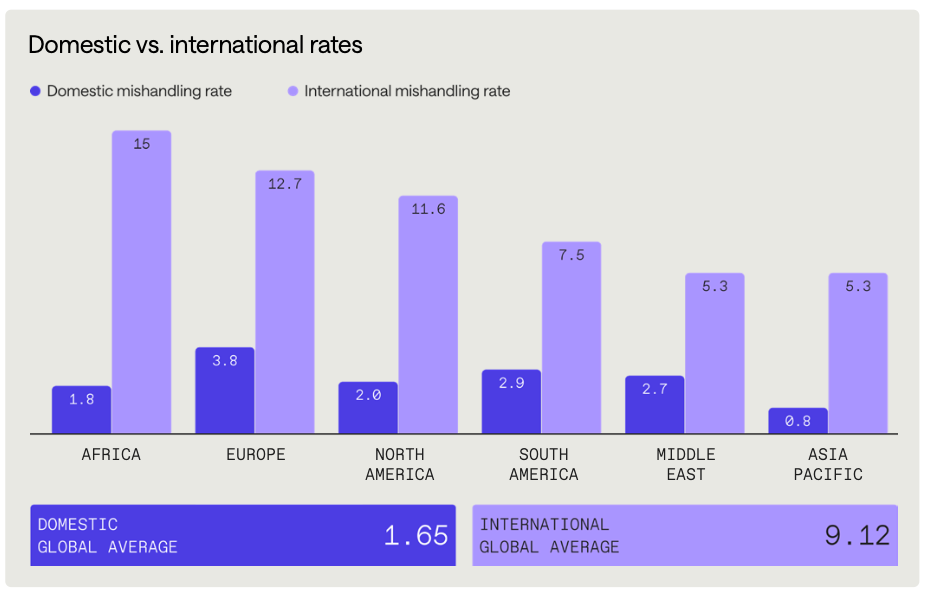
That is also why international journeys carry a much higher risk of mishandling than domestic flights.
SITA’s data places the global domestic mishandling rate at 1.65 bags per 1,000 passengers, compared with 9.12 bags per 1,000 passengers on international routes, where bags are more likely to pass through several airlines, handlers, airports, and connection windows.
For high-growth aviation markets such as India, where airlines and airports are working to build larger international networks and stronger hub operations, the finding is particularly relevant because transfer traffic can raise the baggage risk unless tracking, reconciliation and recovery systems are built into expansion plans early.
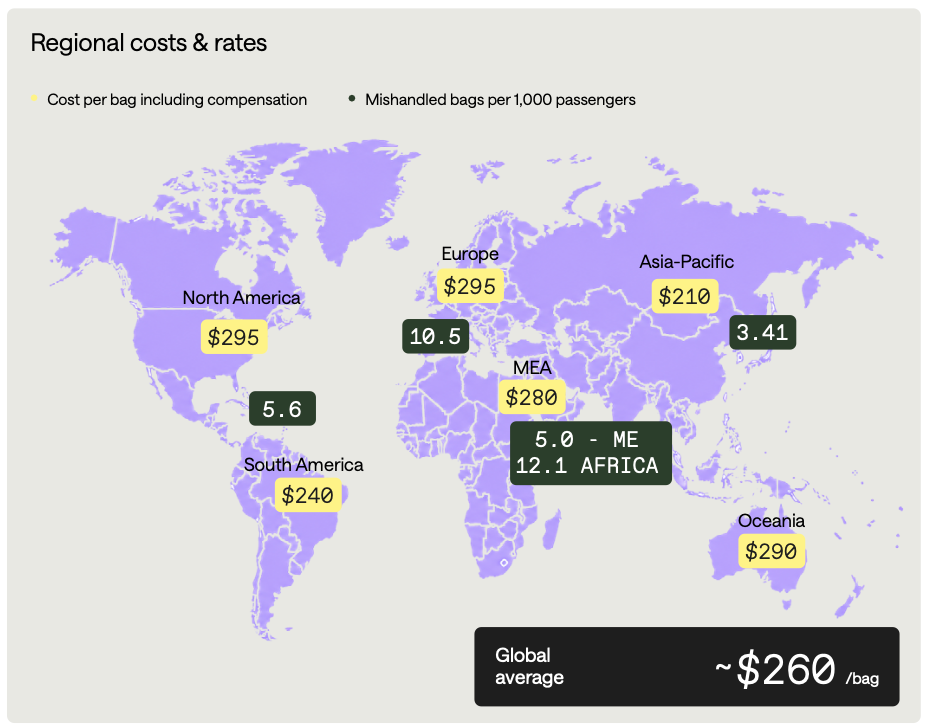
Regional performance reflects differences in infrastructure, transfer exposure and technology adoption. Asia-Pacific recorded the lowest mishandling rate at 3.41 bags per 1,000 passengers and the lowest cost per mishandled bag at $210, while the Middle East also performed comparatively well, with a rate of 5.0 bags per 1,000 passengers.
Europe, with heavier exposure to transfers, capacity limits and stricter labour conditions, recorded a mishandling rate of 10.5 and an average cost of $295 per bag. North America matched Europe’s average cost at $295 per mishandled bag, with a mishandling rate of 5.6 per 1,000 passengers, while South America averaged $240 per bag and Oceania $290.
Figures from the Association of Asia Pacific Airlines add a qualification to Asia-Pacific’s stronger regional performance. Across 12 Asian carriers, passenger volumes in 2025 reached their highest level since 2022, while the mishandled baggage rate rose 9% to 3.4 per 1,000 passengers. The increase was limited, but it shows that higher traffic leaves less margin for error in baggage operations, even in regions where mishandling rates remain comparatively low.
Data, Automation and Regional Gaps
SITA identifies real-time visibility as the practical way to reduce baggage costs, rather than relying on manual recovery once a bag has missed its planned movement. Airlines and airports already record baggage data at check-in, loading, transfer and arrival under IATA Resolution 753, but that information reduces cost only when it is shared quickly across airlines, airports, ground handlers and technology systems. Used early enough, it can help prevent a missed transfer, support automatic reflight decisions or shorten recovery after disruption.
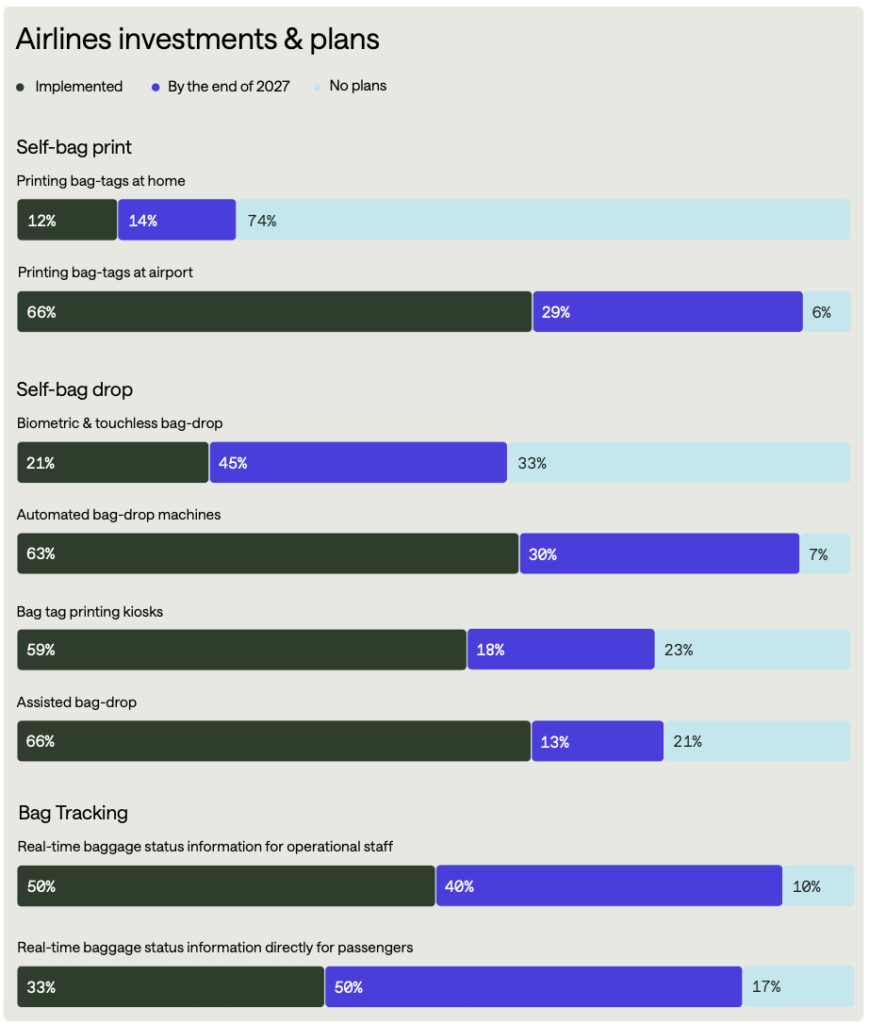
Airline investment plans also point to a stronger focus on data visibility and automation. SITA’s 2025 Air Transport IT Insights found that 83% of airlines are prioritising data-driven decision-making across operations, while 73% plan to invest in artificial intelligence over the next two years. In baggage handling, half of airlines plan to provide real-time baggage status information directly to passengers by the end of 2027, while 40% plan to give operational staff similar visibility.
In baggage handling, the practical role of AI is to predict problems earlier and give operators more time to act.
By analysing historical and real-time data, it can help identify patterns, anticipate disruption, forecast baggage volumes, estimate arrival times and flag issues before they become more costly.
SITA also points to AI-driven tools that can reroute bags when flights change, belts become congested or equipment fails, support robotic movement, loading and unloading, optimise conveyor flow and speed, and trigger repair activity before failures affect operations.
Thai Airways offers one operational example. After the pandemic, baggage reconciliation at the airline still involved paper-based processes, with staff scanning, validating, printing and attaching paper rush tags for mishandled bags.
The airline introduced SITA Bag Manager across nine domestic airports and added SITA WorldTracer Auto Reflight at Bangkok, allowing passenger and flight data to be validated automatically and missed bags to be reassigned to onward flights without paper rush tags.
A task that previously took about three minutes was reduced to one second per bag, while the system also captured the reason for each delay, giving the airline a better view of where costs were being created.
Passenger-provided location data is becoming part of the baggage recovery process. Where location sharing was enabled through WorldTracer, the integration of Apple AirTag and Find My Share Item Location technologies led to a 90% reduction in bags that became permanently lost, while airlines using the integration recorded a 26% reduction in delayed-bag recovery time.
The integration is now used by 29 airlines and allows passengers to share a secure bag-location link when a bag is delayed, giving recovery teams another data point alongside airport scans and airline-to-airline messages.
Google’s Find Hub integration with WorldTracer follows the same principle, with passengers able to generate secure links that can be stopped at any time and expire automatically. The location data remains encrypted and under passenger control, while airlines gain another source of information alongside airport scans and airline-to-airline baggage messages.
WorldTracer is already used by more than 500 airlines and ground handlers across about 2,800 airports, giving these consumer-location tools access to an aviation recovery network that is already global in scale.
Industry bodies are also focusing on baggage visibility across the airline and airport chain. IATA says global adoption of baggage tracking has now exceeded 50%, and the association is targeting full compliance with Resolution 753 by 2027.
It also expects the IATA Baggage Community System to be introduced in 2026, using modern baggage messaging standards to lower implementation costs and support real-time compliance tracking.
ACI World adds the airport perspective, stressing the need for airlines, airports, ground handlers and technology partners to work with timely and reliable baggage information so failure points can be reduced earlier in the journey and bags can be recovered faster when disruption occurs.
Nicole Hogg, Portfolio Director Baggage at SITA, describes the next phase of baggage handling as a move toward real-time visibility, automated redirection and services that begin before the passenger reaches the airport. Passenger location data from Apple AirTags or Google Find Hub, home or hotel baggage pickup, car-based bag drop and future home tagging all point to a system in which the bag has a more complete digital identity across the journey. “Ultimately, baggage is evolving into a digital platform, with a digital bag identity, an intelligent layer and full ecosystem integration,” Hogg said.
If adopted more widely, that approach would bring baggage handling closer to SITA’s stated goal: passengers receive their bags at destination with less uncertainty, while airlines reduce recovery costs by identifying and resolving problems earlier.
Also Read: Asia-Pacific Sets Global Benchmark In Baggage Handling As Air Travel Hits Records