
















26 June 1936: First Flight of the Focke-Wulf Fw 61, the World’s First Practical Helicopter

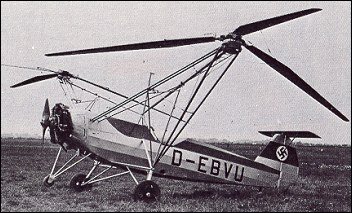
On the morning of 26 June 1936, test pilot Ewald Rohlfs settled into the cockpit of a peculiar machine at Bremen Airport, opened the throttle on a 160-horsepower radial engine, and left the ground—straight up, without a runway, without a roll, without forward speed. The flight lasted 28 seconds. Ninety years later, those 28 seconds are widely regarded as the moment the world’s first practical, fully controllable helicopter moved from theory into reality.
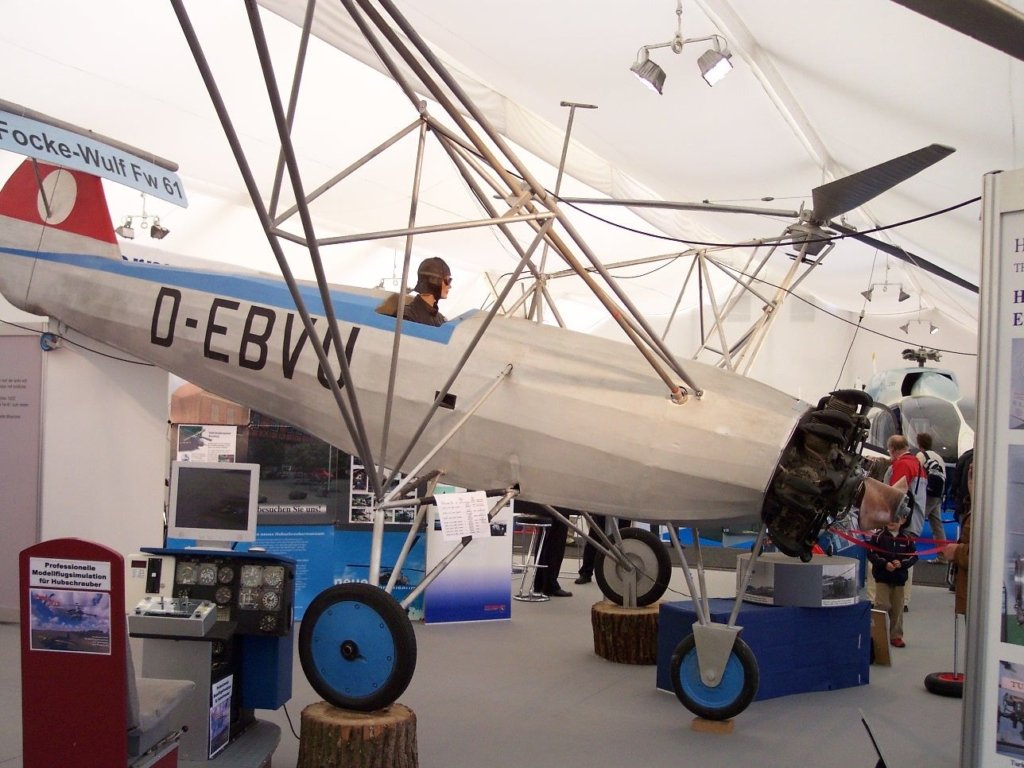
The aircraft was the first prototype of the Focke‑Wulf Fw 61, V1, registered D‑EBVU. What Rohlfs demonstrated that morning had eluded engineers for decades: a machine that could rise vertically, hover under control, move in any direction, and return safely to earth—all under the authority of the pilot’s hands and feet rather than by chance.
Before Bremen: Early Attempts at Vertical Flight
The idea of vertical flight is as old as Leonardo da Vinci’s 15th century aerial screw—a spiral rotor concept sketched long before powered flight—but the engineering problem remained largely unresolved.
Earlier pioneers in vertical flight included the Frenchman Paul Cornu in 1907 and the Spaniard Juan de la Cierva, whose autogyro used a free-spinning rotor for lift and a propeller for forward thrust. An autogyro is a rotary-wing aircraft in which a free-spinning, unpowered rotor provides lift, while a conventional engine-driven propeller provides forward thrust.
In the 1920s, Italian Corradino d’Ascanio developed a coaxial‑rotor machine which, in 1930, managed brief, tentative lifts from the ground, but none of these early efforts achieved what any working aircraft must deliver: controlled, sustained, safe flight.
The autogyro, which Focke-Wulf built under Cierva licence in the early 1930s, came closest. It was a practical aircraft in limited service, but it was not a helicopter. It required forward speed for lift, could not hover, and could not ascend or descend at will.
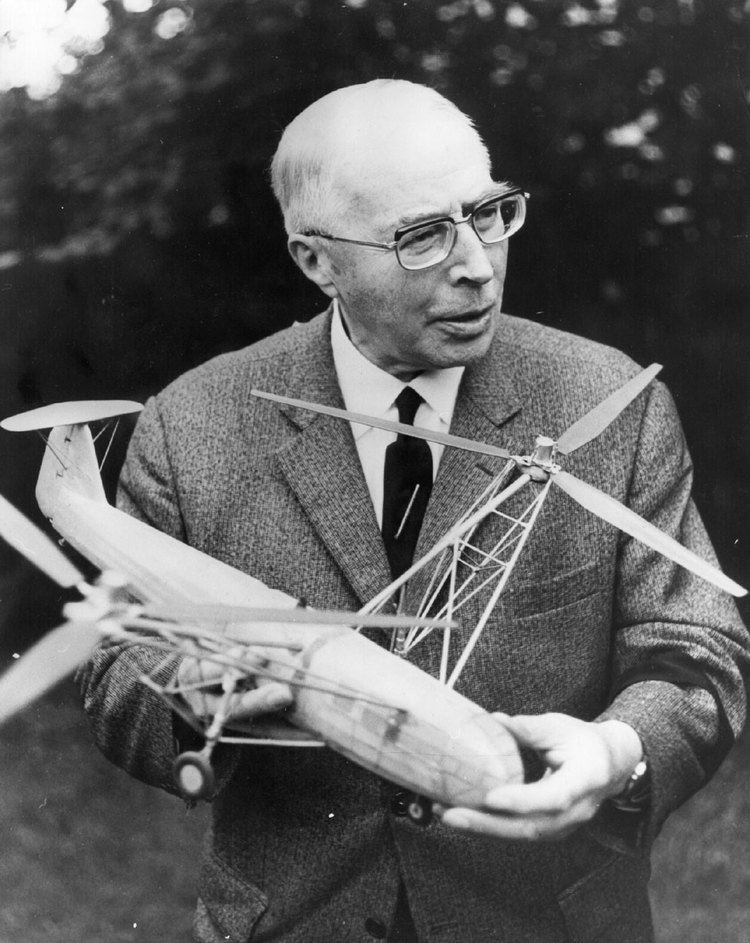
Henrich Focke, the engineer who had co-founded Focke-Wulf in 1924, studied the autogyro’s aerodynamics exhaustively and came to a conclusion that would shape his next decade of work: the helicopter was the only aircraft type that could meet the full range of vertical-flight requirements, and no one had yet built one that was genuinely practical.
Henrich Focke’s Solution
By 1932, Focke had a formal design proposal on paper and enough wind-tunnel data to back it. His priority list, documented later in technical papers published by NASA, placed emergency autorotation safety at the top—the ability to land the machine intact after engine failure—before stability, before controllability, and well before performance. It was the design philosophy of a methodical engineer who had watched earlier helicopter experiments fail catastrophically, and it shaped every decision that followed.
The Reichsluftfahrtministerium (RLM), the German Air Ministry, issued a development order on 9 February 1935. Focke’s team chose the fuselage of the proven Fw 44 Stieglitz trainer as its structural foundation, stripped the wings, and fitted two steel‑tube outriggers extending laterally from the fuselage, each carrying a three‑bladed counter‑rotating rotor.
Counter-rotation cancelled the torque reaction that would otherwise spin the fuselage, eliminating the need for a tail rotor and significantly simplifying control.
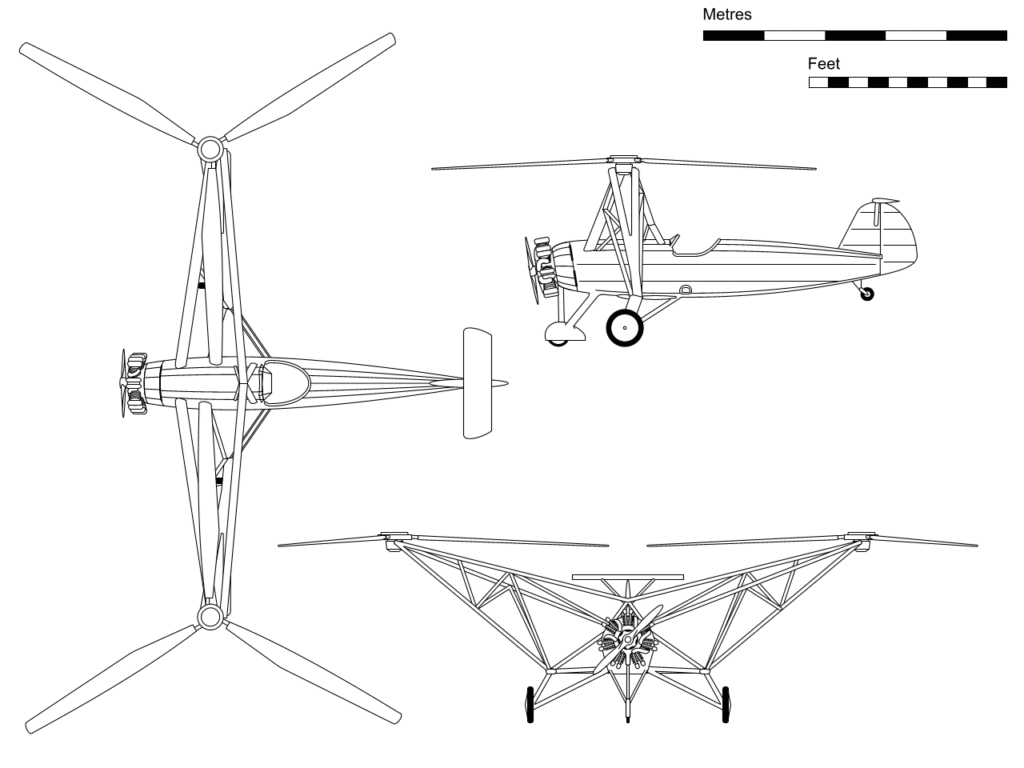
A single Siemens‑Halske Sh 14A radial—later produced as the Bramo Sh 14A and rated at about 150 horsepower continuous and 160 horsepower for take‑off—drove both rotors through a central gearbox and shaft system.
A small propeller at the nose was fitted only to cool the engine in hovering and low-speed flight; it provided negligible thrust.
Each rotor accepted full cyclic and collective pitch control. The pilot could tilt the entire rotor disc to generate directional thrust, adjust overall lift, and use differential inputs between the two rotors to roll sideways or swing the nose left and right—what aviators call yaw.
It was, for 1935, an extraordinarily sophisticated control architecture—and before a single manned flight took place, the team had already conducted full-scale rotor testing in a wind tunnel, built and flown a powered free-flight model, and completed an exhaustive sequence of ground runs and tethered tests.
26 June 1936
The first free flight lasted 28 seconds. By the fourth, Rohlfs had the Fw 61 in the air for 16 minutes—longer than all prior helicopter flights by any aircraft. Each subsequent sortie expanded what the aircraft could do: sustained hover, translational flight (moving forward and sideways rather than standing on the spot), coordinated turns, climbs to altitude, and eventually the deliberate practice of autorotation.
On 10 May 1937, Rohlfs made the defining technical demonstration of the programme: he reduced rotor pitch to the autorotative setting at altitude, disengaged the engine drive, and descended to a safe landing with no power. The helicopter could survive what every aircraft must eventually face. The central objection to operational helicopter deployment—that an engine failure meant a fatal crash—was answered.
The records followed. On 25 June 1937, Rohlfs climbed to 2,439 metres and remained airborne for 1 hour, 20 minutes and 49 seconds. The following day, he recorded a measured speed of 122.5 km/h. In October 1937, Hanna Reitsch flew a 108.9-kilometre cross-country course from Stendal to Berlin.
On 20 June 1938, Carl Bode flew 230.3 kilometres in a straight line between Faßberg and Rangsdorf, setting a new distance record. By 29 January 1939, he had also raised the altitude record to 3,427 metres.
Every figure was formally certified by the Fédération Aéronautique Internationale (FAI), the Paris-based body that has served as the official authority on aviation and aerospace records since 1905. None was remotely close to what any prior rotorcraft had achieved.
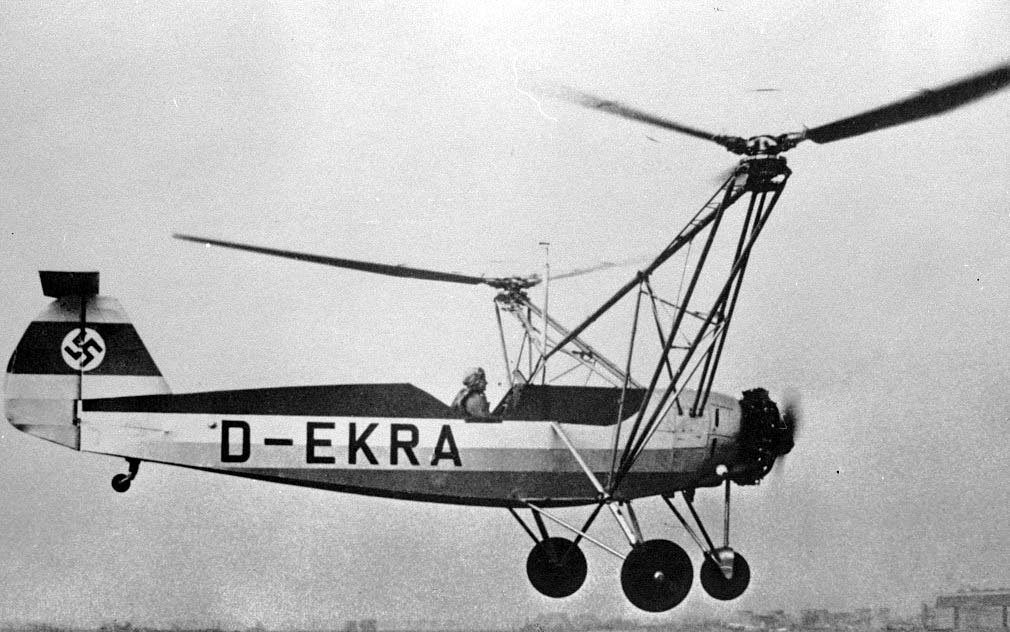
The Fw 61’s most publicly dramatic appearance came in February 1938, when Reitsch flew the second prototype—D-EKRA—inside the Deutschlandhalle arena in Berlin on 14 consecutive evenings during the Berlin Motor Show.
Before crowds of thousands, she performed vertical take-offs, precision hovering, and 360-degree turns inside a building, with barely metres of clearance above and around her. German newsreels carried the footage internationally. The world understood, for the first time, what a practical helicopter looked like in motion.
From Prototype to Operational Helicopter
The Fw 61 was an experimental aircraft, never intended for service. Henrich Focke—by then forced out of his own company by political pressure and, from 1937, leading the new helicopter firm Focke‑Achgelis together with test pilot Gerd Achgelis—applied everything the Fw 61 had taught him to the Fa 223 Drache, a utility helicopter that first flew in 1940 and was capable of lifting external loads up to 1,600 kilograms. Allied bombing destroyed successive production batches; fewer than 20 Fa 223s were completed. Neither Fw 61 prototype survived the war.
Igor Sikorsky’s VS-300, which flew in September 1939, established the single‑main‑rotor‑and‑tail‑rotor configuration that dominates helicopter design to this day, and Sikorsky’s industrial output after the war gave the helicopter its global footprint.
But Sikorsky himself acknowledged the Fw 61’s precedence. By the time his VS-300 left the ground, Focke’s machine had already spent three years in the air, held every significant helicopter world record, and demonstrated before international audiences precisely what the category was capable of.
Every helicopter that has evacuated a casualty, extracted a stranded climber, or ferried freight to a location no fixed-wing aircraft could reach carries, in its engineering lineage, the work that culminated on a grass airfield in Bremen on 26 June 1936.
Also Read: History of Air Navigation – Part II: Transition to Radio Navigation Systems