











Embraer’s First E-Freighter Enters Commercial Service with Bridges Air Cargo

- Embraer’s first E-Freighter has entered commercial service with Bridges Air Cargo, operating its inaugural flight from Cologne to Larnaca.
- The E190-based freighter fills the gap between turboprops and larger cargo jets, designed for mid-density cargo routes.
- Developed for the growing e-commerce market, the aircraft supports faster parcel movement between regional hubs and smaller cities.
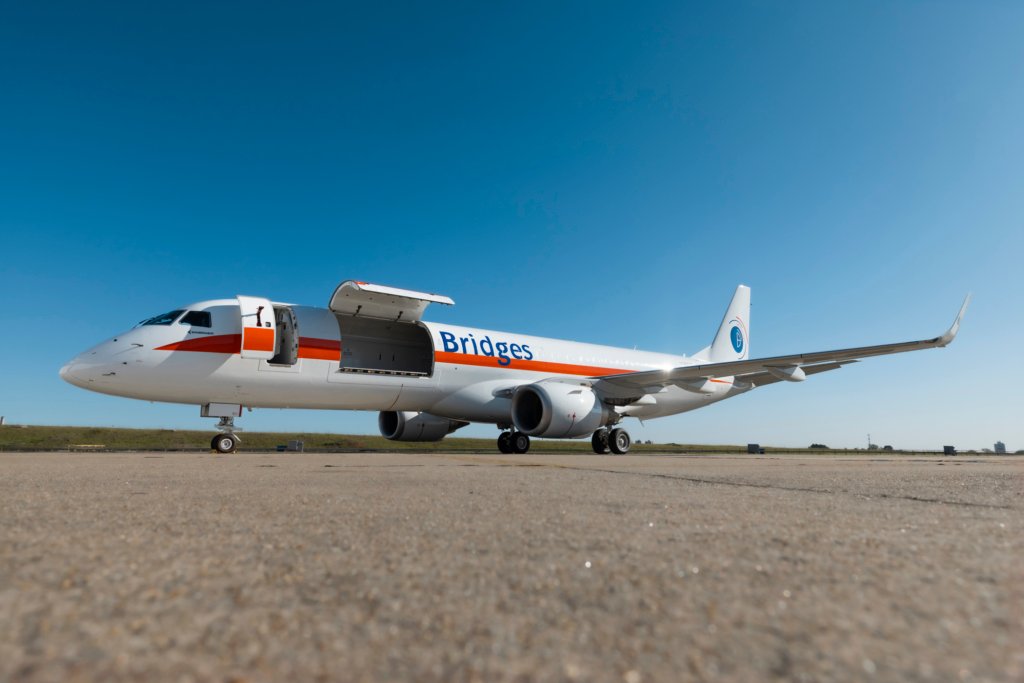
The first E-Freighter developed by Brazilian aerospace major Embraer has officially entered commercial service in Europe with Bridges Air Cargo. The E-Freighter completed its inaugural commercial flight from Cologne (Germany) to Larnaca (Cyprus), carrying time-sensitive express shipments.
The aircraft will support express logistics networks across Europe, the Middle East and Africa through Bridges’ operations for Bridges Worldwide, which provides neutral air cargo network solutions for courier and logistics companies. The deployment signals the beginning of commercial operations for Embraer’s passenger-to-freighter (P2F) conversion programme designed around its popular regional jets.
Key technical features
The converted E-Freighter offers a number of operational advantages compared with older cargo aircraft in its size category. The aircraft can carry a maximum structural payload of up to 13,500 kg, while providing a total cargo volume of around 103 cubic metres (3,630 cubic feet).
With the ability to accommodate up to nine unit load device (ULD) positions, the aircraft is compatible with palletised cargo systems used in larger freighters, enabling seamless integration into existing logistics networks.
The jet operates at a maximum cruise speed of Mach 0.82 and has a service ceiling of 41,000 feet, allowing faster long-distance transport compared with turboprop cargo aircraft. Its volumetric range of approximately 2,590 nautical miles enables operators to connect regional hubs across continents.
Embraer says the converted aircraft offers over 40% more volume capacity than many turboprop freighters while providing three times the range. At the same time, operating costs can be up to 30% lower than larger narrowbody cargo aircraft, making it suitable for routes where demand does not justify deploying bigger jets.
Addressing Secondary & Tertiary Markets
The freighter variant, based on the Embraer E190F platform, was developed to address what Embraer describes as a structural gap in the cargo aircraft market between turboprop freighters and larger narrowbody cargo jets. Airlines and logistics operators often rely on large aircraft even when routes do not require their full capacity, which increases operating costs and reduces efficiency.

The E-Freighter programme was launched to meet evolving logistics patterns driven by the rapid expansion of e-commerce and the decentralisation of supply chains.
The aircraft is capable of serving secondary and tertiary cities rather than only major cargo hubs. Embraer aims to provide operators with a “right-sized” solution that combines the speed of jet aircraft with lower operating costs.
E-commerce Push
One of the central drivers behind the E-Freighter programme is the changing structure of global logistics networks. E-commerce growth has significantly altered cargo distribution patterns, requiring faster delivery timelines and a wider network of smaller cargo routes.
Large freighters remain essential for high-volume trunk routes connecting major cargo hubs. However, logistics companies increasingly need smaller jets to move parcels quickly between regional centres and smaller cities. The E-Freighter is designed to operate on these “feeder” and mid-density routes, enabling express carriers to run more frequent flights while maintaining cost efficiency.
Embraer is also positioning the aircraft as a more sustainable alternative to ageing freighters. Because many older cargo aircraft are converted from aircraft that are already several decades old, they tend to have higher fuel burn and emissions. The E-Freighter uses relatively younger aircraft platforms and modern engineering upgrades, which improves fuel efficiency and reduces operating emissions.
By leveraging its existing fleet of E-Jets and converting a few of them for cargo use, the company is positioning itself to capture a share of the growing middle segment of the air cargo market.
Growing demand for freighter aircraft
The E-freighter programme comes at a time when the global freighter aircraft market is expanding rapidly. According to market research firm DataInsights, the global freighter aircraft market was valued at $6.57 billion in 2025 and is expected to grow steadily in the coming years.
The sector is projected to record a compound annual growth rate (CAGR) of about 5.76% between 2025 and 2033, reflecting strong demand for air cargo capacity worldwide, driven by e-commerce growth, new cargo hubs, improved regional logistics networks and emerging markets.
Also Read: GIFT-IFSC’s Aircraft Leasing Promise: Real Progress, Real Gaps

Chandrakanth R has over four decades of journalism experience, including 25 years as Chief Reporter at The Hindu and four years as Editor of Media One, Dubai. Since returning to India, he has specialised in aerospace and defence and regularly covers major international industry events.