



















Kepplair Evolution Marks Milestone with First Prototype Flight


Having arrived in Toulouse in early August, the first Kepplair Evolution ATR 72 prototype has just completed its first pre-modification flight, a key milestone that officially launches the test campaign for the KEPPLAIR 72, the future multi-role water bomber dedicated to civil protection.
Piloted by Eric Delesalle, the programme’s flight test director, a former chief pilot and test pilot at ATR, and Axel Valat, a test pilot at Aerotec & Concept, the aircraft – now bearing Kepplair Evolution’s livery – is thus commencing its flight test programme, with a view to certification in 2027.
It completed two flights over Toulouse before being grounded until the end of the year whilst it is converted into a water bomber.
The aircraft will be fitted with the KEDS (Kepplair Evolution Delivery System) drop system, specially developed by Kepplair Evolution in collaboration with the Toulouse Institute of Fluid Mechanics (IMFT), Professor Dominique Legendre and Trotter Controls, the international benchmark in the design and manufacture of telemetry systems and drop doors for water-bombing aircraft.
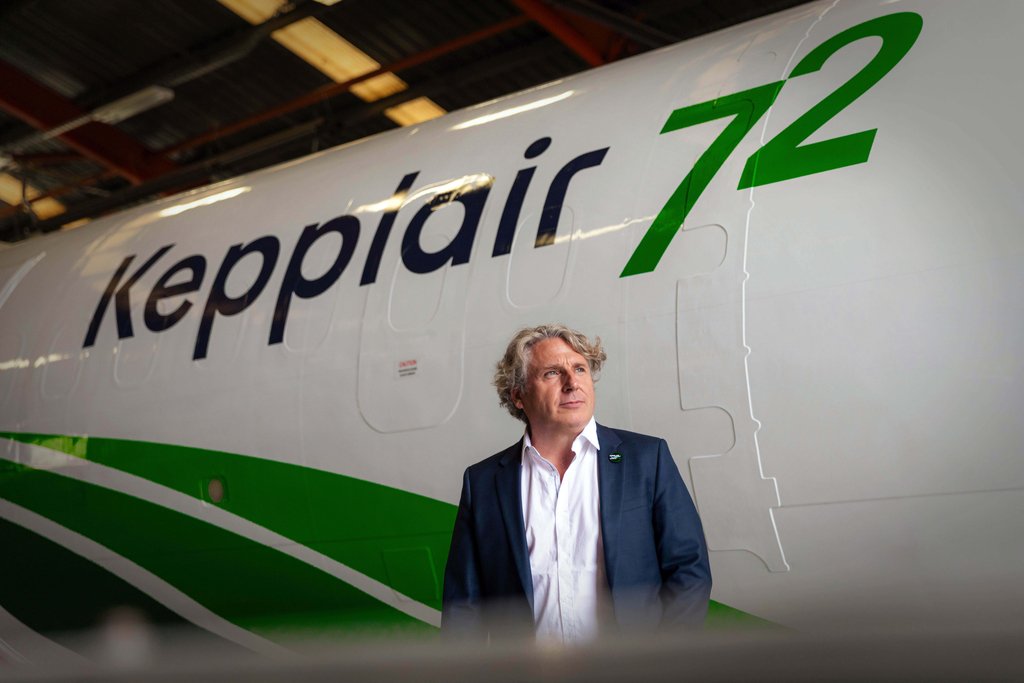
The conversion and certification will be carried out by Aerotec & Concept – the European leader in aircraft modifications – which is already housing the aircraft in its hangar at Toulouse-Blagnac.
Test programme, certification and technical validation
Following a phase of drop tests carried out in the laboratory at the IMFT on a full-scale test rig, drop tests will continue in flight from January 2027 as part of an operational qualification programme designed to confirm the system’s performance under real-world conditions.
Following the flight test programme, the KEPPLAIR 72 is expected to obtain, by 2027, the Supplemental Type Certificate (STC) issued by EASA, the European Union Aviation Safety Agency.
The certification will then be extended to other international authorities, including the FAA, the US Federal Aviation Administration.
The KEPPLAIR 72 is expected to be certified and enter service in 2027, offering civil security authorities a modern, robust and rapidly industrialisable European solution.
Support from a proven ecosystem for key competitive advantages
Based on the ATR 72 platform, the KEPPLAIR 72 programme is underpinned by a rigorous scientific approach aimed at optimising the accuracy of ground tracks and, consequently, operational performance.
With the backing of several recognised industry players, the KEPPLAIR 72 project offers real competitive advantages:
- Rapid time-to-market: Using an existing platform reduces time-to-market to 3 years, compared with 6–10 years for competitors, and limits the initial investment.
- Technical innovation: The deployment system creates a sustainable competitive advantage.
- Cost reductions: Development and procurement costs are reduced by 50 per cent, while operation and maintenance costs are reduced by 30 per cent.
- Reduction in CO₂ emissions: Emissions can be reduced by up to 40 per cent through the reuse of existing aircraft, optimisation of fuel consumption, use of sustainable aviation fuel (SAF), and other measures.
- Unique versatility: The aircraft can be adapted to customers’ needs as either a dedicated water bomber or a multi-role aircraft for water bombing, medical evacuation and cargo.
- Experienced management: The programme operates in a buoyant global market with a limited competitive landscape, offering a unique and favourable strategic window of opportunity.
Fundraising and institutional support
The first two fundraising rounds have been successfully completed, raising a total of €17.5 million, including €5 million in public grants under the France 2030 programme and the ERDF.
A third round is currently underway to support the certification and industrialisation phase of the aircraft.
The KEPPLAIR 72 programme has received a letter of interest from the Directorate-General for Civil Security and Crisis Management and has, since March 2026, benefited from the official support of the State and the Occitanie Region, under the France 2030 plan and the ERDF.
It has also received official support from the National Federation of French Firefighters (FNSPF) and the French Federation of Firefighting Professions (FFMI).
This institutional and operational support confirms the relevance of a European solution designed to address the increasing frequency of forest fires and the challenges of industrial sovereignty and territorial protection.

Aviation Jeta is an aviation news platform covering airlines, airports, aircraft, and global aviation developments. We publish accurate, well-researched, and detailed aviation news and industry insights from around the world.