




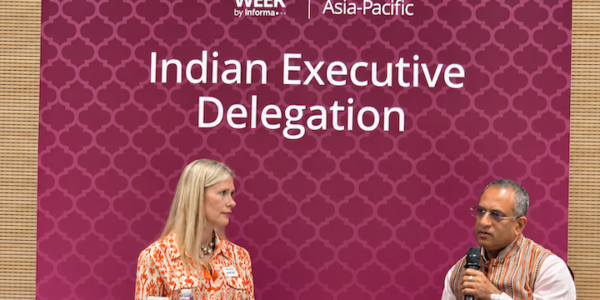
Meeting Global Demand for Airline Training: Inside Etihad Aviation Training


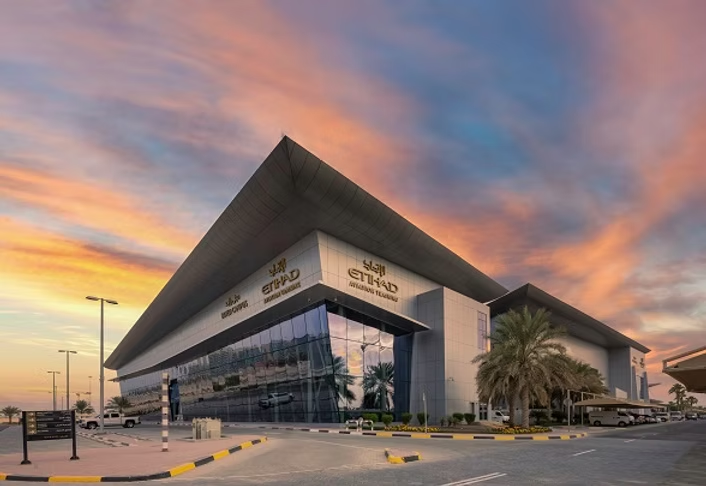
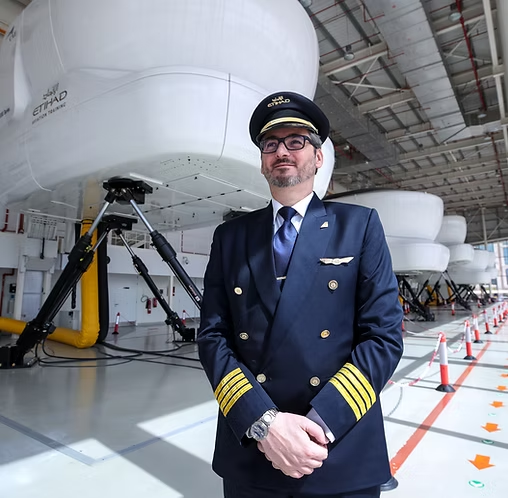
Etihad Aviation Training has emerged as a significant player in the global airline training sector, providing competency-based pilot training alongside cabin crew and ground staff programmes. Based in Abu Dhabi, the facility operates 11 full-flight simulators across multiple aircraft types, with additional devices planned to further expand its portfolio. Whilst Etihad Airways remains its main customer, the training centre serves 80+ airlines and aviation partners worldwide. Captain Stefan Dudda, Head of Training at Etihad Aviation Training, outlines the centre’s facilities, regulatory approvals, training philosophy and commercial vision for scaling capacity without compromising safety or quality.
Could you provide an overview of Etihad Aviation Training’s Abu Dhabi facilities and the services it offers?
Abu Dhabi is our main aviation training base. We provide pilot, cabin crew and ground staff training across the full range of regulatory and operator requirements.
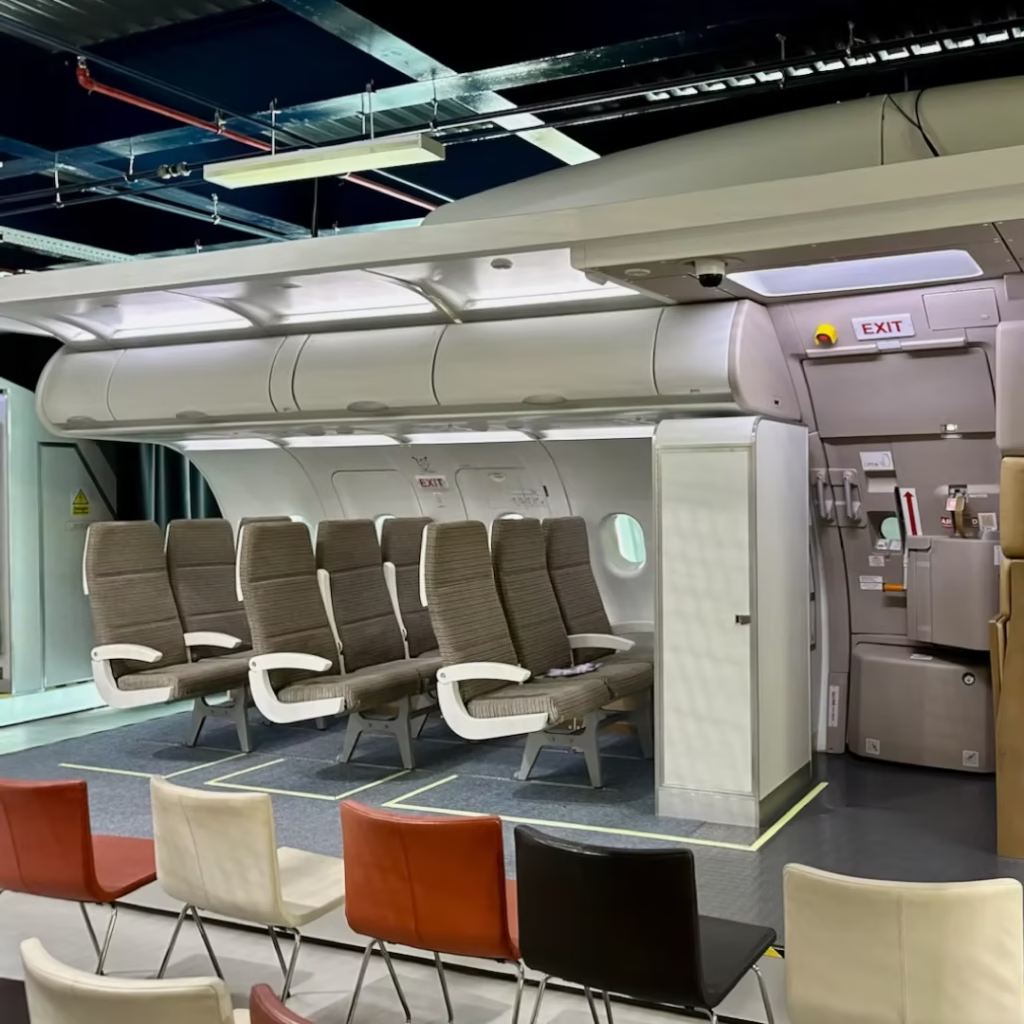
As an Approved Training Organisation (ATO), we run ab initio Multi-Crew Pilot Licence (MPL) programmes for the Boeing 787 and Airbus A320, training around 200 cadets a year. We also provide type rating and conversion training on the Airbus A320, A330, A350 and A380, and the Boeing 777 and 787. These programmes cover pilots at different experience levels, as well as instructor and examiner training. Our cabin crew training covers the same aircraft families.
We train airline customers from around the world. What distinguishes us is that our training is airline-oriented.
We do not simply teach pilots and cabin crew how cockpit controls or safety equipment work. We train them to use that knowledge in an operational context.
The training is scenario-based and follows competency-based training and assessment principles.
Our aim is not merely to meet a customer’s requirements, but to provide more value than expected.
How many simulators do you operate for each aircraft type?
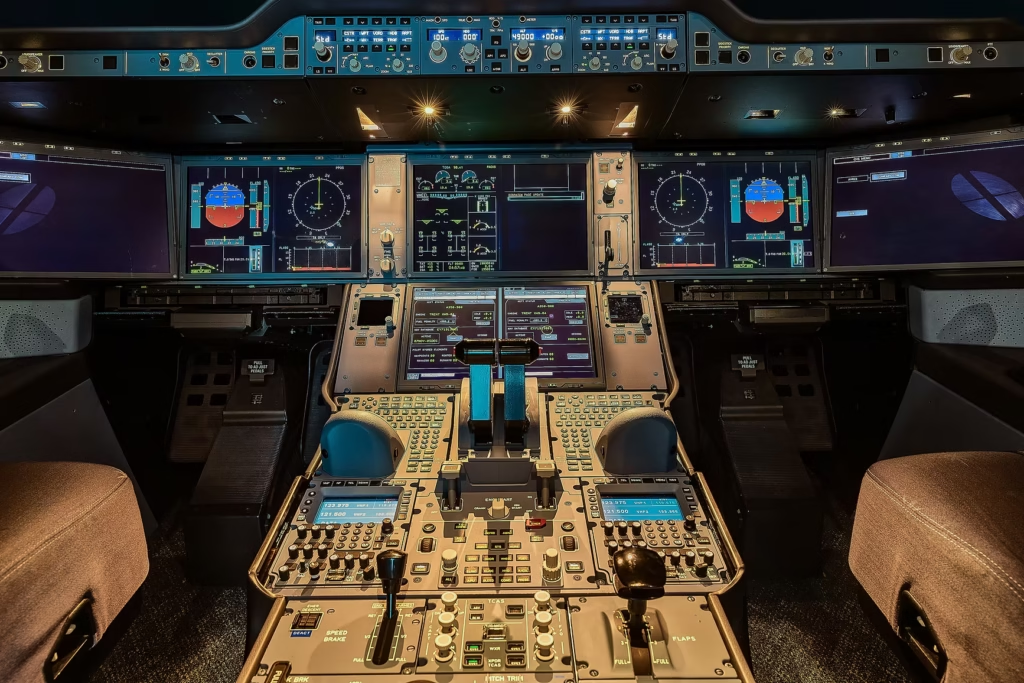
We currently operate 11 full-flight simulators. The fleet comprises four Airbus A320 simulators, including a unit that supports both the CEO and NEO; one A330; one A350; one A380; one Boeing 777; and three Boeing 787 simulators.
We also operate seven flight training devices, together with flight and navigation procedures trainers for the Airbus A320 and Embraer Phenom 100. These devices support different stages and types of pilot training.
We hope to expand further with additional full-flight simulators planned in the near term depending on commercial decisions and overall strategy.
How are competency-based training and assessment applied across your pilot training programmes?
Competency-based training and assessment has become second nature to us. We have used the methodology successfully in recurrent training programmes for more than ten years, while programmes such as MPL are competency-based by design.
As a result, our instructors naturally work with competencies and observable behaviours as training objectives. This distinguishes airline-oriented training from programmes focused primarily on aircraft systems.
We also align initial and type rating programmes with competency-based principles.
A conventional type rating remains task-based by definition, but we assess each trainee at every stage using competencies and observable behaviours.
We then provide feedback through that framework, helping trainees develop sound airmanship throughout the programme rather than simply completing a series of prescribed exercises.
What training options are available to airlines using the Abu Dhabi facility?
We offer the full range. An airline can conduct its own training at our facility using dry simulator time, or it can use our instructors for wet training. We have multiple customers conducting dry training with us after assessing the facility and finding it suitable for their requirements.
An airline using an external training centre must audit the facility and secure the necessary regulatory approvals. That can require considerable work. We developed our facilities to high technical and occupational safety standards, without shortcuts, which helps us meet different operators’ requirements.
We can also support the approval process because we operate as an ATO and work continuously with regulators.
Our compliance department understands what both the airline and its authority require, and it maintains the facility, approvals, and supporting records accordingly.
At various points in its history, EAT has held approvals from several international aviation authorities, reflecting its ability to meet diverse regulatory standards.
These have included approvals from the Saudi General Authority of Civil Aviation (GACA), Jordan Civil Aviation Regulatory Commission (CARC), India’s Directorate General of Civil Aviation (DGCA), Hong Kong Civil Aviation Department (HKCAD) and Uganda Civil Aviation Authority (UCAA).
That knowledge helps establish trust from the first contact. We deliberately speak of training partners rather than customers because a successful training arrangement requires both sides to work closely together.
How do you secure and maintain approvals from multiple aviation authorities?
The approach is similar to the one we take with airline customers: we treat regulators as partners. We do not begin from a position of confrontation or assume that an authority must approve what we present. We work with the regulator, remain transparent and provide the information it needs. Where further action is required, we take it.
Our objective is not simply to comply with the minimum requirement, but to build an open, respectful and dependable relationship. That approach applies to our home regulator and to authorities elsewhere. Maintaining this international approval base is possible only through consistent compliance, transparency and cooperation with each regulator.
How did Etihad Aviation Training secure approval from India’s Directorate General of Civil Aviation (DGCA)?
It was the result of a long process involving the Aeronautical Society of India, our training partners in India and sustained engagement with the DGCA. India has a large and growing requirement for airline training, and there was a need to increase capacity and diversify the locations available to Indian operators.
The approval allows the DGCA to exercise direct oversight of an overseas training organisation serving Indian pilots. Establishing that oversight requires trust, transparency and a relationship that can be maintained over time.
Our task is to meet the current regulatory requirements while also keeping the authority informed as programmes and requirements develop. The approval covers full-flight simulators for the Airbus A320 and A350, and the Boeing 777 and 787.
How many pilots from India does Etihad Aviation Training train each year, and which programmes do they undertake?
Based on current estimates, we train around 300 to 400 Indian pilots each year on initial type rating courses, referred to in Indian regulations as first type ratings, primarily on the Airbus A320.
We also conduct about 200 command upgrade programmes. These are particularly important because the transition from first officer to commander requires more than technical knowledge. It requires sound decision-making, leadership and the competencies needed for the command role.
In addition, we have arrangements with Indian airlines for dry simulator operations and receive enquiries about instructor development. Our strength is that we can support both competency-based training and the conventional training formats that some customers still require.
How many airlines and trainees does Etihad Aviation Training serve worldwide?
At any given time, we are actively working with more than 80 airline and aviation customers. Across our different programmes, annual trainee numbers run into the thousands.
Our MPL programme currently trains around 200 cadets a year. We are discussing partnerships with other airlines interested in joining the programme. We are also exploring opportunities to secure academic recognition for our technical and professional training, providing cadets and trainees with broader, more diverse benefits in the future.
What is Etihad Aviation Training’s commercial vision for expansion?
We have highly ambitious expansion plans. They are achievable, but the principal challenge is delivering the required volume without lowering quality.

We will not trade quality for quantity because that would conflict with our professional standards and safety responsibilities.
Growth may sometimes be limited by the capacity we can add safely, but safety will not be compromised.
Our vision is to build sufficient capacity to support fast-growing airlines by training their crews and ensuring they are operationally ready when needed.
We see them as partners, not just customers. Because we face the same expansion pressures, we understand their need to increase training volume without weakening standards.
Training quality must remain consistent whether the organisation is expanding rapidly or operating at a steadier pace, and it should keep improving.
Also Read: Psychometric Assessment in Aviation