



















Key Takeaways
- Aviation maintenance training is evolving with increased technical data and demand for evidence of effectiveness.
- AI in aviation maintenance training can streamline course development, but quality and oversight remain critical.
- Responsible use of AI must include fidelity, traceability, flexibility, consistency, and privacy to ensure training standards are met.
- Organisations need to transition from seeking efficiency to aimed effectiveness and transformation in training.
- The focus should be on how to use AI responsibly to enhance training and improve workplace performance.

Aviation maintenance training is entering a period of change. The industry is dealing with larger technical datasets, frequent procedure revisions, and growing demand for evidence that training improves workplace performance.
Artificial intelligence is being considered as one way of managing that workload. It can assist with the early stages of course development, help organise source material and support the production of learning content. The prospect of reducing that workload is one reason training teams are examining the technology.
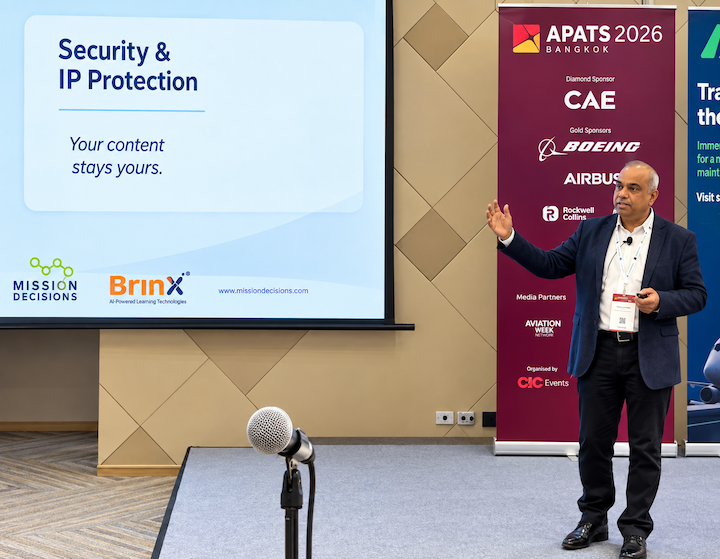
Venudhar Bhatt, EVP and founder of MITR Media, believes the aviation training industry should look beyond faster course production. Speaking at a recent industry gathering, he emphasised the need for accuracy, traceability and human oversight when AI is used to develop training materials.
“Everybody is first looking at it as an opportunity to produce courses faster, possibly even cheaper,” Venudhar said. “But we should be prioritising and thinking about effectiveness and transformation.”
For maintenance training, that transformation would involve more than converting manuals into digital courses. It would require closer alignment among technical information, course design, assessment, and the capabilities expected in the workplace.
Course quality comes first
A training course is not simply a collection of technical information. It is designed for a specific target group of learners, has pre-defined objectives and must provide an appropriate way to establish whether those objectives have been met.
Speed achieved using AI may not resolve the central training design considerations. Has the course covered the required subject matter? Is the information accurate? Does it address the learning objectives for the intended group of personnel? Can the organisation demonstrate or trust the course fidelity with approved technical and regulatory sources?
A standard AI-powered tool may help prepare an initial course structure, but the output still requires technical and instructional review.
It runs the risk of including a plausible explanation not supported by the source material, combining information from different documents, or omitting a limitation important to the maintenance task.
The consequences can be significant. As the core principle of Competency-Based Training and Assessment (CBTA) states, quality depends not only on the outcome but also on how it was achieved, including the decisions made.
The output from an AI-powered tool may look good and accurate, but its fidelity can only be verified by a system that is built to systematically address all the critical design considerations.
“It is not about speed,” Venudhar said. “It is about how that course is designed, built and what the process behind it is. In aviation, what matters is the quality of the training design.”
The organisation remains responsible for the final outcomes, regardless of how it produced the first version. Traditionally, subject-matter experts must verify the technical content. Learning specialists must check the instructional design. Instructors and quality personnel must decide whether the course and its assessments meet the organisation’s approved standards.
The AI-powered course development system must incorporate each of these aspects systematically such that the training development team can trust and be confident in the course produced.
What the AI-Powered course building system must control
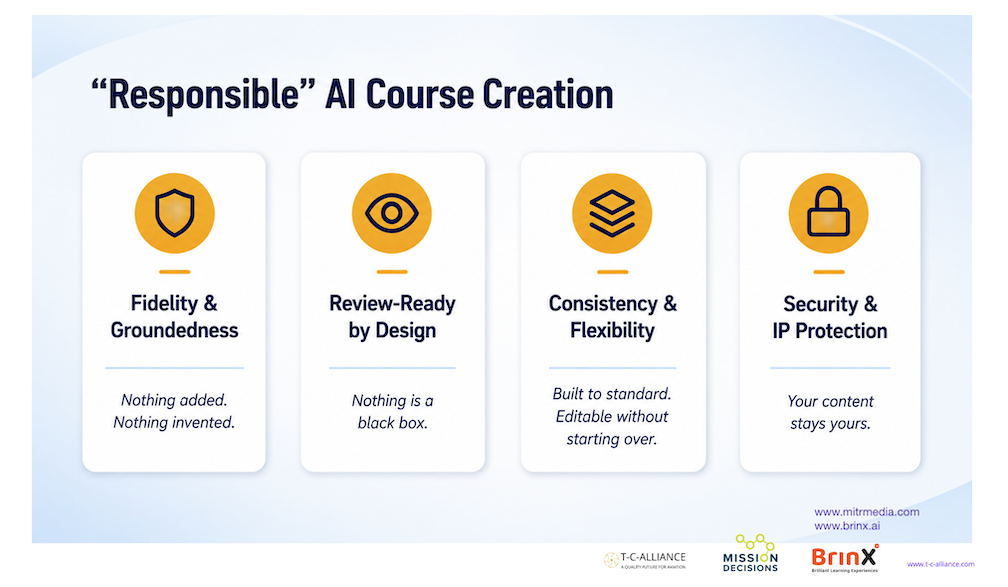
Venudhar identifies four requirements for what he refers to as “Responsible” use of AI in course development: fidelity, traceability, flexibility and consistency, and privacy.
In practice, Fidelity requires that the course remains aligned with regulatory standards, approved technical information and the original training requirement. The course must not include any content beyond what was approved at the design stage. The course coverage should not leave any gaps from the design.
Traceability requires that reviewers be able to establish the basis for important explanations, learning objectives and assessments. Each course screen/slide must be verifiable against an associated design source and a standard. It should support an easy human-in-the-loop audit or review.
Flexibility and consistency allow an organisation to build according to its own course design standards, preferred instructional methods and approved procedures. Training teams must also be able to edit content and make changes when technical experts identify an issue. They must also be able to make future updates smoothly. Consistent output is essential, especially since AI may produce significantly different versions with each iteration.
Privacy is a critical issue. Maintenance organisations are dealing with proprietary manuals, internal procedures, safety reports and reliability information. Before using an external system, they need to understand how that information will be stored, protected and accessed. The courses produced are also intellectual property.
EASA’s NPA 2025-07 proposes detailed specifications for the trustworthy use of AI in aviation. The proposal addresses issues including data governance, documentation and human oversight. It is not a specific maintenance-training regulation, but it demonstrates the broader assurance expected when AI is used in safety-related aviation activities.
An integrated AI-powered solution that addresses these requirements can reduce time and costs while improving quality without compromising it.
At this time, organisations are not all at the same stage. Some are looking primarily for savings in development time and cost. Others are asking whether technology can make training more effective. Fewer are considering how data could support new methods of training, assessment and performance improvement.
Venudhar states that adoption of any new innovative solutions is observed to have 3 stages. He describes these stages as efficiency, efficacy and transformation. In his view, efficiency is the first step, not the final objective.
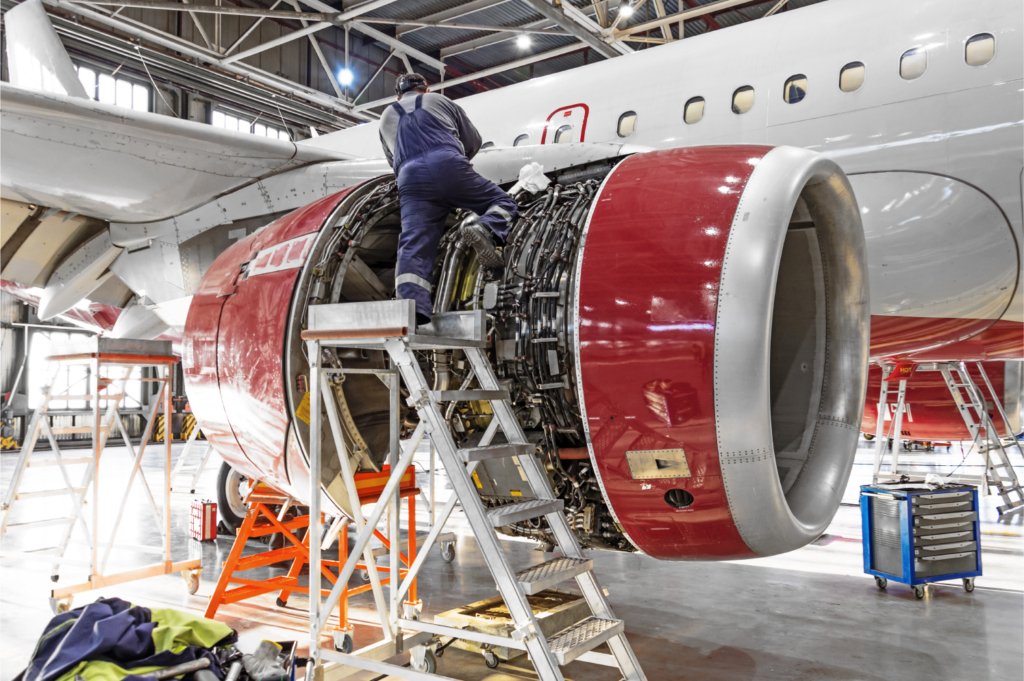
As organisations seek to leverage AI technology for course design and development, a system that is designed specifically to meet its training requirements and associated critical considerations is important.
The pillars of “Responsible” AI Course design and development are essential for long-term transformation of the training development workflow.
It must be done in a manner that optimises the needs of instructors, engineers, technical authors or quality specialists.
They should be the gatekeepers of quality and compliance. And not be required to spend their time manually creating, building, and reviewing every step of the courseware design and development process.
For aviation maintenance training, that is where the journey from efficiency to efficacy and ultimately transformation begins. The question is no longer simply “How quickly can AI help us build a course?” It is “How can we use AI responsibly to build better training and, ultimately, enable better performance?”
Also Read: iPad based FMS Trainers in Airline Pilot Training