











- Aviation training still relies heavily on periodic courses and recurrent checks, while AI offers a way to support competency development throughout a professional’s career.
- Personalised feedback, adaptive learning and performance data can help identify specific skill gaps and direct learners to targeted practice.
- The proposed AICE framework brings training, assessment, analytics and operational performance into one system, with instructors retaining final responsibility for competency decisions.
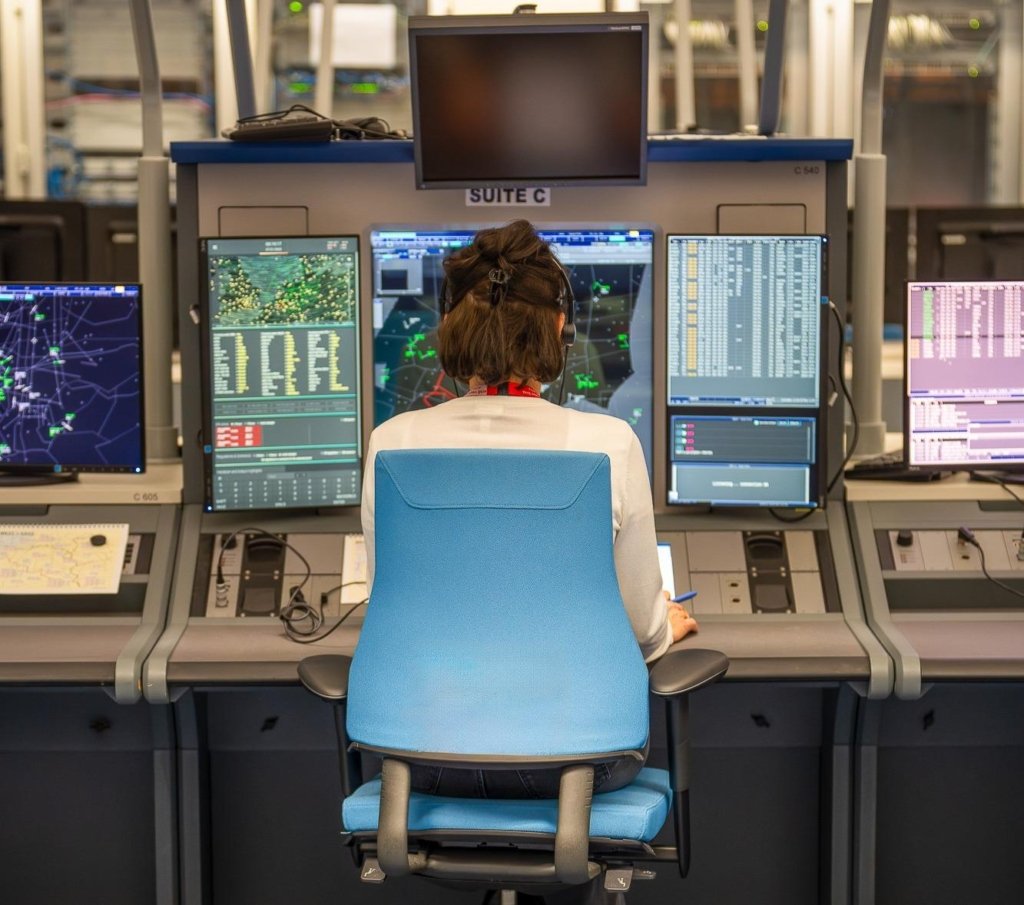
Aviation training has long drawn on curriculum development, competency-based education, assessment and evaluation systems to understand how professionals learn, develop skills and perform under pressure.
As Artificial Intelligence advances in aviation, its implications for professional learning and competency development warrant greater attention.
The greatest impact of Artificial Intelligence on aviation will not happen inside the cockpit. Its impact may emerge long before pilots, controllers, maintenance engineers or dispatchers arrive for work, in the way professional competence is developed.
For years, discussions about Artificial Intelligence in aviation have focused on automation, autonomous systems, predictive maintenance or decision support. While these developments are important, one of AI’s most significant opportunities remains comparatively overlooked: rethinking how aviation professionals learn throughout their careers.
A recurring misconception in professional training is that improving performance requires more training. In reality, the challenge is rarely the amount of training available. More often, it is the lack of meaningful, individualised and timely feedback that limits professional growth.
Artificial Intelligence is not changing how people learn; it is changing how organisations can support continuous competency development at scale.
AI can provide personalised coaching on a scale that was not previously possible. It can support adaptive learning pathways, identify skill gaps as they arise, recommend targeted practice and provide insights that help learners and instructors make better decisions.
In aviation, where competence is directly linked to operational safety, that capability has particular significance. Work on AI-enabled competency platform initiatives in aviation and defence points to the same issue: more information alone does not necessarily improve performance.
Educational research has long identified feedback as one of the most powerful influences on learning and achievement, although its effect depends on how it is delivered. Artificial Intelligence creates the possibility of delivering more individualised feedback consistently and at scale.
The architecture emerged while developing two AI-enabled competency platforms for different operational areas.
AeroSpeak focuses on ICAO Language Proficiency development for pilots and air traffic controllers, while AEGIS·LEX focuses on decision-making competencies in Human Rights, International Humanitarian Law and Rules of Engagement.
Although the environments differ considerably, the design work around both pointed to similar educational requirements.
Despite the different domains, both designs converged on a common combination of adaptive learning, authentic assessment, learning analytics, personalised feedback and operational performance monitoring.
The convergence suggests that these functions may be more useful when treated as parts of a continuous competency system rather than as separate training tools.
These independent design experiences led to the development of the AI-Enabled Competency Ecosystem (AICE), an original conceptual framework that emerged from the author’s work on AeroSpeak and AEGIS·LEX. Rather than viewing training, assessment, feedback and operational performance as separate activities, AICE connects them in a continuous learning cycle supported by Artificial Intelligence.
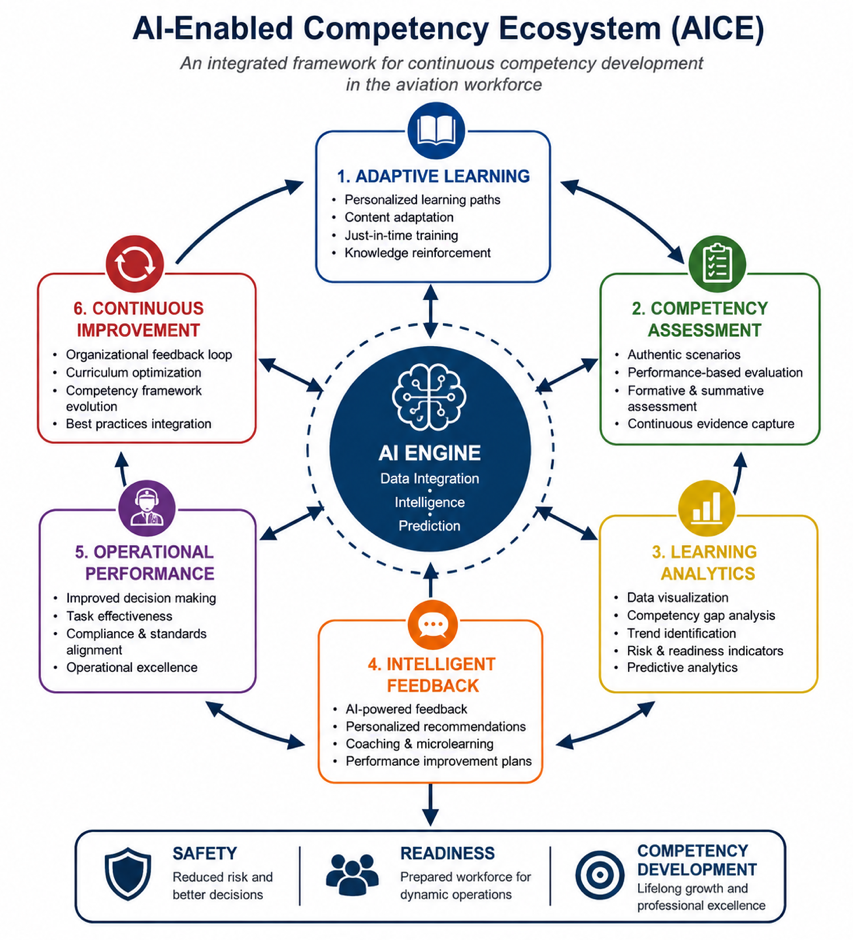
As illustrated in Figure 1, Artificial Intelligence is not intended to replace instructors or competency frameworks. Within the AICE concept, it acts as an enabling engine that connects adaptive learning, competency assessment, learning analytics, intelligent feedback, operational performance and continuous improvement.
The concept is intended to align with ICAO’s Competency-Based Training and Assessment (CBTA) approach. ICAO’s Procedures for Air Navigation Services—Training (PANS-TRG) structures CBTA around adapted competency models, defined performance criteria and valid and reliable evidence of competent performance (ICAO, 2020). AICE proposes an AI-enabled architecture that would connect learning and assessment activities over a professional’s career rather than treating periodic training and recurrent evaluation as isolated events.
In practice, an AI-enabled system could use assessment results and observed performance against defined competency criteria to identify recurring gaps, direct the learner to targeted practice and give instructors a record of progress before subsequent assessment. For example, if repeated assessments show a pilot or air traffic controller struggling with a defined communication competency, the system could identify the recurring pattern, direct the learner to targeted scenario-based practice and give the instructor a record of performance before reassessment.
The instructor would still determine whether the required competency had been demonstrated. EASA’s aviation AI work emphasises a human-centric approach and, in its AI Concept Paper, learning assurance, explainability and ethics-based assessment. Any AICE-type implementation would therefore need human oversight, validated data, privacy controls and clear accountability (EASA, 2023; EASA, 2024).
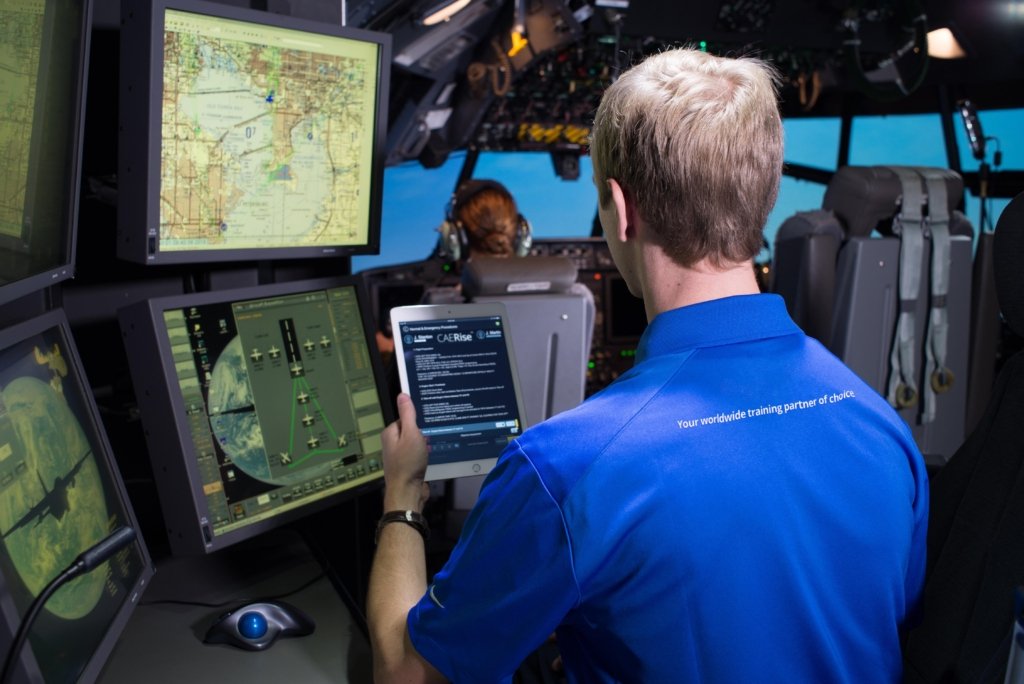
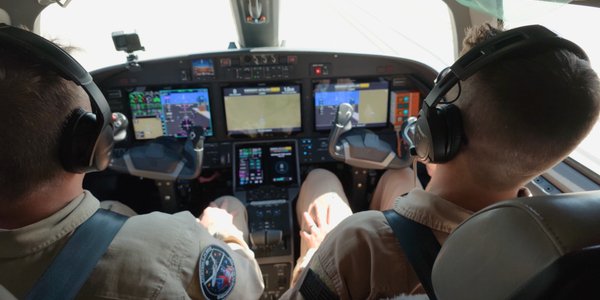
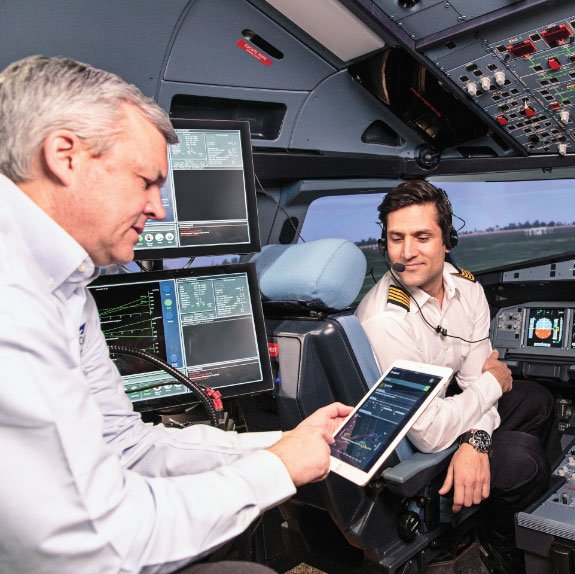
Photo: CAE
The debate over whether Artificial Intelligence will replace instructors or evaluators misses the more important issue.
A more useful question is how AI can make instructors, evaluators and organisations more effective in helping people develop and maintain professional competence.
Technology alone does not transform learning; good educational design does.
Artificial Intelligence can be a powerful educational tool in support of that design. The opportunity for aviation is therefore not simply to automate training, but to reconsider how competency is developed and maintained over time.
Flight simulators changed how pilots train for complex and high-risk situations. Artificial Intelligence could change how aviation professionals develop and maintain competence across an entire career. That would be more than a technological change. It could become an important step in the evolution of aviation training and safety.
Also Read: India’s Pilot-Training Crunch: The Quiet Crisis Behind the Aviation Boom