











Full Throttle: The Women Powering India’s Aviation from Ground to Sky

- India’s aviation industry is seeing a steady rise in women across multiple roles—from pilots and aircraft maintenance engineers to airport operations, cargo logistics and cabin crew—reflecting a broader shift in workforce diversity.
- Many of these careers began far from airports, with women overcoming social, financial and professional barriers to enter highly specialised aviation roles.
- Their journeys show how women are not only joining the industry but gradually shaping its culture, leadership and future direction.
At any Indian airport, the rhythm of aviation is unmistakable. Pilots stride across the tarmac, engineers inspect aircraft under floodlights, ground staff coordinate departures, and cargo handlers move freight that will travel thousands of kilometres overnight.
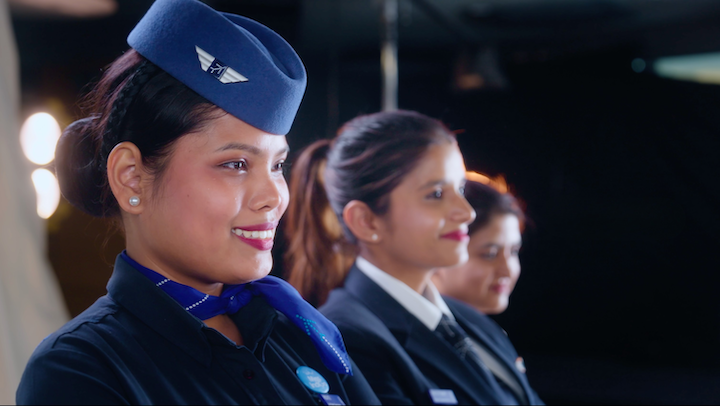
Among them are thousands of women powering India’s aviation industry—in cockpits, engineering bays, operations centres, cargo terminals and airport ramps. Yet the uniform they wear often conceals the deeper stories behind their journeys.
On International Women’s Day, those stories offer an important reminder: aviation is not only about aircraft and infrastructure. It is about people—and the women whose determination and resilience are quietly reshaping the industry.
For many, the journey begins far from airports.

Sandeep Kaur, now a First Officer with IndiGo, grew up in a farming family where aviation felt distant from everyday life.
“Coming from a farming family, my journey to becoming a pilot was never straightforward,” she says. “I watched my father work tirelessly in the fields, but he always believed my dreams could be bigger than our circumstances.”
One of the most emotional moments of her training came when she flew with her parents on board. “It was my mother’s first time on an aircraft,” she recalls. “That moment carried years of sacrifice, hope and silent prayers.”
Stories like hers reflect a broader shift in Indian aviation. India today has one of the highest proportions of women pilots in the world—about 15 per cent, nearly three times the global average.
Airlines have played a significant role in driving that transformation. At Air India, women account for 46 per cent of the workforce and around 16 per cent of pilots, among the highest ratios globally.
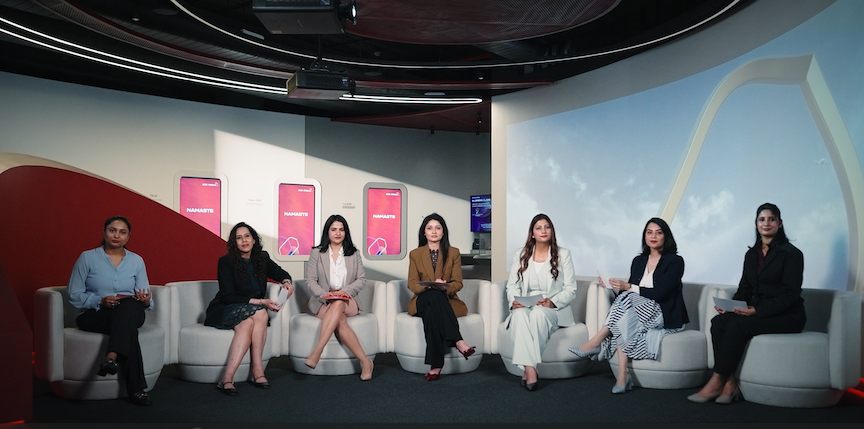
The airline has also operated several ultra-long-haul flights with all-female crews, demonstrating the growing presence of women across operational roles.
“At the Air India Group, we are proud that women leading from the front is the norm rather than the exception,” says CEO and Managing Director Campbell Wilson.
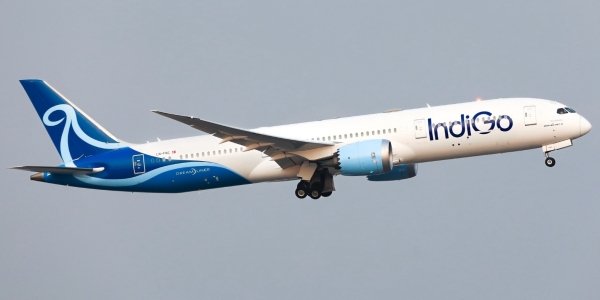
At IndiGo, women make up more than 45 per cent of the workforce, with female pilots accounting for 17.5 per cent of the airline’s cockpit crew.
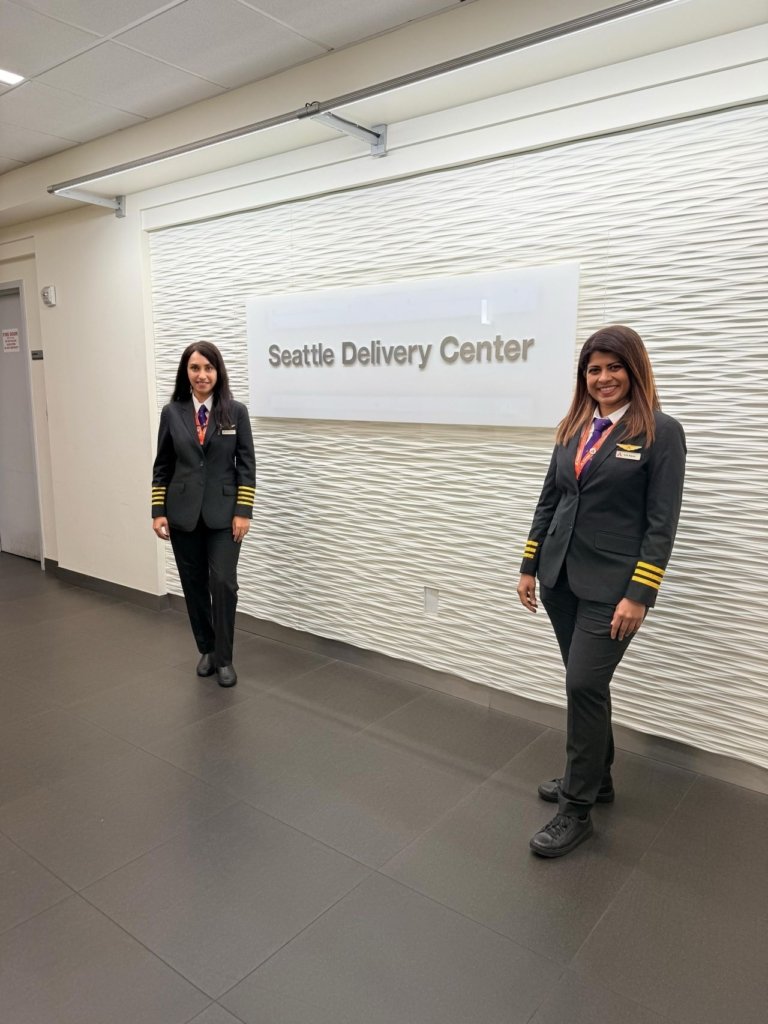
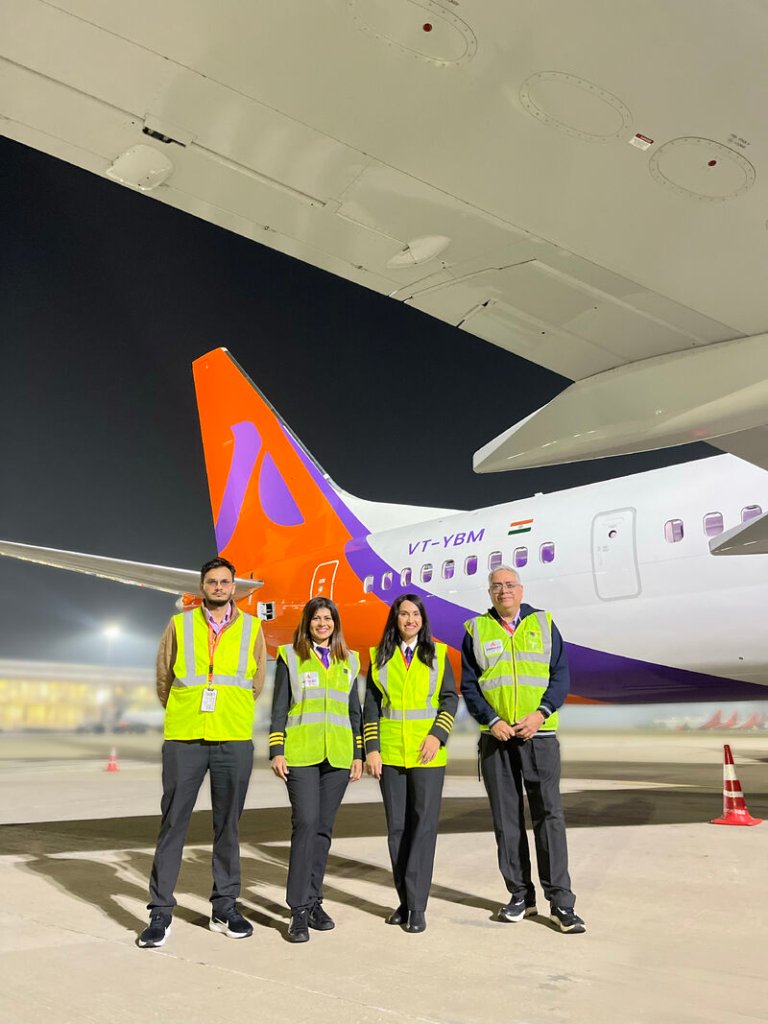
Newer airlines are also building more diverse teams. Akasa Air says women represent about 37 per cent of its workforce and are increasingly visible across operational and leadership roles. That shift was visible earlier this year when Akasa inducted its 33rd aircraft—a Boeing 737 MAX 8—after a multi-stop delivery journey from Seattle to Bengaluru via Keflavik and Larnaca. An all-women crew flew the final leg into India: Captain Svetlana Pereira and First Officer Karen Noronha.
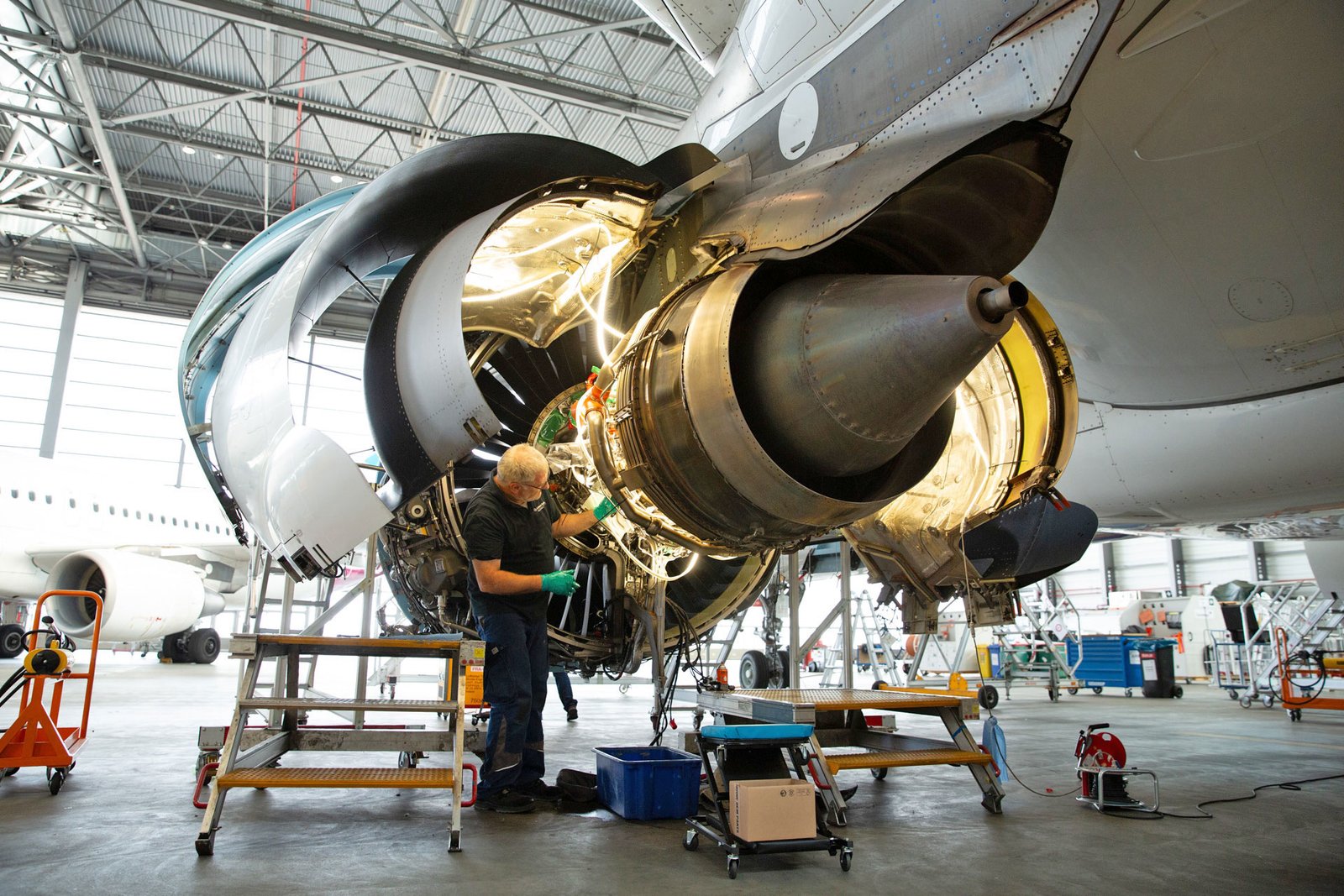
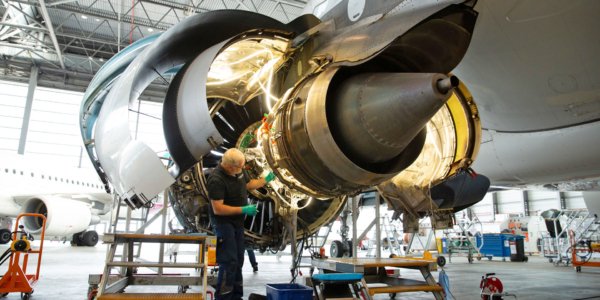
While pilots are the most visible face of aviation, the industry’s safety ultimately rests on the work of aircraft maintenance engineers.
For Kumari Pallavi, an aircraft maintenance engineer with IndiGo in Bengaluru, the fascination began in childhood in Jharkhand. “Growing up, I was always drawn to airplanes flying overhead,” she says. Her path into aircraft maintenance required persistence. “There were long shifts, sleepless nights studying wiring diagrams, and moments of self-doubt when things didn’t work out the first time.”
The turning point came when she earned her licence and signed her first aircraft release—a responsibility that carries enormous weight in aviation. “Watching that aircraft taxi and take off felt like seeing years of perseverance take flight,” she says.
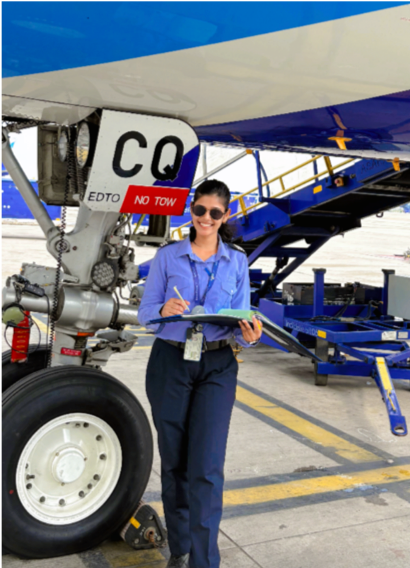
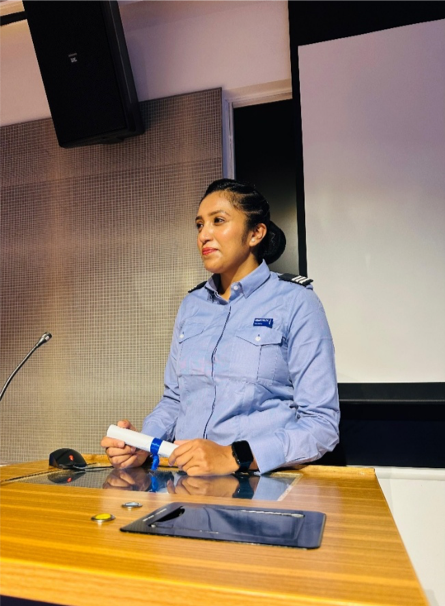
Shreya Tiwari, another aircraft maintenance engineer with IndiGo, traces her journey to a similar childhood curiosity. Growing up in Azamgarh in Uttar Pradesh, she often watched aircraft cross the sky from her rooftop. “That fascination gradually became a dream—not just to see aircraft fly, but to be responsible for their safety,” she says.
After studying aircraft maintenance engineering, she joined IndiGo in 2023 as an Associate Technician. Signing her first aircraft release was both humbling and empowering. “Every signature represents responsibility for the safety of hundreds of passengers,” she says.
Women are also increasingly visible in operational leadership roles at airports.
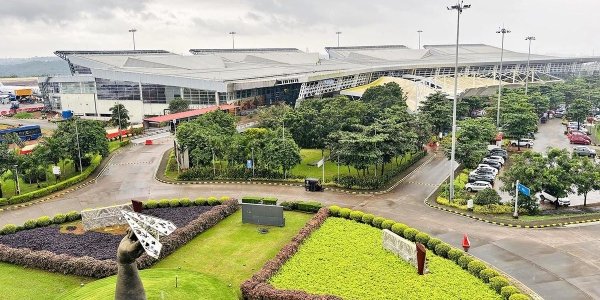
At Kolkata’s Netaji Subhas Chandra Bose International Airport, airline operations for several carriers are overseen by women leaders—including Air India’s airport manager Bharati Dasgupta, Akasa Air’s Pampa Mahanta and Emirates’ Anushila Chaturvedi. Their careers reflect the resilience aviation often demands. Dasgupta, for instance, managed operations from Madrid during the COVID-19 pandemic while India conducted the large-scale Vande Bharat repatriation mission.
Mahanta’s journey highlights another dimension of aviation careers. Growing up in Guwahati, she balanced college with part-time work before entering the industry as a customer service trainee, eventually rising to lead airline operations at one of India’s busiest airports.
Beyond passenger travel, aviation also includes a vast cargo ecosystem—an area where women are increasingly visible.
Cargo carriers such as Blue Dart Aviation and Quikjet Cargo operate largely through the night, linking India’s logistics network to global supply chains. In cargo terminals and operations centres, women work as pilots, engineers, planners and logistics specialists.
At Quikjet in Bengaluru, Pratibha Sengupta leads the airline’s engineering team, overseeing maintenance of Boeing 737-800BCF freighters that fly demanding overnight schedules, transporting e-commerce shipments and essential cargo. Much of this work happens far from public view, yet it keeps India’s cargo network moving every night.
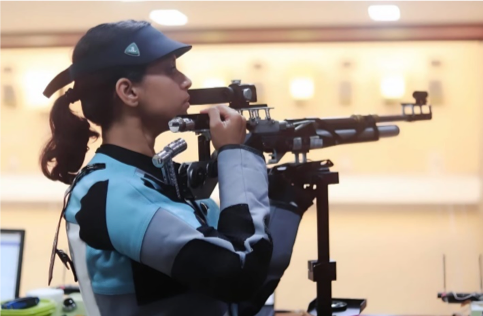
For many women in aviation, the uniform represents only one dimension of their identity.
IndiGo First Officer Gauri Parulekar balances her flying career with another demanding pursuit—competitive shooting. She discovered the sport as a child after noticing a rifle range at her swimming club.
“Within a couple of months I participated in my first competition and won a silver medal,” she recalls. Even while completing her commercial pilot training in New Zealand and building her aviation career, she continued competing at the national level. Her goal remains clear: one day representing India on an international podium.
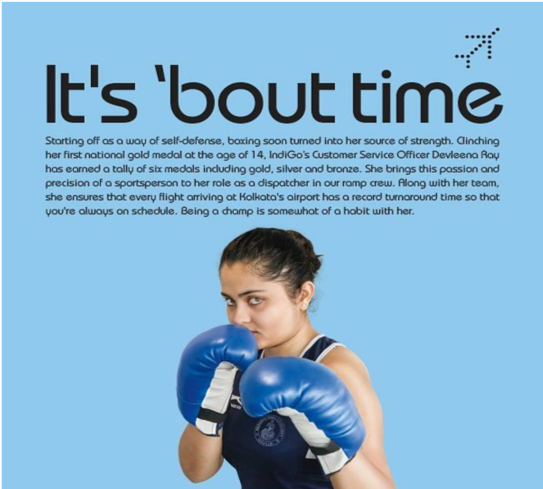
For Devleena Ray Canday, Assistant Manager Ramp Safety at IndiGo in Mumbai, aviation coexists with another passion—combat sports. A national boxing medalist and an international amateur MMA judge and referee, she also became a mother in 2025.
“Pregnancy didn’t feel like a pause in my journey,” she says. “It became the most meaningful training phase of my life.”
Returning to work brought new challenges, but support from colleagues helped her find a new rhythm. “The gloves may still be on, the IndiGo uniform is pressed, and nursery rhymes now play in the background—but this chapter has made my fight even more meaningful.”
Aviation can also be a space for creativity.
Rajshree, an Air India cabin crew member from West Bengal, uses her artistic talents to create murals in airline workspaces. A Calcutta University graduate who began painting at age nine, she balances flying with art. Since joining Air India in 2023, her murals have transformed crew areas in Mumbai, Delhi and Bengaluru—celebrating the culture and unity of airline teams.
The women who keep aircraft flying often navigate midnight shifts, irregular rosters and operational disruptions while balancing family responsibilities and personal ambitions. Among the pioneers who helped open these doors is Captain Nivedita Bhasin, who became the world’s youngest woman jet commander at the age of 26. Speaking recently at Wings India 2026, she emphasised that awareness and family support remain crucial to encouraging more girls to pursue aviation careers. “Understanding the range of opportunities in aviation can change the destiny of thousands of girls,” she said.
Many journeys into aviation still begin far from runways—on rooftops where children watch aircraft crossing the sky, in villages where parents quietly nurture unlikely dreams, or in small towns where aviation once felt distant.
When the uniform finally comes off after a long shift, those stories remain.
Stories of ambition, resilience and quiet determination—shaping the future of Indian aviation, one flight at a time.
Also Read: Pilot Mental Health Is Aviation’s Next Safety Frontier