


















Table of contents
Embraer ERJ140
Once a standout in the busy world of regional aviation, the Embraer ERJ140 is a multipurpose, twin-engine regional jet designed to balance capacity, efficiency, and performance. In Embraer’s ERJ family, it sits comfortably between the 37-seat ERJ135 and the 50-seat ERJ145, with a standard seating capacity of 44 passengers. It was first flown on June 27, 2000, after being introduced in September 1999. Envoy Air (as American Eagle) started using it in July 2001.
The ERJ140 was designed to assist US airlines in complying with pilot union regulations that limit aircraft to 50 seats. It offered a tailored solution for mid-range regional routes, facilitating the seamless connection of smaller markets to bigger hubs. It was created by strategically shrinking the ERJ145, which reduced maintenance costs and simplified operations in its prime. It shares 96 per cent of its parts with its siblings. More than 70 units were delivered. American Eagle dominated its operational career until 2020, when it retired the fleet, marking the ERJ140’s move from frontline service to a more enduring legacy. Smaller operators, charter companies, and specialised missions still use it today, demonstrating its versatility even after its prime commercial years. With speed, range, and durability, the ERJ140 bridged a critical gap in regional travel, leaving a lasting imprint even as newer models take the stage.
Cabin Experience
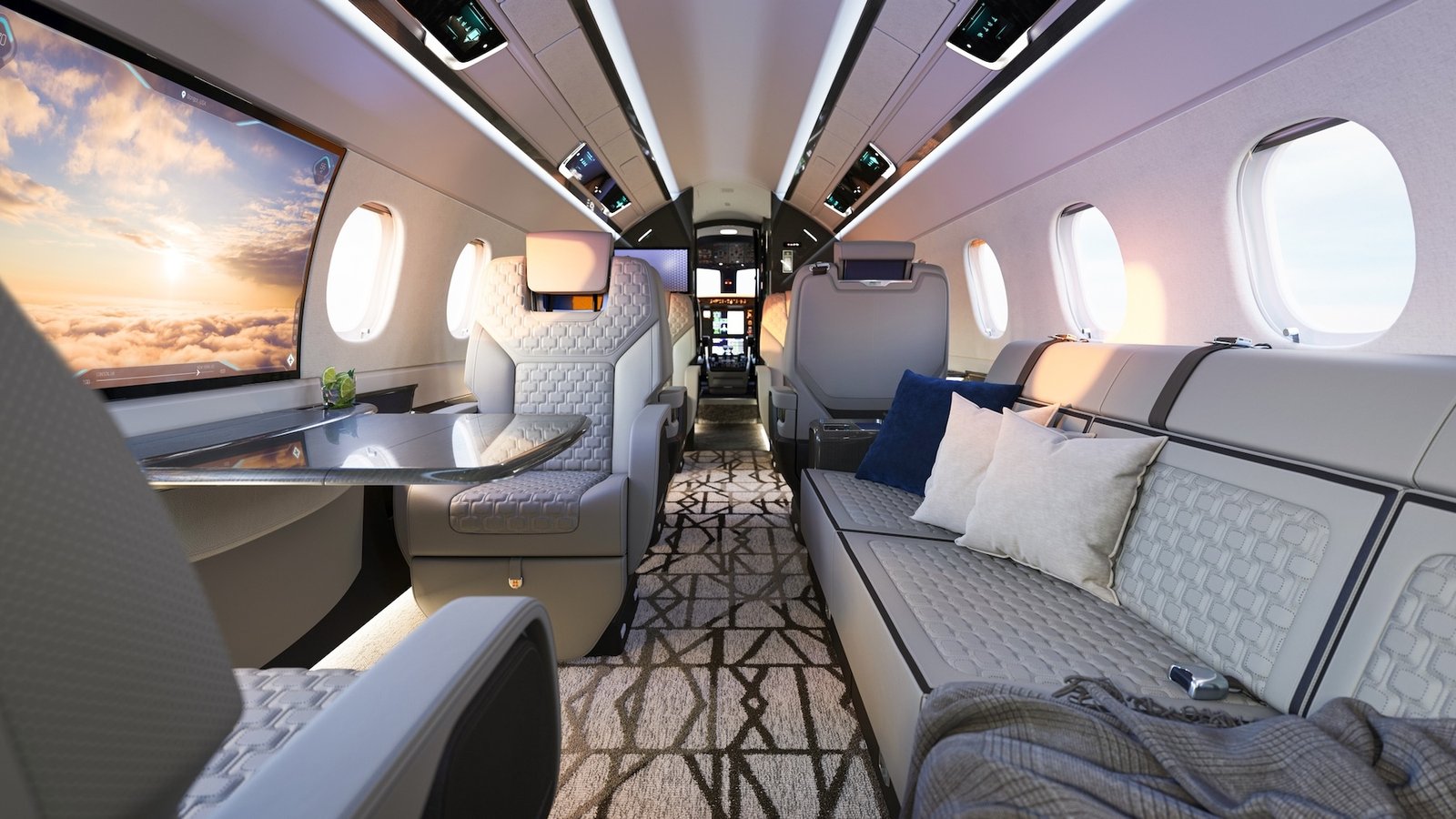
The aircraft’s passenger-centric cabin prioritises comfort and practicality within its mid-sized frame. Like its ERJ siblings, its single-aisle, 2-1 seating layout eliminates the middle seat, ensuring every passenger enjoys a window or aisle position. Measuring 1.7 meters wide and 1.82 meters high, the cabin provides ample headroom and a bright, airy ambiance thanks to large windows—a standout feature for its class. This design enhances the onboard experience in contrast with the confines of many turboprops.
Airline operators can customise the aircraft’s interior for various roles, from the standard 44-seat setup for scheduled flights to plush configurations with as few as 20 seats for private charters. The cabin features overhead bins with retractable panels to optimise storage, with the added advantage of a total cargo capacity of approximately 11 cubic meters (across forward and aft compartments) to support efficient baggage handling, which is key for quick turnarounds. Backed by rear-mounted engines and soundproofing, the aircraft is able to keep noise levels low, leading to a quieter ride than many rivals. The aircraft’s thoughtful design provides passengers on short- to medium-haul flights with unmatched comfort and accessibility.
Technology (Engines & Avionics)
The aircraft is propelled by two Rolls-Royce AE 3007A1 turbofan engines, rear-mounted on the fuselage, each producing up to 7,426 pounds of thrust. These engines, slightly tuned down from the ERJ145’s, blend power and fuel efficiency, which sets new benchmarks in regional aviation. Known for reliability and low maintenance, the AE 3007A1 series utilises advanced engineering to cut emissions and noise, meeting environmental standards while keeping costs manageable.
The aircraft is equipped with the Honeywell Primus 1000 avionics suite, with five displays (initially CRT, later upgradeable to LCD) delivering clear flight data to pilots. Equipped with a flight management system (FMS), autopilot, and weather radar, it boosts precision and safety. Though lacking full fly-by-wire tech, its conventional controls are enhanced by an electronic flight control system for smoother handling. The 96 per cent parts commonality with the ERJ135 and ERJ145 enables a single crew type rating, cutting training and maintenance costs—a boon for operators like American Eagle during its active years.
Performance
The aircraft excels in performance, offering speed, range, and agility, establishing its great value in regional networks. It cruises at Mach 0.78 (approximately 903 km/h or 561 mph), outpacing turboprops and trimming flight times on short- to medium-haul routes. The Long Range (LR) version, the main variant, provides a range of 3,057 kilometres (1,650 nautical miles) with a full passenger load, linking smaller airports to hubs or mid-sized cities efficiently.
The aircraft’s take-off distance of 1,780 meters and a landing distance of 1,380 meters (at maximum take-off weight, ISA, sea level) enable it to handle shorter runways, expanding its reach to modest airfields with limited infrastructure. With a service ceiling of 37,000, the aircraft can comfortably cruise above weather and traffic, boosting efficiency and comfort. Its tight ground turn radius of around 20 meters ensures nimble handling at constrained facilities. These traits make the ERJ140 a flexible choice for airlines targeting mid-tier markets.
Specifications
| Feature | Specification |
| Seating Capacity | 44 passengers (standard) |
| Engines | 2 × Rolls-Royce AE 3007A1 |
| Maximum Thrust | 7,426 lbf per engine |
| Cruise Speed | Mach 0.78 |
| Range | 3,057 km (1,650 nm) – LR version |
| Service Ceiling | 37,000 ft |
| Take-off Distance | 1,780 m (MTOW, ISA, SL) |
| Landing Distance | 1,380 m (MLW, ISA, SL) |
| Cargo Capacity | ~11 m³ (combined forward & aft) |
| Cabin Width | 1.7 m |
| Cabin Height | 1.82 m |
Takeaways
The Embraer ERJ140 remains a mid-sized marvel that serves regional aviation with distinction. Its 2-1 seating, spacious cabin, and quiet ride deliver a passenger experience that bridges the gap between turboprops and larger jets. The Rolls-Royce AE 3007A1 engines provide economical power, enabling access to smaller airports while spanning distances up to 3,057 kilometres—ideal for connecting secondary markets.
The aircraft’s advanced avionics and high parts commonality with the ERJ family result in increased operational efficiency and reduced costs, making it a savvy choice for operators. Its runway flexibility and ground agility reinforces its role as a regional connector. Though its production run ended in 2020 and major airlines have phased it out, the aircraft lives on in useful service with smaller carriers, charter operations, and niche roles. From its peak with American Eagle to its quieter presence today, the ERJ140 reaffirms Embraer’s ingenuity in crafting practical, enduring solutions for regional aviation.