




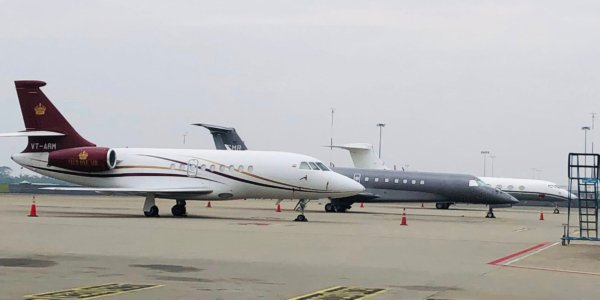






- Amelia and Thales have successfully moved contrail-avoidance from a theoretical research phase to a standard operational reality, completing a full year of deployment across a diverse fleet of 20 regional and narrowbody aircraft.
- The program validated a high-precision 80/20 strategy, where targeting only the 5% of flights with the highest warming potential avoided over 2,000 tonnes of CO2-equivalent with a total fleet fuel penalty of less than 0.1%.
- This operational success demonstrates that significant non-CO2 mitigation is achievable today using existing ground-based flight planning software, requiring no expensive hardware retrofits or changes to aircraft avionics.
Aviation has spent the better part of a decade in an increasingly intense conversation about its climate footprint. Sustainable aviation fuel draws the most attention, fleet renewal the most capital, and carbon offsetting the most scepticism. Through all of it, one aspect of the climate picture has remained largely unaddressed — not because it is unknown, but because acting on it has never been commercially compulsory.
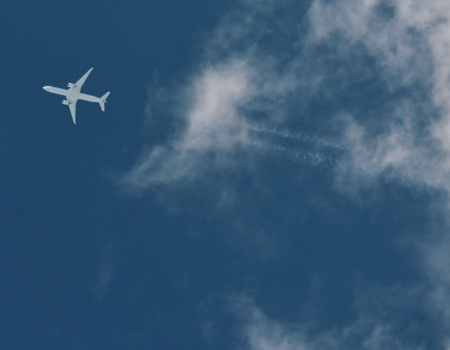
Condensation trails, the white streaks that commercial aircraft leave across the upper atmosphere in certain conditions, trap heat in ways that current scientific estimates place in the same order of magnitude as aviation’s CO₂ emissions combined.

The science carries genuine uncertainty, estimates vary between research groups and models — but the direction is not in dispute.
What makes contrails particularly manageable as a problem is their concentration: roughly 5% of flights generate around 80% of the total contrail warming effect.
Any airline serious about addressing this needs tools that can identify those specific flights before departure, not after.
Amelia, a French charter and wet-lease carrier, and Thales have been working on exactly that since 2021 — a five-year collaboration that began with Thales measuring Amelia’s full climate footprint, spending roughly two years building a data picture before moving to avoidance experiments. Last week, they reported what a full year of running it across an entire airline network actually produces.
From Proof-of-Concept to Fleet-Wide Reality
The programme did not begin at a network scale. In mid-2024, Amelia ran the first live trials on a single route between Paris and Valladolid in Spain, using its Embraer ERJ-145 regional jets — aircraft with relatively basic avionics by current standards. Across five flights on that route, the approach prevented around 20 tonnes of CO₂-equivalent.
The numbers were modest; the purpose was to prove the process could function inside a real airline’s operations, through the Operations Control Centre (OCC), dispatch, crew briefing, and ATC filing — rather than in a controlled environment.
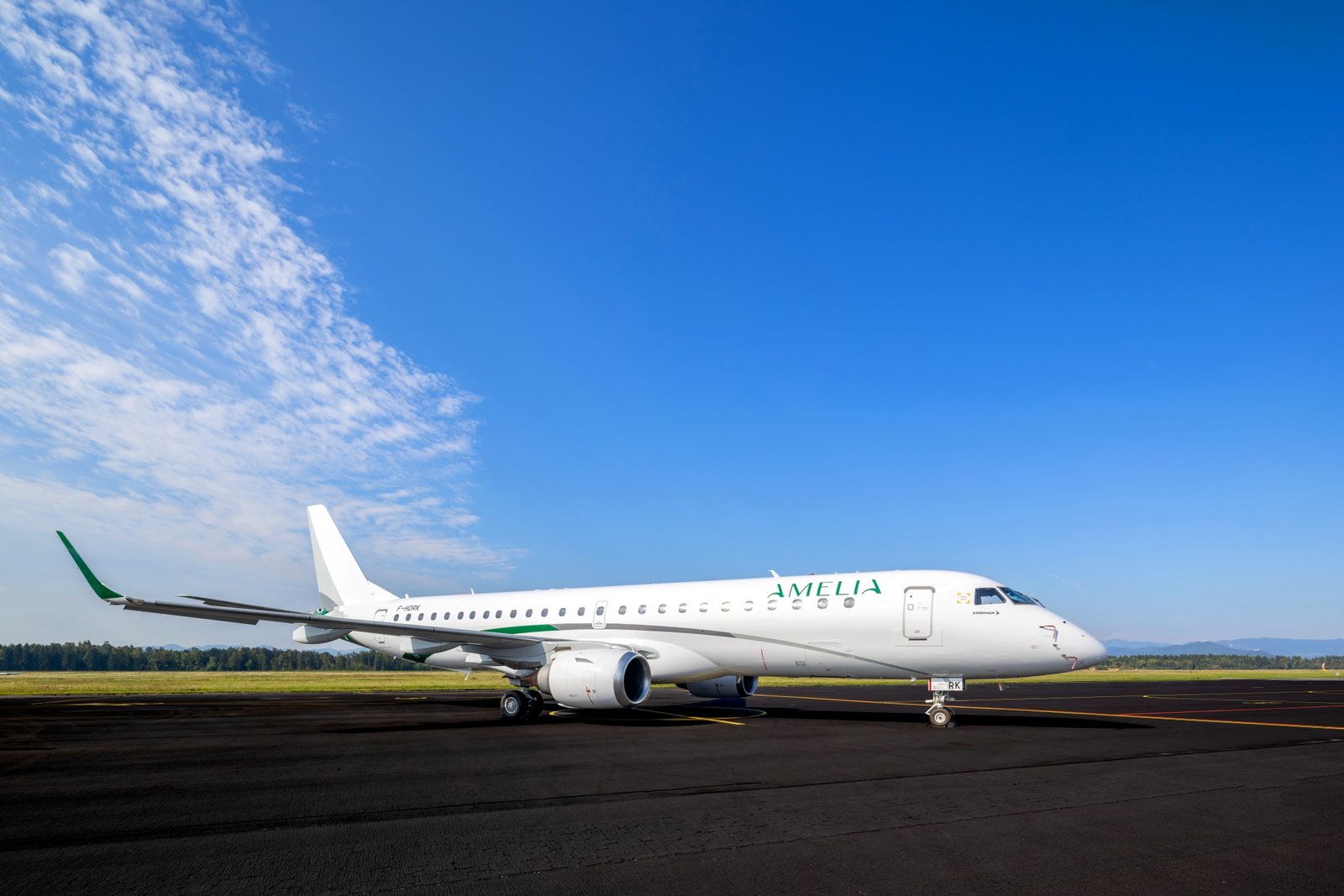
That proof established, Amelia extended the programme from March 2025 to cover every flight it operated, including its Airbus A319 and A320 fleet. The deliberate inclusion of both aircraft types — older regional jets alongside more modern narrowbodies with different avionics — was itself a demonstration that the approach is not contingent on specific aircraft generation or equipment fit.
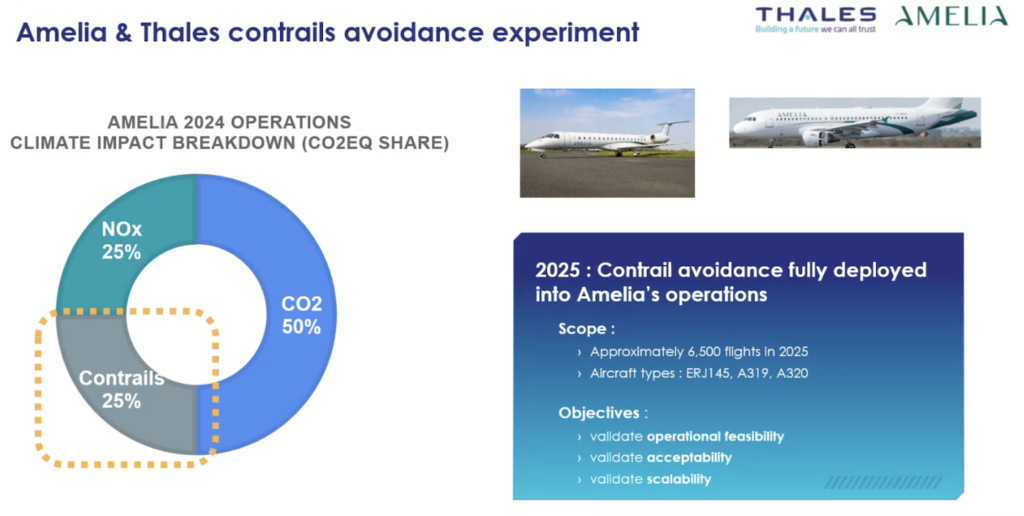
Over the full year, more than 6,400 flights were screened. Fifty-nine had their flight plans modified. The avoided climate impact from those changes came to more than 2,000 tonnes of CO₂-equivalent — roughly 1% of Amelia’s total annual climate footprint. The additional fuel consumed across all 59 modified flights represented less than 0.1% of the airline’s total annual fuel burn.
Amelia had set an internal ceiling of 3% additional consumption as its acceptance threshold per modified flight. That ceiling was never approached.
For context on what those numbers mean at an airline level: looking back at Amelia’s 2024 operations, contrail warming effects accounted for approximately a quarter of the airline’s total climate footprint. The 2025 programme directly targeted that share.
Klima, a scientific startup that independently re-analysed the results using multiple weather models and impact metrics, confirmed the methodology was sound and placed the plausible range of avoided impact at 1,500 to 4,000 tonnes — meaning even the conservative end of the estimate is meaningful.
Targeting the “Big Hits”
The programme’s logic directly challenges the scientific uncertainty that has long given the industry a pretext for delay. Because warming estimates can vary by a factor of 2 depending on the model, many operators have historically dismissed the science as too contested to warrant action.
Amelia and Thales took a different position: focus only on flights where the predicted contrail impact is very large relative to the flight’s CO₂ footprint — the “big hits” — where the margin of error in the model is least likely to negate the climate benefit of taking action.
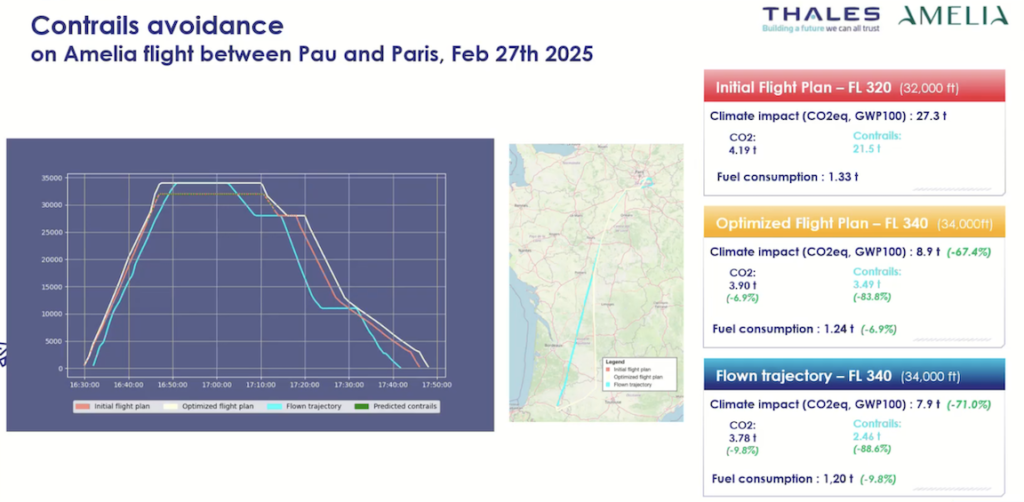
A single flight assessed during the programme illustrated this precisely.
An initial plan for a sector from southern France to Paris showed a fuel-burn CO₂ figure of just over four tonnes.
The contrail warming effect predicted for the same flight was 21 tonnes CO₂-equivalent — five times the CO₂ number. A level change from FL320 to FL340, shifting the aircraft above the humidity layer, reduced contrail impact on the revised plan to 3.5 tonnes. The flight as operated came in at 2.5 tonnes. Overall climate impact for that leg fell by more than 70%.
“By targeting high-impact flights, we remove the barrier of scientific uncertainty about the magnitude of the phenomenon and focus on immediate action,” said Adrien Chabot, Director of Sustainability at Amelia.
At that scale of predicted impact, even a large modelling error still produces a clear net benefit. That is the operating logic embedded in the programme — and it is what allowed Amelia to produce credible results while the underlying science continues to develop.
The Technology and What It Is Built On
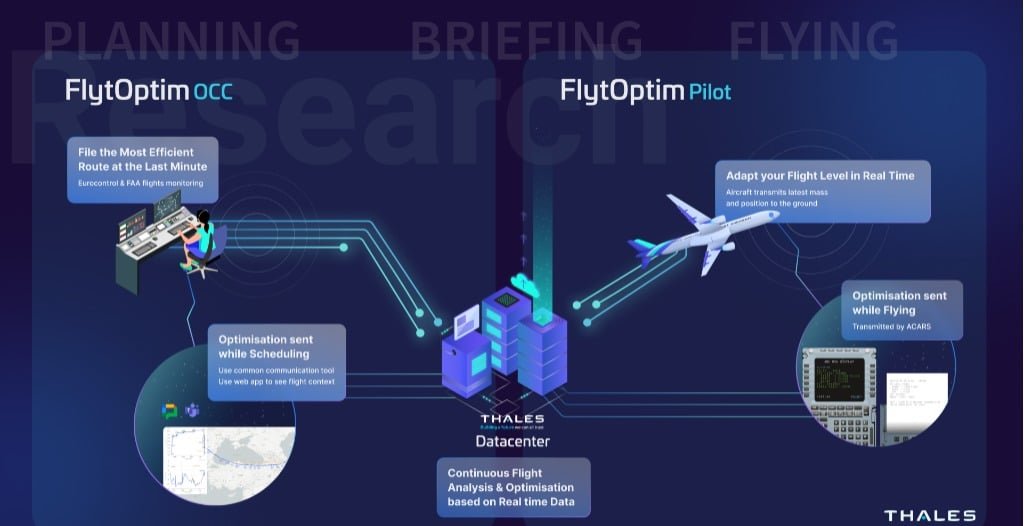
Thales did not build the contrail-avoidance capability from the ground up. It extended FlytOptim, a trajectory optimisation platform that the company already sells commercially to airlines for fuel efficiency and CO₂ reduction, into a broader climate assessment tool.
The contrail layer runs within the same platform, drawing on live weather forecasts and models from Breakthrough Energy to calculate the total warming footprint of a proposed flight plan. This deployment is supported by DECOR, a French research initiative funded through the France 2030 investment plan.
That design decision matters more than it might appear. One of the standard objections to new sustainability tools in airline operations is integration complexity — a separate system, separate data feeds, separate training, separate workflow. Thales’s answer is that the foundation was already in place. The climate assessment runs inside the tool that the OCC is already using. Amelia’s 12 months of uninterrupted daily use provide operational evidence that this is not a theoretical advantage.
“The technology is ready, and it’s been proven. We would be ready to roll out tomorrow,” said Julien Lopez, Head of Green Operations at Thales — adding that the constraint is not the product but the absence of a regulatory signal strong enough to make airlines treat non-CO₂ management as a priority.
Source: Thales
Nothing in the implementation required aircraft modification. No avionics changes, no added sensors, no retrofit costs or certification timelines.
The entire process runs on the ground before departure. The OCC assesses the initial plan, reviews the proposed alternative where one is generated, and — provided it clears the fuel threshold and satisfies safety requirements, which always take precedence over the climate objective — files the revised plan with ATC before the crew boards. The programme assesses the full non-CO₂ picture — contrails and nitrogen oxides (NOx) — not contrails alone, targeting the best balance across all warming effects.
The philosophy governing ATC interaction is deliberate: file the optimised plan before departure, so air traffic management is working with it from the start. No in-flight deviations are requested. The crew flies the plan as filed. This “fly as you file” principle is what made the programme compatible with existing ATC frameworks without adding coordination complexity.
For spot-check verification, Thales, alongside partner firms SII and Reuniwatt, installed a sky-facing camera at Perpignan airport in southern France, monitoring approximately 60 kilometres of visible airspace.
Flights monitored included Amelia’s Paris–Algiers services transiting that airspace — cross-referencing predicted avoidance against whether contrails actually appeared. It was not a comprehensive validation system, but it connected model outputs to physical observations on a sample basis.
The Human Integration
The harder integration challenge across the twelve months was human, not technical.
Dispatchers and OCC staff trained throughout their careers to optimise flight plans for fuel efficiency were being asked to add a climate variable that carries no direct cost saving and, until recently, no regulatory reporting obligation.
Getting that embedded consistently into daily workflow — across more than 60 dispatch staff — and sustaining it for a full year is what separates this from a managed trial.
The process is now close to seamless, but full integration into a dedicated flight planning system tool has not yet been completed — that remains the next step. Amelia describes the process as now standard in its OCC and carried into 2026 without interruption.
The Industry Gap This Exposes
Amelia is a 20-aircraft carrier. The proportional logic of what it achieved scales directly. An airline operating 200 or 500 aircraft, with a corresponding volume of high-impact contrail flights, could avoid tens of thousands of tonnes of CO₂-equivalent annually through the same methodology — provided it has the tools, the trained staff, and the institutional will to use them.
Several larger carriers are working on exactly this. American Airlines, Lufthansa, and TUI have all been active in contrail-avoidance research, particularly on long-haul operations where cruise altitudes are higher and the atmospheric conditions for persistent contrail formation are more frequently encountered. Published results at the operational scale Amelia has now demonstrated are not yet available from those programmes.
Thales has been working in parallel on the airspace-level version of the problem through a European research initiative called Concerto. The challenge it addresses is a real one: a single airline adjusting its cruise level creates no meaningful disruption.
Multiple airlines simultaneously attempting to avoid the same contrail-prone layer over shared airspace create competing demands for the same flight levels — a coordination problem that individual operators cannot solve unilaterally. Concerto ran simulations based on a full year of actual European traffic data, defined a coordinated operational process, and tested it in shadow mode with live air traffic controllers. The step not yet taken is a live, multi-airline deviation trial.
Separately, a scientific conference held in London the week before the Amelia-Thales briefing brought together researchers, meteorological offices, satellite data providers, and onboard sensor developers — all working on scaling contrail observation and model validation. The convergence of that ecosystem signals that this is becoming a field, not an isolated project.
Thales has indicated a target of beginning large-scale live trials within the next year, with analysis running through the end of the decade and broad commercial deployment potentially viable from around 2030. That timeline depends on trial outcomes, available funding, and the readiness of air navigation service providers to participate in coordinated operations.
The regulatory framework is being built in parallel. Under the EU’s Fit-for-55 framework, airlines operating within Europe were required to begin monitoring and reporting non-CO₂ climate effects — including contrails — from January 2025. That reporting obligation creates the baseline dataset European policymakers need to attach a price or regulatory mechanism to these effects.
The logical progression — from voluntary reporting to mandatory monitoring to pricing — is the one that changes commercial behaviour across the industry, not just among carriers already motivated by sustainability commitments.
What This Means for Indian Aviation
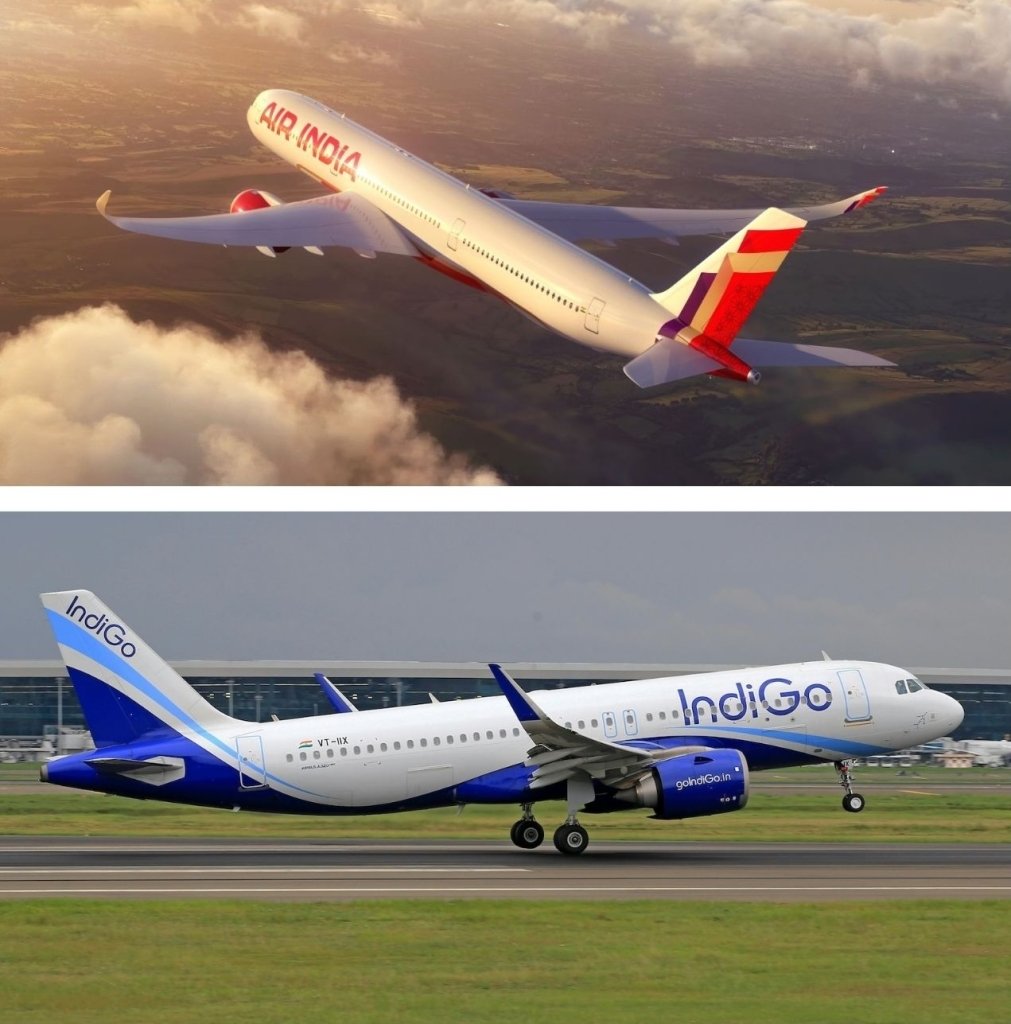
India is the third-largest domestic aviation market in the world and is expanding at a pace most other markets cannot match. The climate conversation in Indian aviation has, reasonably, concentrated on what is most immediate: SAF access and its cost, fleet renewal timelines, and airport infrastructure. Non-CO₂ effects have not entered the mainstream of that planning.
The regulatory reality will change that. Indian carriers operating into European airspace are already subject to EU emissions monitoring. As the EU’s non-CO₂ Monitoring, Reporting, and Verification (MRV) framework matures toward a pricing mechanism, airlines on India-Europe corridors will face reporting and financial obligations that extend well beyond fuel burn. For carriers expanding long-haul operations westward, these ‘climate costs’ are no longer theoretical—they are a core part of the network’s future cost structure.
The atmospheric conditions that produce persistent contrails are not unique to European airspace.
High-altitude cruise sectors across the subcontinent — and particularly on westbound international departures where upper-atmosphere conditions are more likely to generate persistent ice cloud formation — pass through the same layers the Amelia programme was designed to avoid.
What the Amelia programme demonstrates most usefully for Indian carriers is the entry point.
This does not require new aircraft, new avionics, or a long certification process. It requires a climate assessment capability integrated into existing flight planning, a defined fuel threshold, trained dispatch staff, and the institutional decision to treat non-CO₂ impacts as part of how a flight is planned.
Also Read: A Century of Grit and Innovation: The 100-Year Legacy of Pratt & Whitney