












- Air India is rapidly expanding its global reach through strategic codeshare partnerships with major airlines like Singapore Airlines, Lufthansa Group, ANA, and Virgin Australia, enhancing connectivity across Asia-Pacific, Europe, and beyond.
- These alliances, combined with schedule changes and the Vistara merger, are strengthening Air India’s hub operations, improving transit options, and positioning the airline for a more competitive global footprint.

This January, Air India completed three years under the Tata group. As it pushed ahead with its ambitious five-year turnaround plan named Vihaan.AI, it continues to get brickbats and bouquets at the same time. Over the last six months, the airline has started expanding its partnerships. This is timed well with the merger of Vistara into Air India, giving it access to aircraft standards which were hitherto not available on its aircraft.
The airline is looking at all corners, from Australia to Japan and Singapore to Europe for partnering with airlines to ensure that it can offer a streamlined experience to its passengers like never before. The Air India group now has a formidable partnership with Singapore Airlines (which now has a 25.1 per cent stake in Air India (Air India Express is a wholly owned subsidiary) and that means it has strong backing in Star Alliance and support at multiple stations across the world where Singapore Airlines already operates and is an established brand.
A codeshare is a partnership between two or more airlines that allows one airline to sell seats on a flight operated by another airline under its own flight number. This means a single flight can have multiple flight numbers from different airlines. This enables the airlines to offer more destinations, clock higher revenue, expand the benefits of frequent flier programs and offer seamless connections.
With Equity partner Singapore Airlines
Singapore Airlines (SIA) has been at the forefront of partnership. Fifteen years since the last revision of the partnership between Singapore Airlines and Air India, a fresh update on that collaboration was announced late last year.

The expansion will see the addition of 11 Indian cities and 40 international destinations to their network, and became effective October 27, 2024, when the winter schedule began. Additionally, the two airlines also started codeshare on each other’s flights between Singapore to Bengaluru and Chennai, increasing their total weekly scheduled codeshare services between the two countries to 56 from 14. In both these sectors, the operators are Air India Group, Singapore Airlines Group and IndiGo, making the competition tough for the Indian market leader. SIA started codeshare on Air India’s domestic flights between Delhi and Amritsar, Bengaluru, Coimbatore, Lucknow, and Varanasi; between Mumbai and Ahmedabad, Amritsar, Bengaluru, Coimbatore, Goa, Jaipur, Kolkata, Lucknow, and Thiruvananthapuram, and between Kolkata and Guwahati.
This tie-up has helped Air India too. Air India customers can access 29 destinations across SIA’s network. These are Adelaide, Brisbane, Cairns, Darwin, Melbourne, Perth, and Sydney (Australia), Bandar Seri Begawan (Brunei), Phnom Penh and Siem Reap (Cambodia), Denpasar, Jakarta, Medan, and Surabaya (Indonesia), Fukuoka, Nagoya, Osaka, Tokyo-Haneda, and Tokyo-Narita (Japan), Busan and Seoul (South Korea), Kuala Lumpur and Penang (Malaysia), Auckland (New Zealand), Cebu and Manila (the Philippines), as well as Danang, Hanoi, and Ho Chi Minh City (Vietnam). This includes existing codeshare arrangements to Kuala Lumpur.
Lufthansa Group
Lufthansa is one of the five founding members of Star Alliance and also supported Air India’s entry to Star Alliance. The long-standing partnership is now headed to the next level. Lufthansa today is more than just an airline but an airline group. It holds equity in SWISS as well as Austrian and the new partnership is an umbrella for all which sees Air India enter into a new codeshare agreement with Austrian Airlines, as well as expand the existing codeshare agreements between Air India, Lufthansa, and Swiss International Air Lines (SWISS). The expanded partnership significantly boosts flight options and connectivity for travellers between the Indian Subcontinent and Europe with the addition of close to 60 codeshare routes operated by the four airlines across 12 Indian and 26 European cities.
The expanded agreements increase the total number of codeshare routes between Air India, Lufthansa and SWISS from 55 to nearly 100. Additionally, the new agreement between Air India and Austrian Airlines adds 26 codeshare routes. This provides greater choice, convenience, and seamless experiences to travellers from both regions. Air India will now offer its customers a total of 26 destinations across Europe and 3 destinations in the Americas beyond its gateways in Europe (Frankfurt, Vienna, and Zurich), with the ‘AI’ designator code placed on the following services operated by airlines in the Lufthansa Group, including Austrian Airlines for the first time.
Reciprocally, customers of Lufthansa Group will now be able to connect to Air India’s domestic services to or from 15 points within India, namely Ahmedabad, Amritsar, Bengaluru, Bhubaneswar, Chennai, Delhi, Goa Mopa, Goa Dabolim, Hyderabad, Indore, Kochi, Kolkata, Mumbai, Pune, and Thiruvananthapuram. Additionally, Lufthansa Group carriers will add their respective designator codes to Air India’s international services to 3 destinations from Delhi and Mumbai: Kathmandu, Melbourne, and Sydney.
Additionally, flights currently operated by Air India and Lufthansa Group carriers between India and Germany or Switzerland will be covered under the expanded codeshare partnership. For example, customers who wish to fly between Delhi and Frankfurt will now have three daily flight options each way with ‘LH’ flight numbers, including two flights operated by Air India and one flight operated by Lufthansa. Air India and the three Lufthansa Group carriers are members of Star Alliance. Frequent flyers will continue to earn and redeem points/miles on all four airlines, while elite status holders of Air India’s Maharaja Club and Lufthansa Group’s Miles & More programmes will benefit from Star Alliance Gold benefits including priority services, extra baggage allowance, and airport lounge access across the world.
What else?
Air India is focusing on multiple markets, with one of them being Japan. Starting March 31, 2025, Air India will shift its four times a week service to Tokyo from Narita Airport to Haneda, which is the hub of ANA, a Star Alliance carrier. Complementing the shift to Tokyo Haneda, Air India also announced an expanded codeshare agreement with its Star Alliance partner, All Nippon Airways (ANA), to provide Air India passengers convenient onward connections from Tokyo Haneda to 6 other major cities in Japan. This builds on Air India’s existing codeshare and interline agreements with ANA.
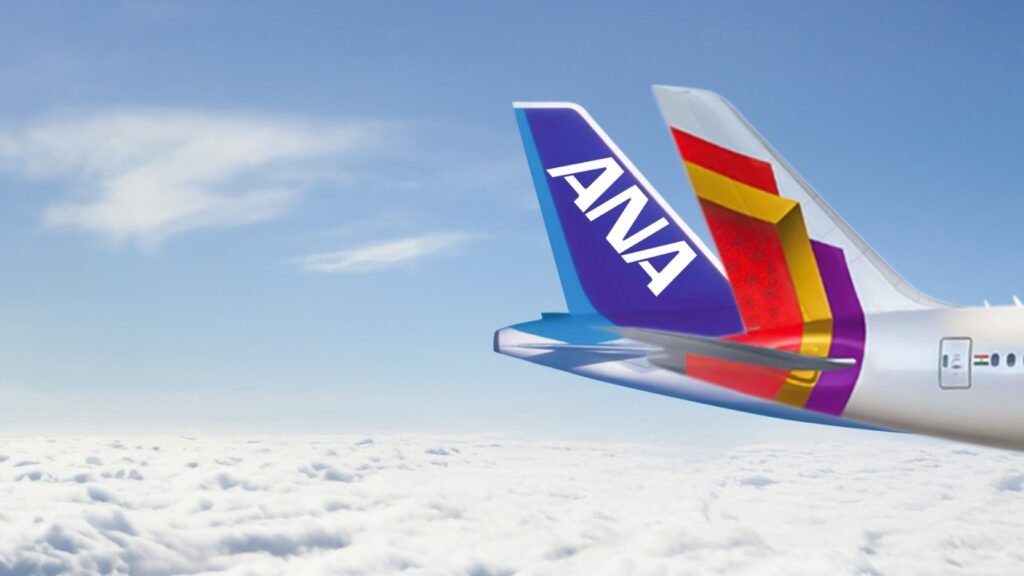
Air India’s strategic transition to Haneda Airport, located 18 km from downtown Tokyo, cuts travel time to Tokyo Station from nearly one hour by road (70 km from Narita) to approximately 30 minutes. This not only saves valuable time for passengers but also offers more cost-effective transportation options, enhancing the overall journey experience. Subject to due regulatory approvals, beginning 01 April 2025, Air India will place its ‘AI’ designator code on ANA’s flights between Tokyo Haneda and 6 other cities in Japan: Fukuoka, Hiroshima, Nagoya, Okinawa, Osaka, and Sapporo. This will allow Air India guests to travel to any of these destinations on a single ticket, with their baggage checked through the entire journey.
Reciprocally, ANA will place its ‘NH’ designator code on Air India’s flights between Delhi and Tokyo Haneda, Delhi and Ahmedabad, Bengaluru, Chennai, Hyderabad, Kolkata, and Pune, enabling their customers seamless access to Air India’s robust domestic India network. Air India and ANA first signed a codeshare agreement in April last year, which allowed Air India to codeshare on ANA’s Tokyo Haneda-Delhi and Tokyo-Narita-Mumbai flights, and ANA to codeshare on Air India’s Delhi-Tokyo flights. Passengers of both airlines flying on codeshare flights will enjoy premium services such as lounge access and priority boarding that Star Alliance offers to its premium members. According to Japan National Tourism Organisation, 2.33, lakh Indians visited Japan between January and December 2024, a 40 per cent increase from the previous year, underscoring Japan’s growing appeal as a travel destination for Indian tourists.
Air India made a major change to its Australian network to better connect to Frankfurt and Paris and at the same time signed up with Virgin Australia for partnership. The unilateral codeshare agreement enables Air India to place its ‘AI’ code on flights operated by Virgin Australia. This enhances the opportunities that Air India customers have when travelling from Delhi to Melbourne or Sydney and take seamless onward connections on Virgin Australia flights to 16 destinations in Australia and New Zealand. The enhanced cooperation will also ensure that passengers travelling on a single ticket will have their baggage checked throughout the entire journey. The 16 cities in Australia and New Zealand include: Adelaide, Ballina/Byron Bay, Brisbane, Cairns, Canberra, Darwin, Gold Coast, Hamilton Island, Hobart, Launceston, Melbourne, Newcastle, Perth, Queenstown (New Zealand), Sunshine Coast, and Sydney.
Post-merger with Vistara, Air India made its first big changes on international routes in February 2025, marking the first major rejig to the international network that the airline is doing under the Tata group, which since 2022 was focused on reinstating flights and frequencies to Europe. While the airline publicly stated that it would continue having the Vistara network, number it separately and operate the same aircraft till early 2025, the changes were swift with the legacy Air India metal replacing Vistara’s Dreamliner to Denpasar, Bali from the day of the merger and swaps thereafter. Air India then made multiple changes to its domestic network to offer five metro sectors on exclusive former Vistara aircraft and space out the flights.
Air India inherited the Vistara Delhi – Paris and Mumbai – Paris operations with the merger. While Delhi – Paris nearly went hand in hand, Air India has now discontinued the Mumbai – Paris operation. On the Delhi – Paris – Delhi segment, the Vistara flight has been retimed to leave in the wee hours and reach Paris CDG at 0945 hours. The return flight will leave at 1115 hours and reach at 2330 hours in Delhi. There also is a downgrade of equipment to 787-8, making it a sector without premium economy and with a uniform standardised product since the current operations see one flight with premium economy and a superior product and another without.
The importance of Frankfurt is higher than Paris for Air India since it prioritised having both flights with the 787-9 Dreamliner immediately after the merger. The equipment stays but there is a change in timing. One of the two departures would leave Delhi at 0515 hours, reaching Frankfurt at 0945 hours. The return flight departs at 1115 hours local time and lands in Delhi at 2325 hours.
The current deployment of both flights being ex-Vistara aircraft continues for Frankfurt. In addition to flights from Delhi, Frankfurt continues to see ex-Vistara aircraft being deployed for Mumbai – Frankfurt – Mumbai, making it a seamless three-class operation for all departures on Air India from Frankfurt.
Changes to Australia
The biggest question that comes up amidst these changes is, why make changes to flights to Australia? The answer lies in connections. The existing midday departures allowed connections from the EU to Australia, but the return flight was most unsuitable for transit passengers since the Australian flights arrived in the evening and onward passengers will have to wait until the next afternoon for departure to the EU. The new timings will see a quick 90-minute transfer for passengers from Paris and Frankfurt to both Melbourne and Sydney. Passengers transiting from Australia to either Paris or Frankfurt will have a transit time of 65 to 80 minutes. These are the best connections available in the market as of now for any one-stop flight, be it via Singapore or Dubai. This connection also works well for flights to London – which are now on the A350s from Delhi, giving a premium experience compared to the legacy fleet.
Not every city pair will get a second frequency, but it looks like there is enough data to prove that the flow of traffic between Frankfurt and Paris to Sydney and Melbourne is high hence the tinkering of flights to Australia. This also speaks volumes about the nature of traffic on the route and the fact that Air India has a near monopoly and thus the ability to tinker with the timings without being bothered about the market impact for O-D (Origin-Destination) traffic. The changed timings and spacing of frequency to Paris and Frankfurt would help with better revenue opportunities. The existing bank which all departed in the afternoon meant that only a select set of flights coming into Delhi by mid-morning were available for connections to the EU and likewise from the EU. The two banks to Paris and Frankfurt mean that there are more options available to passengers along with streamlining the passenger flow across multiple flights and not just a handful. This also bodes well for passengers travelling beyond Frankfurt and Paris on codeshare and interline partners, since it opens up multiple options. Lastly, this gives better pricing power to help connect Paris and Frankfurt to Singapore, Australia and Thailand.
Mark of confidence
The biggest mark of confidence in this partnership is other airlines placing their code on Air India-operated flights. Air India has been pushing its refurbishment for quite some time and has been in the news for issues with seats and service. Equity partner Singapore Airlines has started selling Air India flights as part of codeshare to 11 destinations, which include Copenhagen, Paris, Frankfurt, Milan, Nairobi, Amsterdam, Jeddah, Riyadh, Colombo, Birmingham and London. Singapore Airlines already operates to all destinations except Nairobi, Jeddah, Riyadh and Birmingham.
While Air India’s operations to London from Delhi are already seeing the new product with the deployment of the A350s, the other destinations to Europe likely indicate sectors that would see the deployment of refurbished aircraft in future. Such cooperation in the early days could pave the way for a metal-neutral pact in future, at least on the metro routes between Air India and Singapore Airlines. A metal-neutral pact is an agreement between airlines to share revenue regardless of which airline’s aircraft is used on a flight. This also is a big leap for Delhi Airport, which has been focusing on becoming a hub. Having international operations at the same terminal will facilitate faster transfers, but a longer connection time based on the current schedules– for which the codeshare is planned — shows that the airport has the potential to grow its non-aero revenue on the back of captive transfer passengers. This may also possibly need to expand into a larger food and retail offering with global brands, unlike the current ones.
Gearing up for the future
The airline has repeatedly delayed its refit of legacy widebody aircraft, which was first announced at the time of revealing its new brand identity. While there remains a crunch of seats in the market with everything being blamed on supply chain issues, the airline could have well avoided multiple announcements around the same. As per its latest announcements, there will be an interim measure before the whole refit is completed in 2026, at the earliest. Its first refit of the narrowbody aircraft has also suffered delays with the aircraft, which was expected to be operational in December, by the airline’s own admission, has not made it out to commercial service over a month and a half later.
With signs of thaw in Ukraine, if and when the Russian airspace opens, the airline will have to make do with competition on the North American routes, which was hitherto limited due to airspace availability challenges for American carriers while Air India overflew Russia, the shortest path to the Americas.