








- Safran is developing a hybrid turbofan that integrates high-power electrical machines onto both the high-pressure and low-pressure spools, allowing for real-time energy exchange and power injection from an onboard battery.
- The program leverages two decades of research, including the 2025 EASA type certification of the ENGINeUS 100B—the first for an electric motor, which established the regulatory and industrial framework for larger 800V hybrid systems.
- As one of the core pillars of the CFM RISE programme, this technology is currently undergoing system-level testing to validate its performance for next-generation short- to medium-range aircraft targeted for the mid-2030s.
The next leap in civil aviation fuel efficiency may not come from a radically different engine architecture. It may come from something already familiar, the turbofan made smarter, more adaptable, and more connected to a broader electrical system.
That is the core of what Safran means when it talks about a hybrid turbofan: a gas turbine engine integrated with two high-power electrical machines and a battery, capable of managing power flows across the propulsion system in real time.
Safran is not alone in exploring this territory, but is positioning itself among the leading players in terms of test evidence and certified product building blocks. And as of early 2026, the company has signalled that a complete hybrid turbofan test, one fully representative of the next generation of short-to-medium range aircraft, is imminent.
What a Hybrid Turbofan Actually Does
In a conventional turbofan, the high-pressure (HP) spool and the low-pressure (LP) spool operate independently. Each extracts power from combustion; each drives its own compressor and turbine stages. The electrical machines on a hybrid turbofan change that dynamic fundamentally.
Safran’s concept places one electrical machine on the HP spool and one on the LP spool. Each machine can operate as either a motor or a generator, a dual-mode capability that opens several distinct operating modes:
- Power balance: Electrical power extracted from the HP spool, the LP spool, or both simultaneously, redirected to aircraft systems.
- Power transfer: If one machine acts as a generator and the other as a motor, energy flows from one spool to the other, something no conventional architecture allows.
- Battery injection: When an aircraft battery is added to the system, energy can be injected into either spool, or the battery can serve as an additional onboard power source.
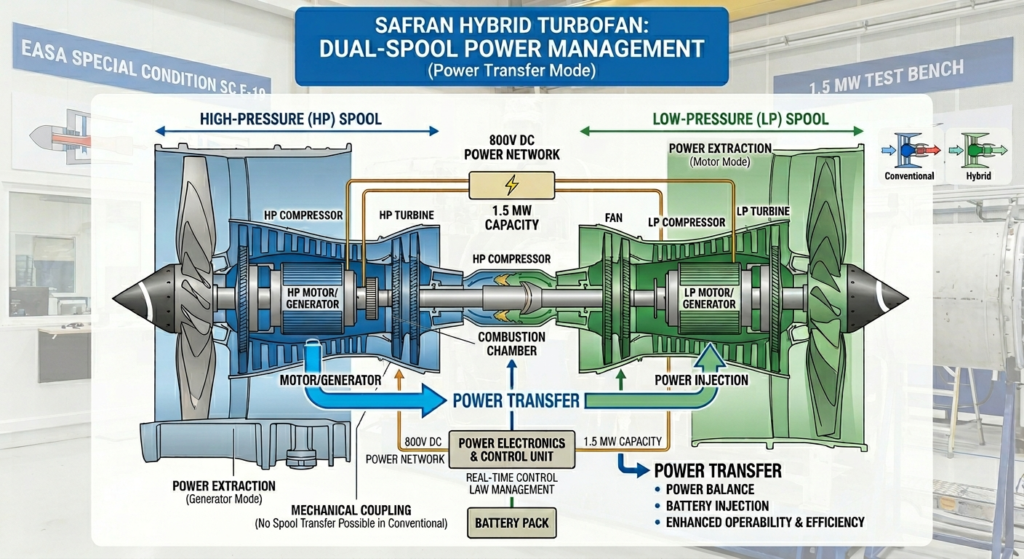
This multi-mode flexibility is what makes the architecture distinctive. Unlike a simple more-electric engine that extracts electrical power in a fixed way, a hybrid turbofan can actively adjust power flows depending on the flight phase, engine condition, and aircraft demand. The practical benefit is that the engine can be optimised more precisely at its design point, reducing fuel burn across the full flight mission rather than just at cruise.
There is a second major benefit that is less discussed but arguably as significant: the electrification of aircraft systems. A turbofan not only provides thrust, but it also supplies what engineers call non-propulsive energy: electrical, mechanical, and pneumatic power that runs cabin systems, climate control, wing anti-icing, and flight actuation.
A hybrid turbofan with high-power electrical machines can dramatically increase the amount of electrical power drawn from the engine, enabling a shift toward more-electric aircraft architectures where pneumatic and hydraulic systems are progressively replaced by electrical equivalents.
Two Decades in the Making
Safran’s current work on hybrid turbofans has its roots well before the CFM RISE programme or even the Silvercrest test campaign. The company began exploring hybrid electric propulsion architectures and applications in the early 2000s, building progressively through demonstrators, collaborative programmes, and certified product families.
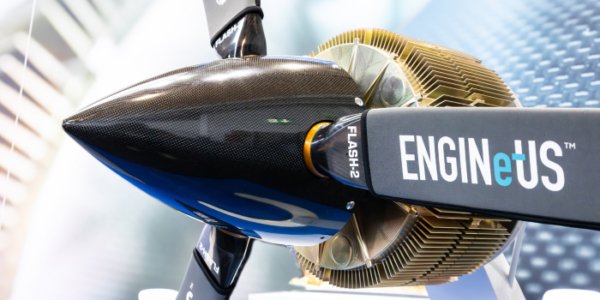
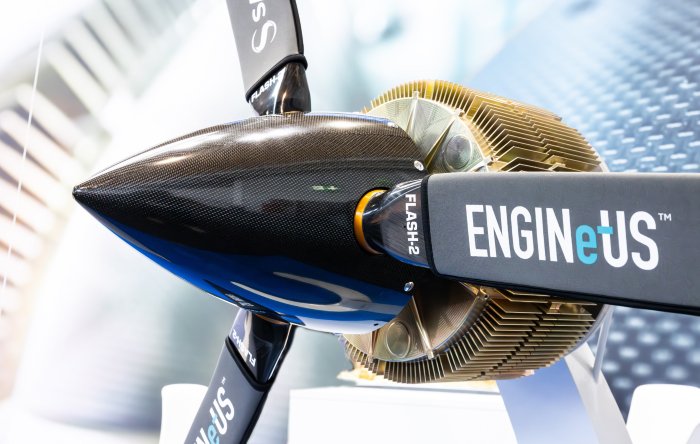
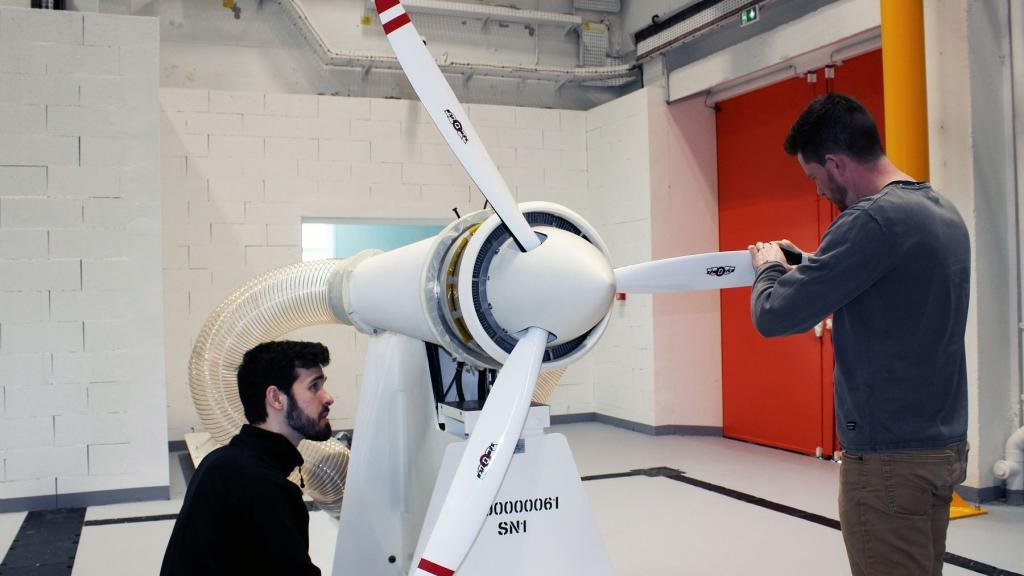
That long arc of research materialised in the ENGINeUS family of electric motors, a product line built on permanent magnet technology. The first model, the ENGINeUS 100B, delivers 150 kW and was designed for small aircraft and new air mobility applications.
In February 2025, it became the world’s first electric motor to receive EASA type certification under Special Condition SC E-19, the regulatory framework EASA developed specifically for electric and hybrid propulsion systems.
The significance of that certification extends well beyond small aircraft. By completing the SC E-19 certification process, Safran built a working relationship with EASA on the constraints of redundancy, thermal management, insulation, and power electronics that will govern larger hybrid systems.
It also demonstrated that the ENGINeUS technology platform could be industrialised and that certification of novel propulsion architectures was achievable in a reasonable timeline.
The ENGINeUS 100 certification was supported by the UK’s Aerospace Technology Institute (ATI), an indication that Safran’s hybrid-electric work is embedded in national industrial policy frameworks on both sides of the English Channel. This UK-France-European dimension becomes important when examining the funding and research ecosystem backing the hybrid turbofan programme.
The Silvercrest Tests: Learning the Hard Way
In 2023, Safran marked a significant milestone in hybrid turbofan development with the first integration test of an advanced motor-generator on an actual turbofan engine. The testbed was the Silvercrest, a 10,000 lb-thrust business jet engine powerplant developed by Safran Aircraft Engines, and the tests were conducted at the company’s Villaroche facility near Paris, supported by the French DGAC (Directorate General for Civil Aviation).
Over more than 300 hours of engine testing, Safran fitted an electric motor on the HP spool and explored power extraction and power injection across flight-representative conditions. The campaign generated critical data on engine operability, control law impacts, and the dynamic interaction between the electric motor and the gas turbine, including challenges associated with managing rapid power changes.
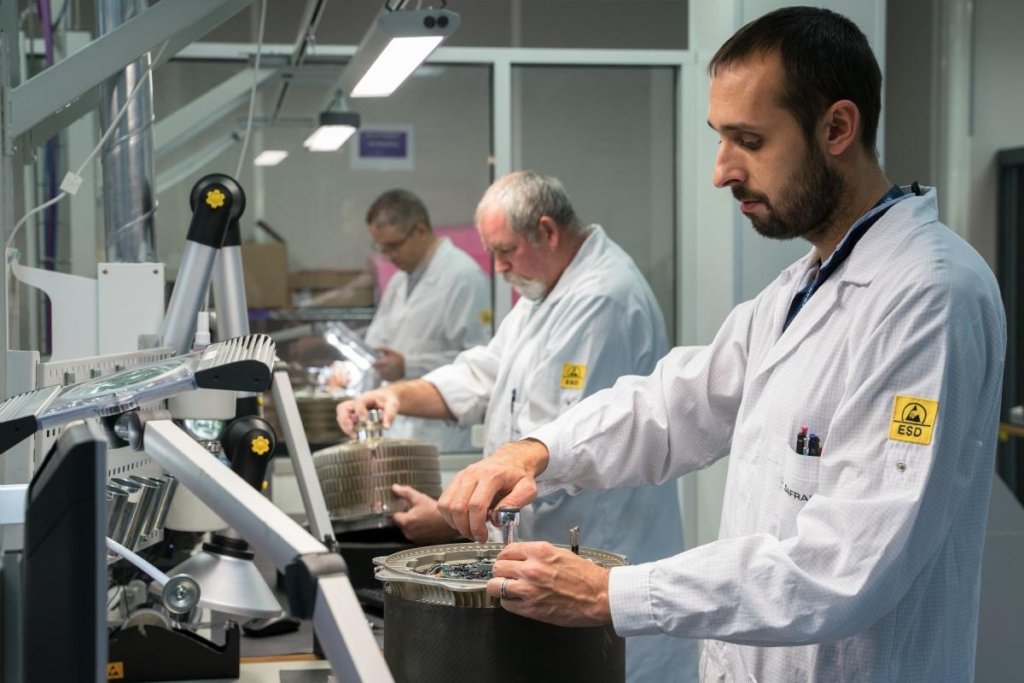
Photo: Safran
This test was pivotal in a way that purely theoretical work cannot replicate.
It established that the control laws and integration concepts developed over years of research could function on a physical turbofan without destabilising engine behaviour.
The lessons fed directly into the next generation of hardware. Tests are expected this summer at Istres in southern France, where Safran is reported to be fitting 250 kW electric motors on both the HP and LP spools of the Silvercrest to evaluate a full dual-spool hybrid configuration.
Moving to a Full Electrical System Test
Following the Silvercrest campaign, Safran escalated the programme significantly. Since late 2025, the company has been running tests of the complete electrical system of a hybrid turbofan at a 1.5 MW test bench in Europe. The test bench is designed to simulate an 800-volt aircraft electrical network, the high-voltage DC architecture expected in next-generation short-to-medium range (SMR) aircraft.
The electrical equipment under evaluation, including the two motor-generators, is the first generation sized specifically for the future requirements of an SMR aircraft. These are not scaled-down demonstrators but systems calibrated to the actual power requirements of a 150–200 seat aircraft powertrain.
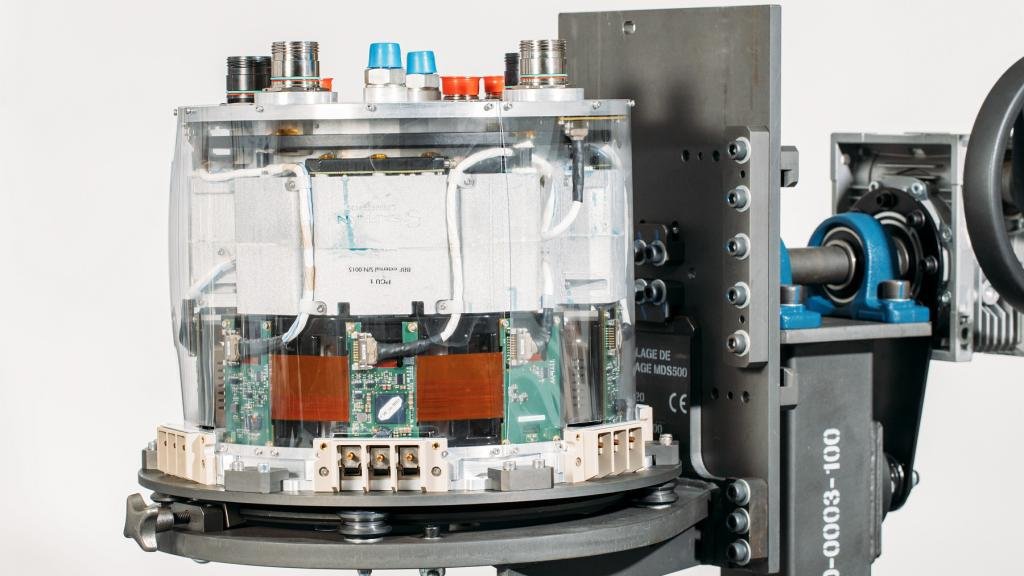
The current test campaign is proceeding in stages: first, intensive characterisation of each individual piece of equipment to verify performance and reliability under SMR aircraft conditions; then validation of the complete electrical system operating across all hybrid modes, including power balance and power transfer. All modes are controlled and monitored in real time, allowing engineers to assess system behaviour, integration maturity, and fault response.
What this test bench represents is a significant step in hybrid turbofan system-level validation currently underway in civil aviation. The 1.5 MW scale and the 800 V network simulation indicate alignment with future short- to medium-range aircraft requirements, not generic technology levels.
The RISE Programme Context
Safran’s hybrid turbofan work does not exist in isolation. It is one of the technology pillars of the CFM RISE (Revolutionary Innovation for Sustainable Engines) programme, by GE Aerospace and Safran Aircraft Engines.
RISE targets more than 20 per cent lower fuel consumption and CO2 emissions compared to today’s LEAP engines, which already power the Airbus A320neo and Boeing 737 MAX families. The programme explores an open-fan (unducted rotor) architecture, advanced composite materials and additive manufacturing, compatibility with 100 per cent sustainable aviation fuels and hydrogen, and hybrid-electric capability. Entry into service is targeted around the mid-2030s.
Within that framework, hybrid-electric capability addresses a different problem from the open fan. Where the open fan improves aerodynamic efficiency at the thrust end, the hybrid electrical system manages how power is extracted, transferred, and distributed across the engine and the aircraft in real time. The two technologies are complementary, not competing.
A Cross-Group Commitment
What makes Safran’s hybrid turbofan programme credible beyond engineering ambition is the breadth of institutional support behind it. The programme draws on:
- French DGAC funding and active support for engine test campaigns.
- Clean Aviation Programme (EU), which has identified highly efficient mid-range turbofan development as a priority research and innovation axis.
- ATI (UK) support for ENGINeUS motor development and certification, recognising hybrid-electric propulsion as a key lever for emission reduction.
- CORAC, France’s civil aeronautics research council, is backing hybrid-electric propulsion as a national industrial priority.
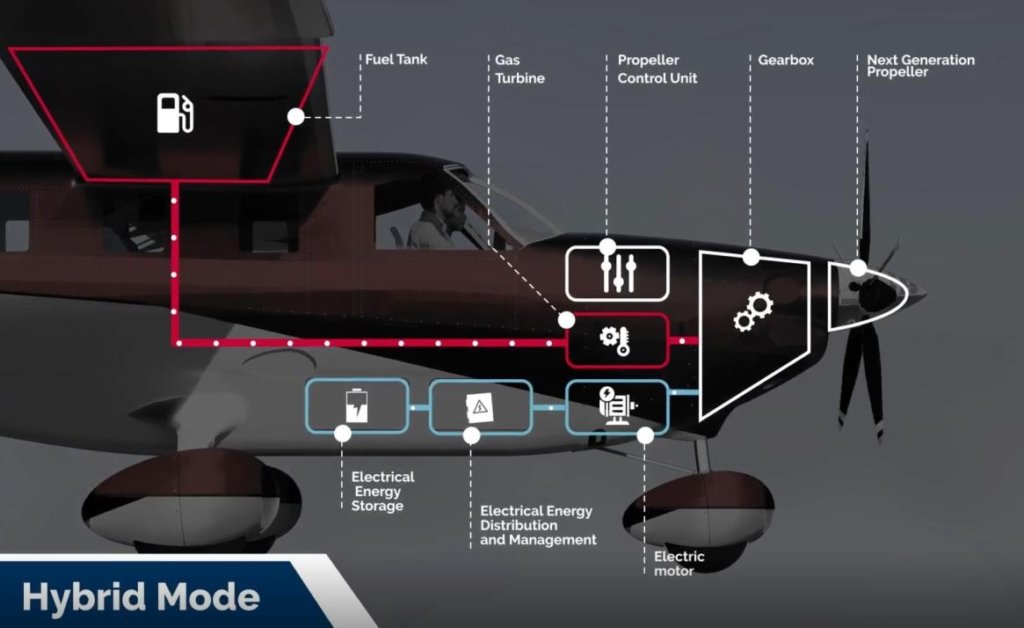
Photo: Safran
Safran is also using smaller platforms to build operational experience ahead of the large-engine programme. In June 2025, Daher, Safran, Collins Aerospace, and startup Ascendance launched TAGINE, an acronym for Tentative dans l’Aviation Générale d’Introduction de Nouvelles Énergies, broadly an initiative to introduce clean energy technologies into general aviation.
Backed by DGAC and CORAC, the two-year project will study the feasibility, economics, and environmental impact of hybrid-electric propulsion on a 6-10 seat aircraft, using the Daher Kodiak turboprop as the reference platform.
Safran handles the combined thermal and electric propulsion system; Collins leads propeller integration and noise studies; Ascendance manages the energy management system; and Daher provides the aircraft and OEM expertise.
This is relevant not because TAGINE is directly linked to the hybrid turbofan, but because it shows Safran treating hybrid-electric propulsion as a consistent strategy across segments, generating operational data on smaller platforms while maturing large-engine technology in parallel.
What Comes Next
Safran’s stated near-term milestone is a complete hybrid turbofan test: a full engine with the complete electrical system integrated, representative of next-generation SMR requirements. No specific date has been given, but the language in the company’s communications is unambiguous: this is a matter of months, not years.
Beyond that, the programme roadmap points toward demonstrating hybrid turbofan technology within a ground-based and eventually flight-representative environment, building toward the technology readiness levels required for the CFM RISE decision on architecture and features for a new engine programme.
The industry context matters here, Airbus and Boeing both need successor aircraft to the A320neo and 737 MAX families by the mid-2030s to early 2040s at the latest.
The engine technology chosen for those aircraft will determine the fuel efficiency and emissions profile of the world’s busiest air routes for decades.
If Safran and GE Aerospace can successfully integrate hybrid-electric capability into an open-fan architecture at the required performance, weight, and cost targets, it would represent the most consequential propulsion advancement since the introduction of the high-bypass turbofan.
The 1.5 MW test bench running in Europe today is a step in that long chain. Small in physical scale, large in what it represents.
Also Read: Onshore and Capable: GMR Aero Technic’s Expanding Role in India’s MRO Sector