












- India’s aerospace manufacturing base is gaining global trust, with OEM sourcing rising steadily, but the country still captures only a small share of the global value chain relative to its aviation market size.
- Industry leaders see reliability, supplier visibility, skills, certification capacity and shared infrastructure as the real constraints that will determine whether India can scale beyond machining into higher-value aerospace work.
- The consensus at Wings India was clear that targeted policy support, long-cycle investment thinking and coordinated action across government, industry and academia are now essential to convert momentum into durable manufacturing depth.
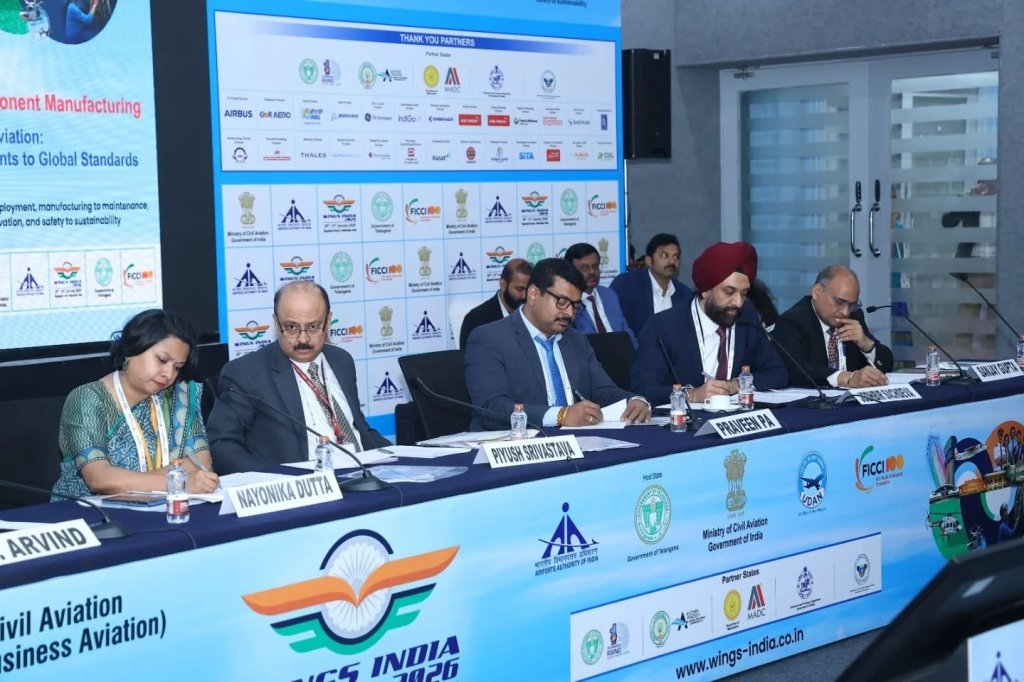
India accounts for around 5% of the global aircraft fleet deliveries, but aircraft manufacturing contributes just 2%, highlighting a significant gap. The message from industry leaders at Wings India 2026 Roundtable was clear that India’s aerospace manufacturing base is expanding and increasingly trusted by global OEMs. However, structural bottlenecks remain and need to be addressed forthwith if the country is to move beyond machining and claim a larger share of the global aerospace value chain.
Piyush Srivastava, Senior Economic Advisor at the Ministry of Civil Aviation, noted that India’s manufacturing footprint has strengthened in recent years. Indian firms are now producing fuselages, wings and complex structural assemblies, signalling a move up the value chain. Around 30 Indian suppliers, largely from the MSME segment, together supply components worth approximately $6.25 billion, underscoring the depth of the country’s supplier base. The challenge lies in scaling these capabilities through partnerships, investment and ecosystem development to meet surging global demand.
India’s share of the global aerospace supply chain has hovered at just 1–2%, despite being the world’s third-largest aviation market by seating capacity. Today, global OEMs source over $2 billion worth of aerospace components and services annually from India, a figure that continues to rise.
Airbus has publicly committed to expanding sourcing from India beyond €1 billion, with plans to double that in the coming years. Every Airbus commercial aircraft delivered globally now contains parts manufactured in India. Rolls-Royce has similarly indicated plans to significantly increase sourcing as Western supply chains face labour shortages and cost pressures, prompting diversification toward competitive destinations like India.
The company currently sources $1.35 billion worth of components from 325 Indian suppliers, said Ashwani Bhargava, Head of Supply Chain at Boeing. However, he cautioned that growth must be matched by reliability. Continuity of supply and performance is what matters, pointing to recent demand-supply imbalances, gaps in specialised processes and attrition rates of 25–30% across parts of the industry. He also highlighted the need for better visibility across tier-two and tier-three suppliers as pressure builds on tier-one manufacturers.
Machining as India’s most significant aerospace contribution so far was the way it was described by Ashish Saraf, Country Head and Chairman of Pratt & Whitney India. To move higher up the value chain, he called for a production-linked incentive (PLI) scheme tailored specifically to aerospace, the creation of dedicated industrial clusters and a sharper focus on component MRO to retain value domestically.
Concerns about the ease of doing business were echoed, citing regulatory delays and clearance timelines that can affect global competitiveness. Aerospace programmes operate on tight schedules, and uncertainty in approvals can deter high-value investments—an issue flagged by Lockheed Martin’s AVM Michael Fernandez.
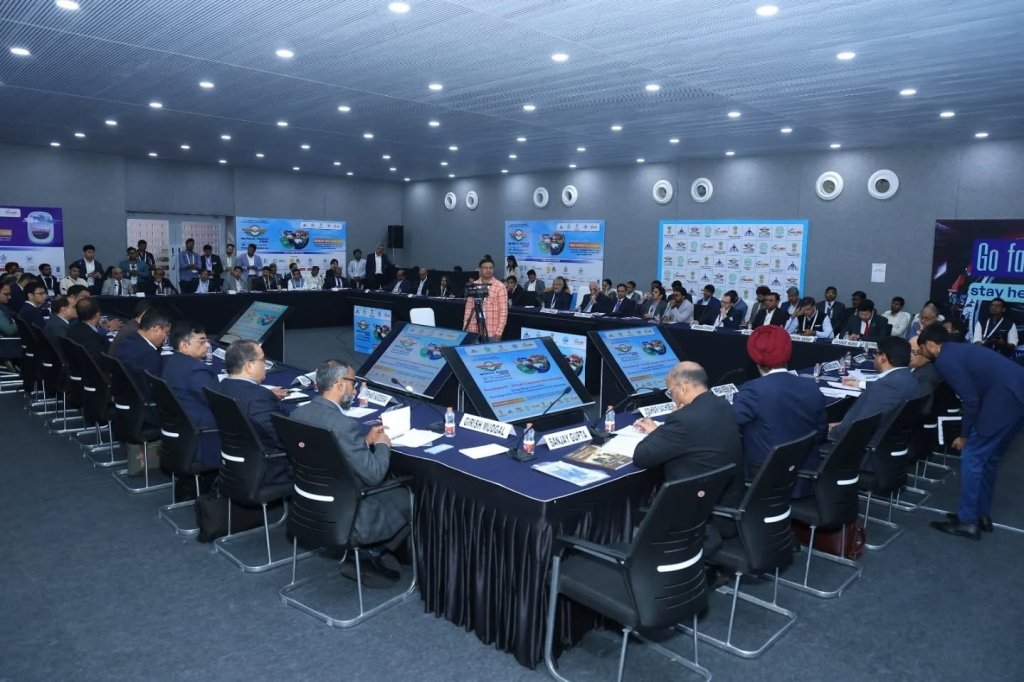
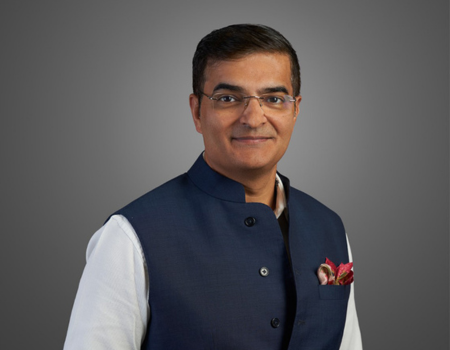
Photo: MoCA
Aerospace manufacturing requires more than technical skills, as Ashutosh Kumar of Safran stressed, it demands a specialised mindset rooted in quality, precision and long-term programme commitment. Reform in education, he argued, must align curricula with aerospace requirements, with industry taking joint ownership of workforce development.
Ajay Gururaj, Chief Commercial Officer at Dynamatic Technologies Ltd, emphasised the need for common testing facilities to enable companies to move from design to build. Aerospace development cycles, particularly for composites, are long and capital intensive. Raw material certification, viability gap funding and shared infrastructure are essential to de-risk investments. “A pure vanilla PLI scheme may not work without accounting for these extended timelines,” he noted.
Dynamatic Technologies itself exemplifies how Indian firms are moving up the aerospace value chain. The Bengaluru-headquartered company has evolved into a tier-one supplier of critical aerostructures for global OEMs including Airbus, Boeing, Bell Helicopter, Deutsche Aircraft and Dassault Aviation. It is a global supplier of flap-track beam assemblies—flight-critical components that guide wing flaps—for Airbus A320 and A330 family aircraft, delivering hundreds of shipsets annually.
In one of the largest aerospace export contracts awarded to an Indian company, Airbus selected Dynamatic to manufacture all major door structures for the A220 programme, including passenger and cargo doors. The company also supplies mission-critical assemblies for Boeing’s P-8 Poseidon and structural components for platforms such as the Chinook helicopter and F-15EX fighter. Through a partnership with Deutsche Aircraft, it is producing the rear fuselage assembly for the D328eco regional turboprop, further cementing India’s position in next-generation regional aircraft manufacturing.
Other Indian manufacturers are also making significant contributions. Aequs supplies aerostructures and precision components to Airbus, Boeing and Spirit AeroSystems. Azad Engineering has secured contracts with Honeywell, Rolls-Royce and Eaton Aerospace, reflecting growing demand for high-precision machined parts. Companies such as Hical Technologies, JJG Aero, Unimech Aerospace, Samtel Avionics, MTAR Technologies and Tata Advanced Systems are expanding into complex assemblies, avionics and systems integration.
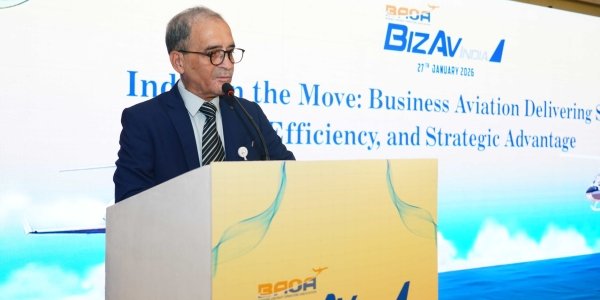
Srinivasan Dwarkanath, Director General of the Aerospace India Association, observed that India must now accelerate its transition from build-to-print manufacturing to design-and-build capabilities in commercial aviation. He called for a national aerospace roadmap jointly led by industry, government and academia, prioritising skilling, raw material capacity, capital access and common facility centres with shared testing and design infrastructure.
Earlier, inaugurating the event, Union Civil Aviation Minister K. Rammohan Naidu reinforced the government’s commitment, stating that the Centre is working to strengthen the manufacturing ecosystem to position India as a global exporter of aviation components and products.
The consensus at Wings India was that India’s aerospace manufacturing sector stands at an inflection point. But to increase manufacturing share, India must address skills, certification, infrastructure and capital constraints.
Also Read: Building a Global, Design-Led Capability from India